THORACIC VERTEBRAE ANATOMY
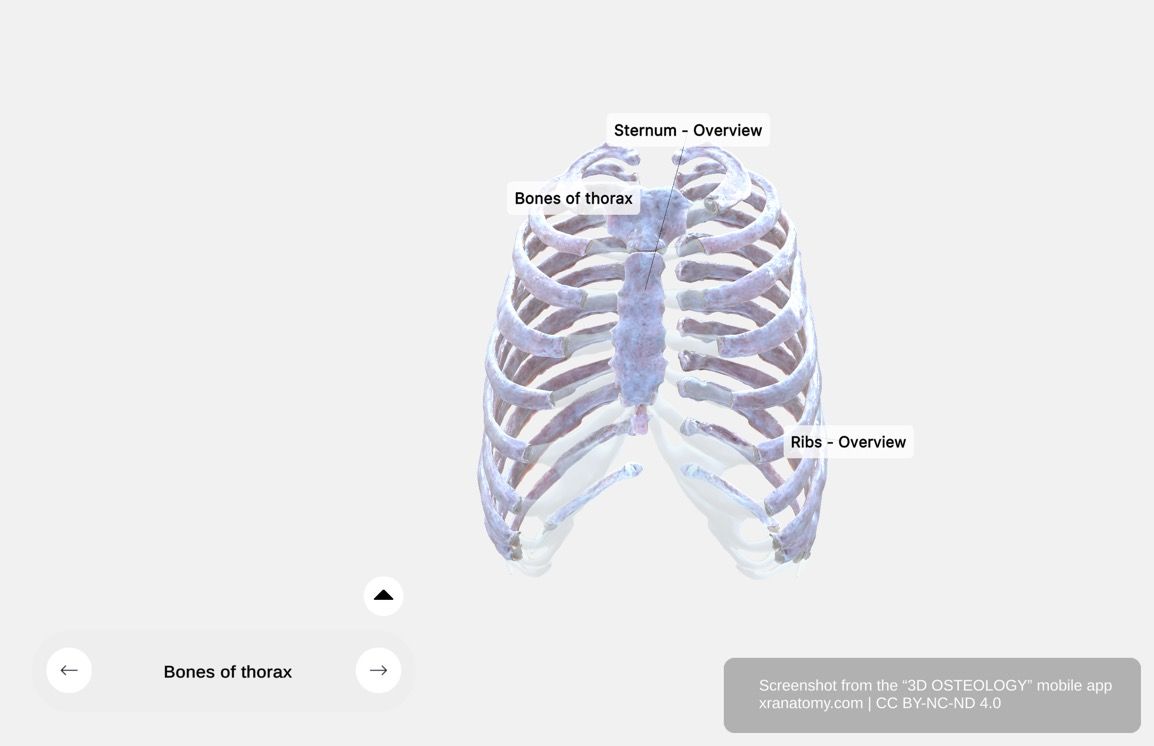
Thoracic Skeleton - Thoracic Vertebrae Overview, Preview from the app. Download 3D OSTEOLOGY for full 3D control—multiple views, x-ray mode, and unlimited zoom.
WHY THIS MATTERS
Your twelve thoracic vertebrae are uniquely designed for rib articulation. Their specialized costal facets connect to your ribs, forming the thoracic cage that protects your heart and lungs. Understanding these vertebrae helps you see how the spine transitions from a mobile cervical region to a stabilized, rib-bearing middle section.
GENERAL CHARACTERISTICS
Your thoracic spine comprises twelve vertebrae that increase in size from top to bottom. They are uniquely designed for rib articulation, with rib attachment facilitated by specialized costal facets. Thoracic vertebrae have heart-shaped vertebral bodies of near-equal width and depth, and their spinous processes angle downward.
COSTAL FACETS
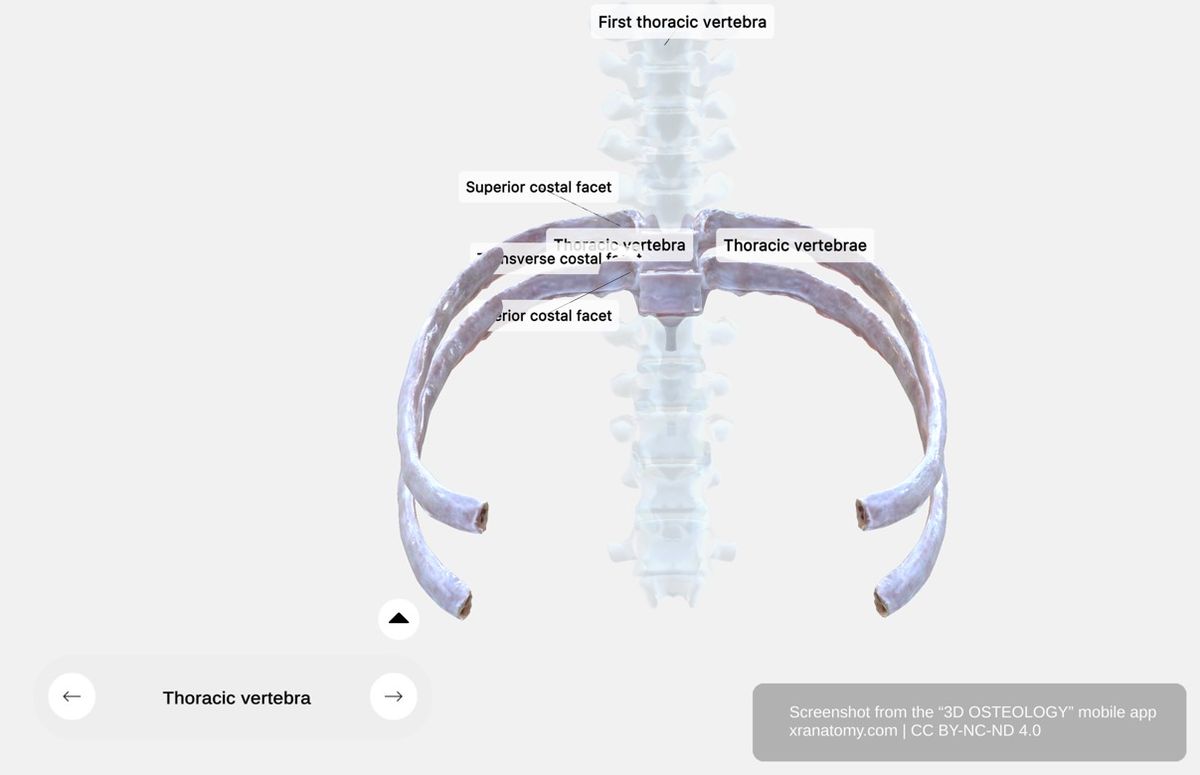
Thoracic Vertebra - Superior and Inferior Costal Facets, Preview from the app. Download 3D OSTEOLOGY for full 3D control—multiple views, x-ray mode, and unlimited zoom.
Each typical thoracic vertebra features two types of costal facets on the vertebral body: the superior costal facet and the inferior costal facet. Both articulate with the head of your rib.
Superior Costal Facet
The superior costal facet is located on the side of the vertebra, near the base of the pedicle. It articulates with the head of your rib, forming a sturdy connection.
Inferior Costal Facet
The inferior costal facet is positioned lower on the vertebra, just above the inferior notch. It forms an oval surface for articulation with the lower part of your rib's head.
TRANSVERSE COSTAL FACET
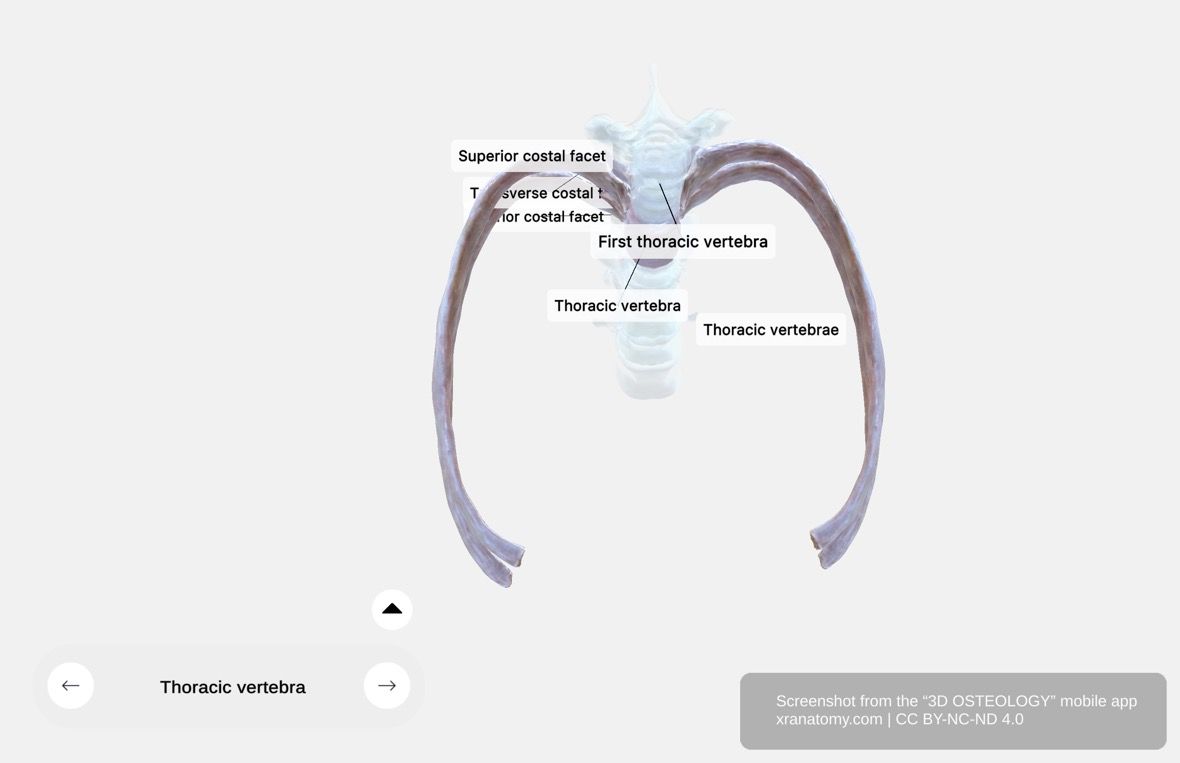
Thoracic Vertebra - Transverse Costal Facet, Preview from the app. Download 3D OSTEOLOGY for full 3D control—multiple views, x-ray mode, and unlimited zoom.
The transverse costal facet is found on the transverse process, the wing-like structure of the vertebra. It accommodates the tubercle of your rib for articulation.
FIRST THORACIC VERTEBRA (T1)
The T1 vertebra has distinctive features that set it apart from other thoracic vertebrae. It bears a full facet on each side for your first rib, along with a smaller demi-facet for the upper part of your second rib.
CHECK YOUR UNDERSTANDING
1. What shape are thoracic vertebral bodies?
Reveal Answer
Heart-shaped, with near-equal width and depth.
2. Name the three types of costal facets found on a typical thoracic vertebra.
Reveal Answer
The superior costal facet (on the side of the vertebra near the base of the pedicle), the inferior costal facet (lower on the vertebra, just above the inferior notch), and the transverse costal facet (on the transverse process).
3. What makes the T1 vertebra different from other thoracic vertebrae?
Reveal Answer
T1 has a full facet on each side for the first rib and a smaller demi-facet for the upper part of the second rib.
WHAT'S NEXT
Next, explore the Lumbar Vertebrae. You will study the five large vertebrae that form the largest movable segment of your spine, including their mammillary processes, accessory processes, and distinctive quadrilateral spinous processes.
Review this page again in 3 days to reinforce what you have learned.
BIBLIOGRAPHY
1. Henry G, Warren HL. Osteology. In: Anatomy of the Human Body. 20th ed. Philadelphia: Lea & Febiger; 1918. p. 129–97.
2. Standring S, editor. Gray's Anatomy: The Anatomical Basis of Clinical Practice. 41st ed. London: Elsevier; 2016.
3. Moore KL, Agur AMR, Dalley AF. Essential Clinical Anatomy. 5th ed. Philadelphia: Wolters Kluwer; 2015.