LUMBAR VERTEBRAE ANATOMY
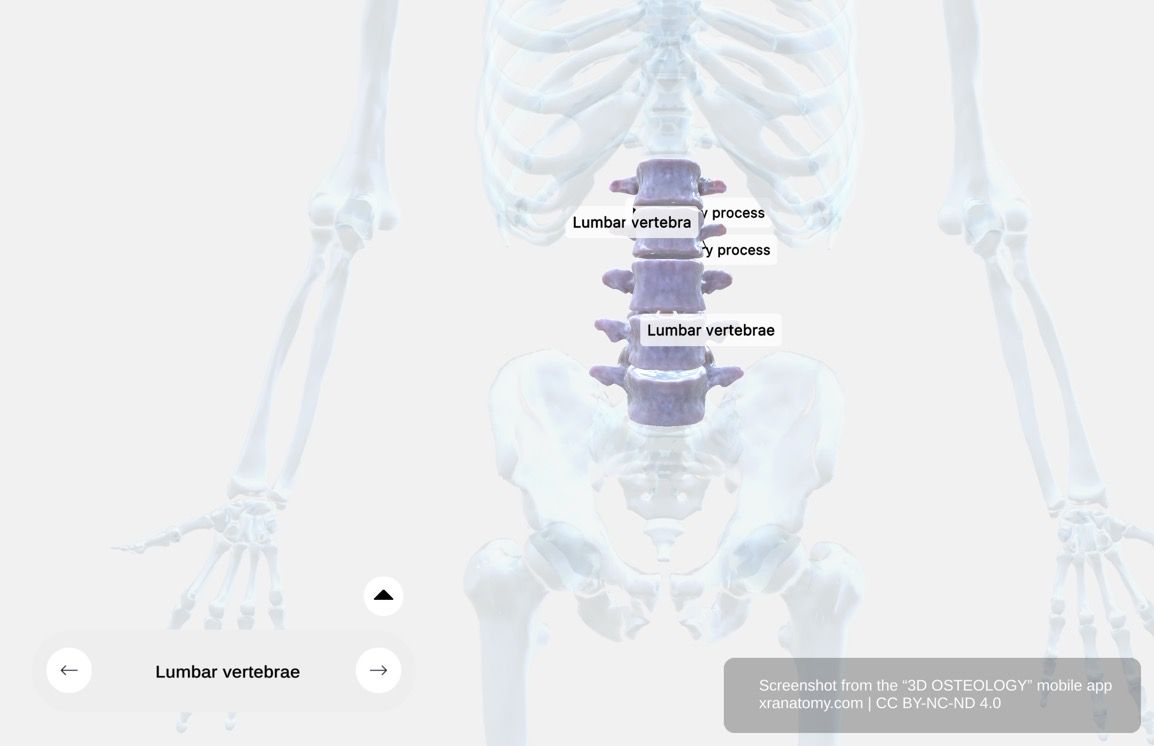
Lumbar Vertebra - X-ray Mode Overview, Preview from the app. Download 3D OSTEOLOGY for full 3D control—multiple views, x-ray mode, and unlimited zoom.
WHY THIS MATTERS
The lumbar vertebrae form the largest segment of your movable spine and carry the greatest loads. Understanding their large bodies, unique mammillary and accessory processes, and horizontally projecting spinous processes helps you see how your lower back supports and stabilizes your trunk.
GENERAL CHARACTERISTICS
The lumbar spine consists of five vertebrae, forming the largest segment of your movable spine. These vertebrae lack foramina in the transverse processes and lack costal facets on the vertebral bodies. They are characterized by large, strong bodies and thick spinous processes that project horizontally. The transverse processes are homologous with ribs, differing in orientation between upper and lower lumbar vertebrae.
BODY
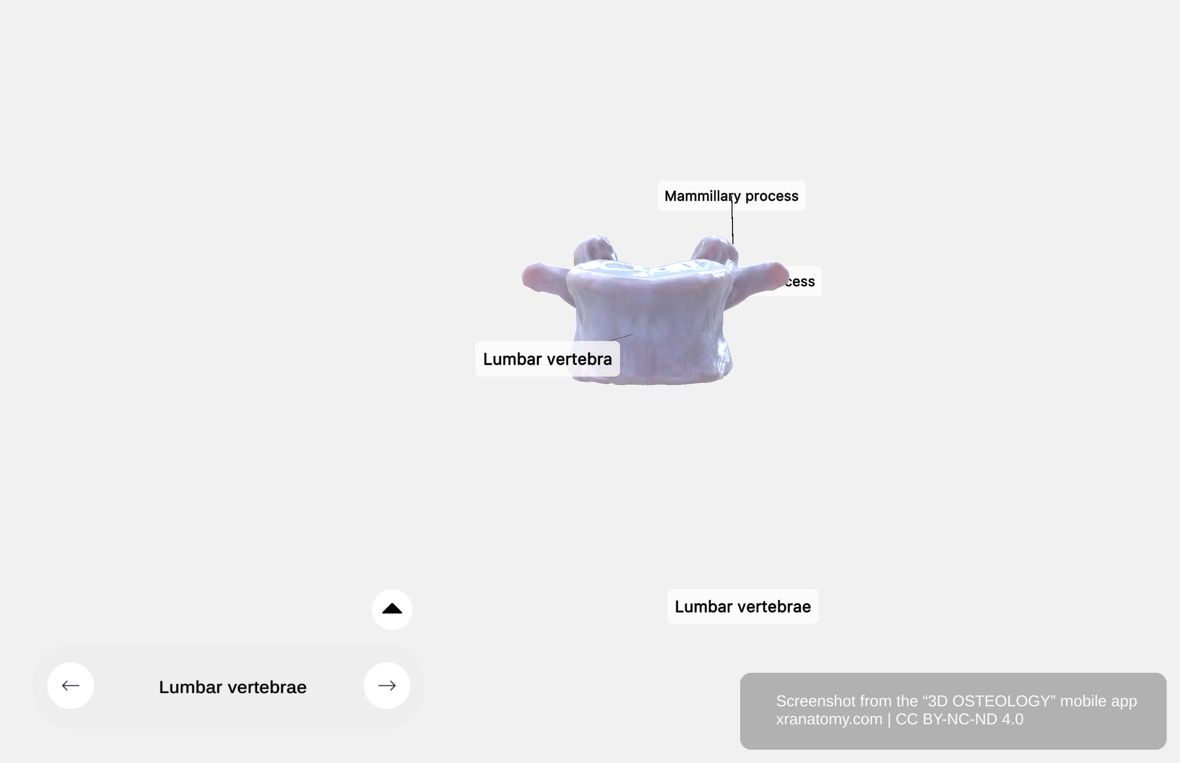
Lumbar Vertebra - Anterior-Posterior View, Preview from the app. Download 3D OSTEOLOGY for full 3D control—multiple views, x-ray mode, and unlimited zoom.
The body of a lumbar vertebra is large and robust, wider side-to-side than front-to-back. It is thicker anteriorly than posteriorly. The posterior surface is concave, contributing to the vertebral foramen.
PEDICLES AND LAMINAE
Two components form the vertebral arch of a lumbar vertebra: the pedicles, which project backward from the body and create the intervertebral foramina, and the laminae, which are broad and short.
Pedicles
The pedicles are strong, projecting backward from the upper part of the body. They feature a shallow superior vertebral notch and a deep inferior vertebral notch. Adjacent superior and inferior notches of neighbouring vertebrae form the intervertebral foramen, which transmits spinal nerves and blood vessels.
Laminae
The laminae are broad and short.
VERTEBRAL FORAMEN
The vertebral foramen of a lumbar vertebra is triangular in shape. It is larger than in thoracic vertebrae but smaller than in cervical vertebrae.
SPINOUS PROCESS
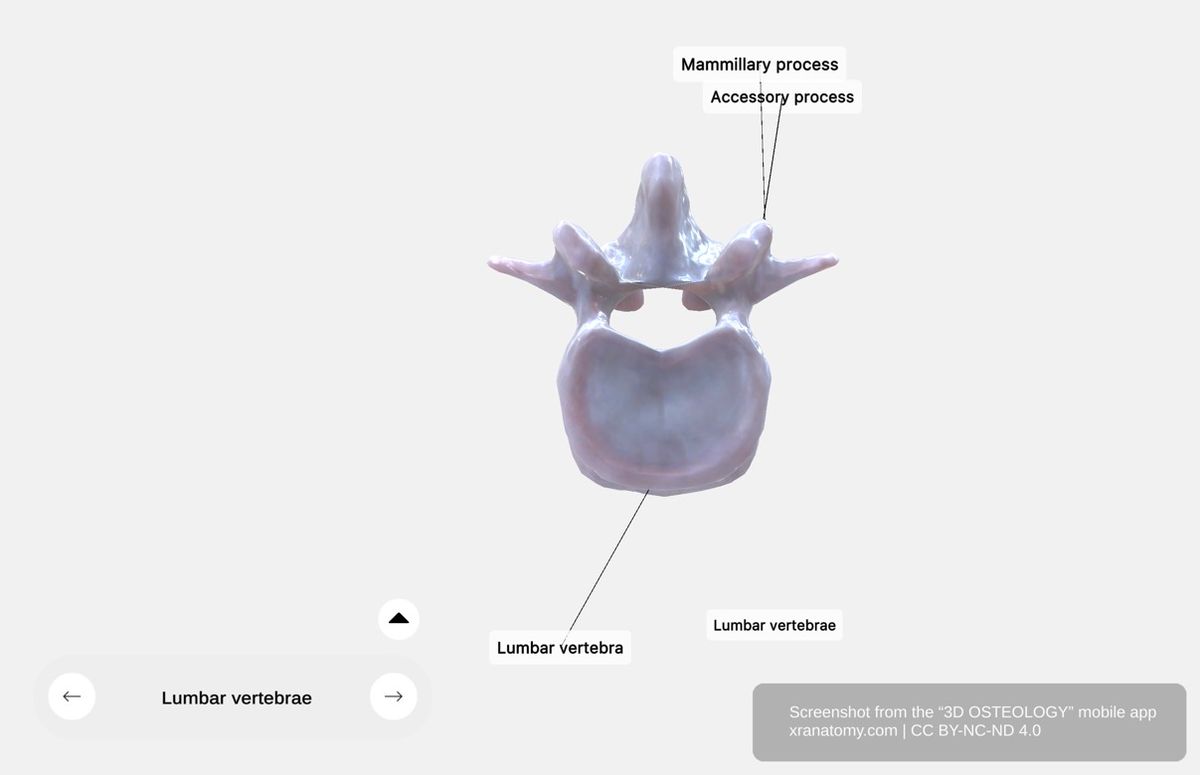
Lumbar Vertebra - Superior-Inferior View, Preview from the app. Download 3D OSTEOLOGY for full 3D control—multiple views, x-ray mode, and unlimited zoom.
The spinous process of a lumbar vertebra is quadrilateral in shape. Its posterior and inferior borders bulge. It projects almost horizontally backward.
ACCESSORY PROCESS
The accessory process is a small bony projection located at the posterior base of the transverse process. It serves as a muscle attachment point. The accessory process is the counterpart to the inferior tubercle of lower thoracic vertebrae.
MAMMILLARY PROCESS
The mammillary process is a rounded projection on the posterior part of the superior articular process. It provides attachment for your muscles and enhances stability and mobility of your lumbar spine.
CHECK YOUR UNDERSTANDING
1. What two features do lumbar vertebrae lack that distinguish them from other vertebrae?
Reveal Answer
Lumbar vertebrae lack foramina in the transverse processes and lack costal facets on the vertebral bodies.
2. What shape is the spinous process of a lumbar vertebra, and in which direction does it project?
Reveal Answer
The spinous process is quadrilateral in shape and projects almost horizontally backward.
3. Where is the mammillary process located?
Reveal Answer
The mammillary process is a rounded projection on the posterior part of the superior articular process.
WHAT'S NEXT
Now that you know the lumbar vertebrae, the next page covers the Coccyx. You will explore the terminal segment of your vertebral column, formed by fusion of small vertebrae, including its base, coccygeal horns, and apex.
Review this page again in 3 days to reinforce what you have learned.
BIBLIOGRAPHY
1. Henry G, Warren HL. Osteology. In: Anatomy of the Human Body. 20th ed. Philadelphia: Lea & Febiger; 1918. p. 129–97.
2. Standring S, editor. Gray's Anatomy: The Anatomical Basis of Clinical Practice. 41st ed. London: Elsevier; 2016.
3. Moore KL, Agur AMR, Dalley AF. Essential Clinical Anatomy. 5th ed. Philadelphia: Wolters Kluwer; 2015.