COCCYX ANATOMY
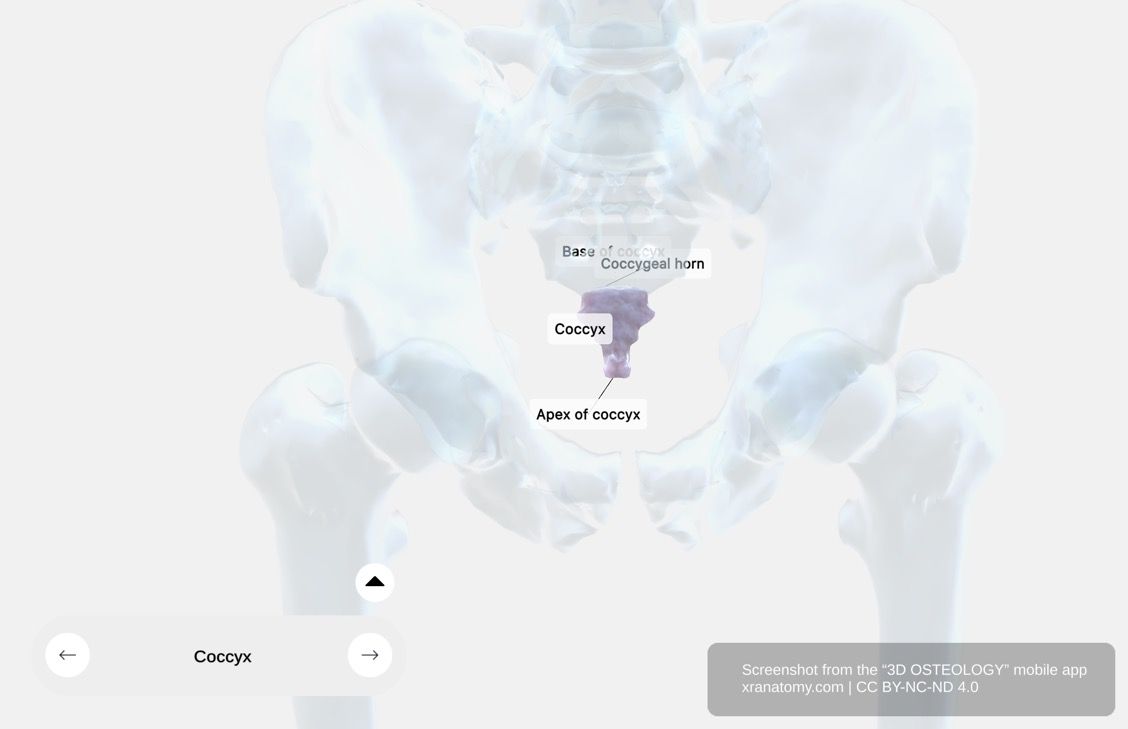
Coccyx - X-ray Mode Overview, Preview from the app. Download 3D OSTEOLOGY for full 3D control—multiple views, x-ray mode, and unlimited zoom.
WHY THIS MATTERS
The coccyx is the final segment of your vertebral column. Though small and vestigial, it connects to the sacrum and serves as an anchor for ligaments that support your pelvic structures. Understanding its base, coccygeal horns, and apex helps you see how this tailbone completes your spine.
OVERVIEW
What Is the Coccyx
The coccyx, or tailbone, is the lowermost part of your spine. It is formed by the fusion of 3 to 5 small vertebrae, making it a vestigial remnant of the embryonic tail. The coccyx connects to the apex of the sacrum, forming the coccygeal segment of your vertebral column.
Main Components
The coccyx features three main anatomical components: the base, the coccygeal horns (cornua), and the apex.
BASE OF THE COCCYX
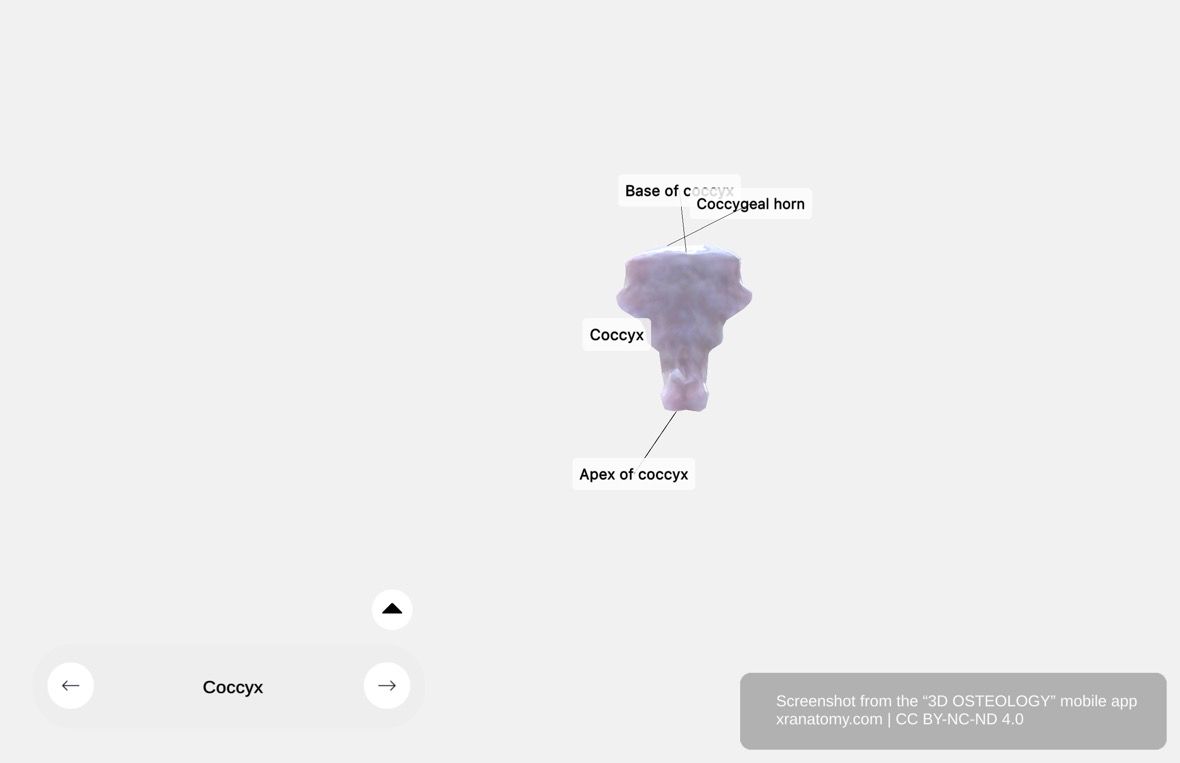
Coccyx - General Structure, Preview from the app. Download 3D OSTEOLOGY for full 3D control—multiple views, x-ray mode, and unlimited zoom.
The base is the broad, uppermost portion of the coccyx. It articulates with the apex of the sacrum through an oval-shaped facet.
COCCYGEAL HORNS (CORNUA)
The coccygeal horns are upward-projecting structures on the posterior aspect of your coccyx. They align with the sacral horns to form a connection between your sacrum and coccyx.
APEX OF THE COCCYX
The apex is the tapered lower tip of the coccyx, pointing downward. It functions as an anchor point for ligaments supporting your pelvic structures.
CHECK YOUR UNDERSTANDING
1. How many small vertebrae fuse to form the coccyx?
Reveal Answer
3 to 5 small vertebrae fuse to form the coccyx.
2. What are the three main anatomical components of the coccyx?
Reveal Answer
The base, the coccygeal horns (cornua), and the apex.
3. What do the coccygeal horns align with to connect the sacrum and coccyx?
Reveal Answer
The coccygeal horns align with the sacral horns to form a connection between the sacrum and coccyx.
WHAT'S NEXT
Next, you will move from the vertebral column to the cranium and explore the Occipital Bone. This trapezoidal bone forms the back and base of your skull, contains the foramen magnum, and consists of four distinct parts.
Review this page again in 3 days to reinforce what you have learned.
BIBLIOGRAPHY
1. Henry G, Warren HL. Osteology. In: Anatomy of the Human Body. 20th ed. Philadelphia: Lea & Febiger; 1918. p. 129–97.
2. Standring S, editor. Gray's Anatomy: The Anatomical Basis of Clinical Practice. 41st ed. London: Elsevier; 2016.
3. Moore KL, Agur AMR, Dalley AF. Essential Clinical Anatomy. 5th ed. Philadelphia: Wolters Kluwer; 2015.