OCCIPITAL BONE ANATOMY
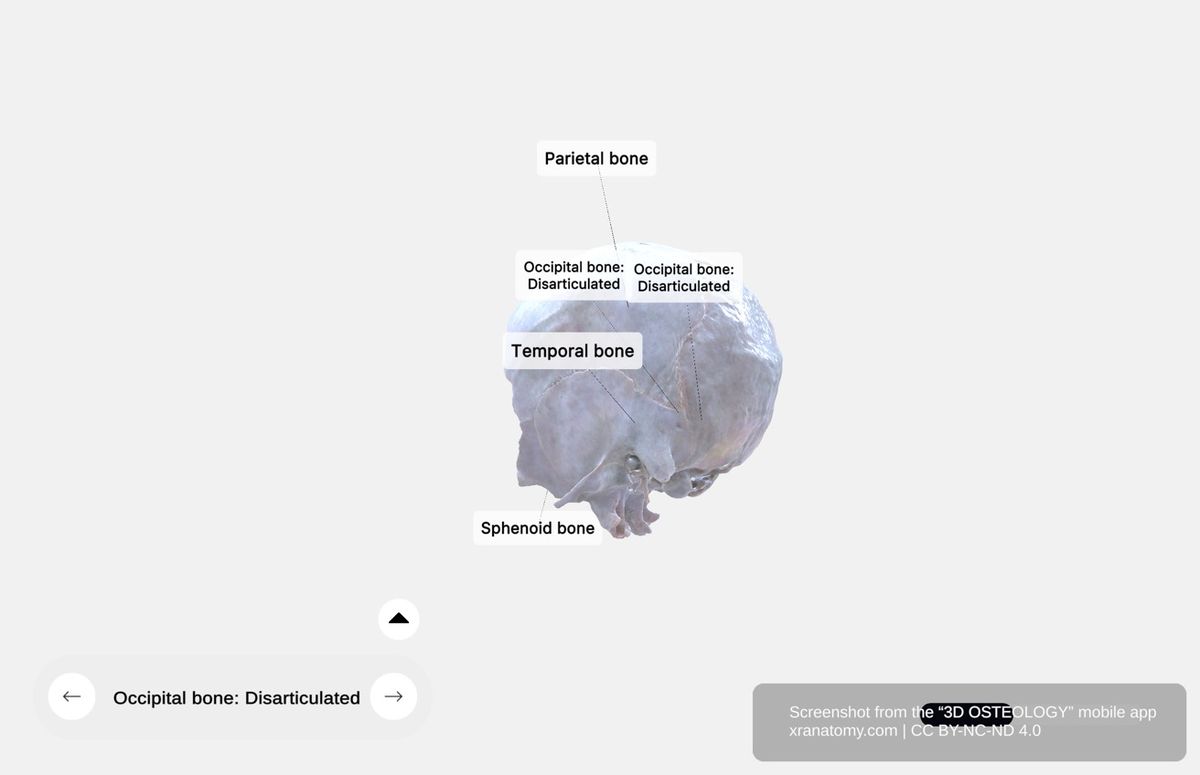
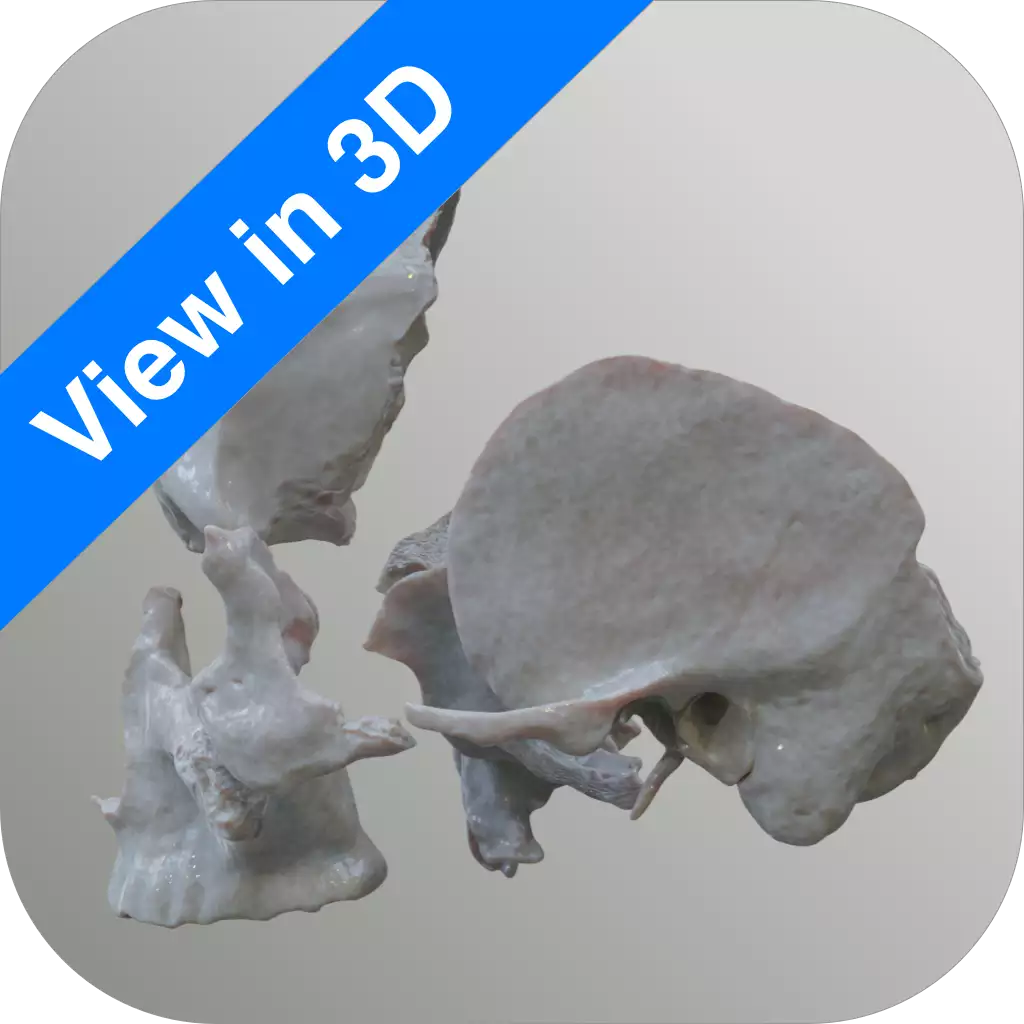
Occipital Bone - General Structure, Preview from the app. Download 3D OSTEOLOGY for full 3D control—multiple views, x-ray mode, and unlimited zoom.
WHY THIS MATTERS
The occipital bone forms the back and base of your skull, housing the foramen magnum where your brainstem transitions into the spinal cord. Its four parts surround this critical opening, and the occipital condyles on the lateral parts connect your skull to the atlas (C1) for head movement.
In-Depth AR Atlas Available
Read the comprehensive anatomy description with AR illustrations and videos
Read AR Atlas →GENERAL CHARACTERISTICS
The occipital bone is a trapezoidal cranial bone positioned at the posteroinferior aspect of your skull. It forms the posterior and inferior walls of your cranial cavity and articulates with the parietal, temporal, and sphenoid bones.
STRUCTURAL COMPONENTS
The occipital bone is composed of four parts surrounding the foramen magnum: the squamous part, the basilar part, and two lateral parts.
FORAMEN MAGNUM
The foramen magnum is the large central aperture of the occipital bone. It transmits your brainstem at the junction of the medulla oblongata and spinal cord. Key structures passing through include the vertebral arteries, the spinal root of the spinal accessory nerve (CN XI), and the meninges continuous between your cranial and spinal coverings.
BASILAR PART
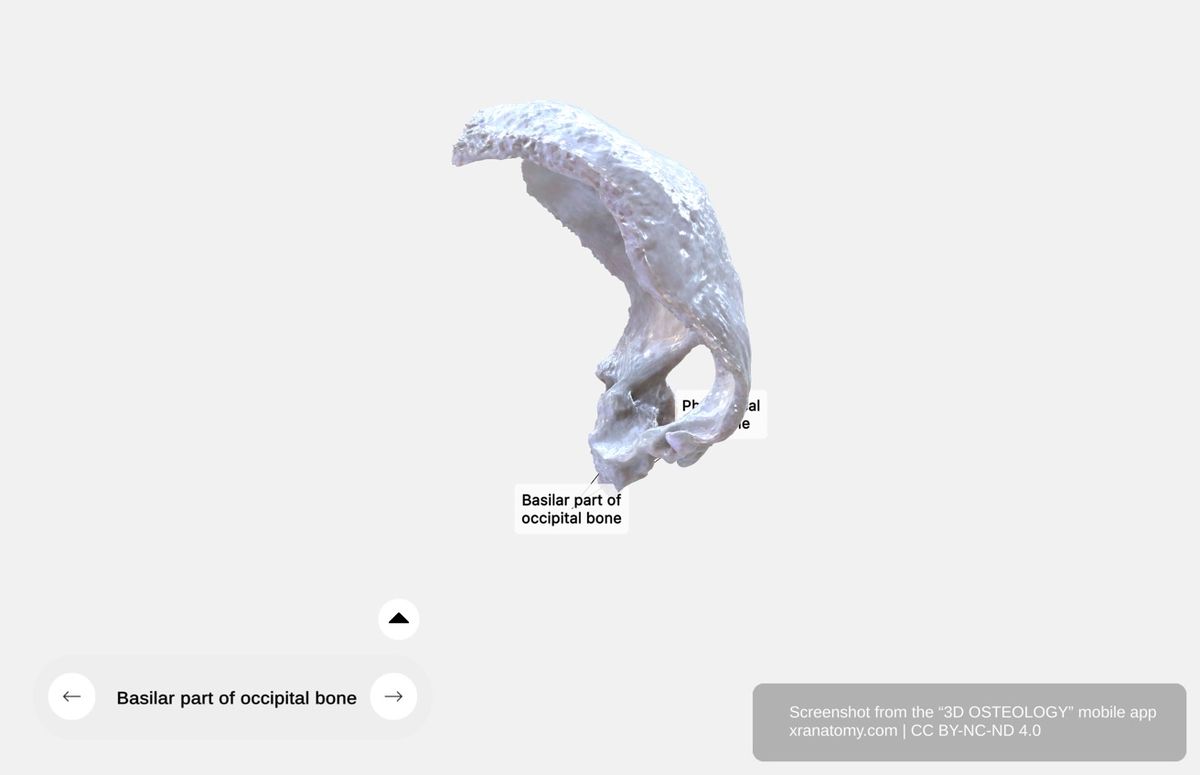
Basilar Part of the Occipital Bone, Preview from the app. Download 3D OSTEOLOGY for full 3D control—multiple views, x-ray mode, and unlimited zoom.
The basilar part sits anterior to the foramen magnum and fuses with the sphenoid bone anteriorly.
LATERAL PARTS
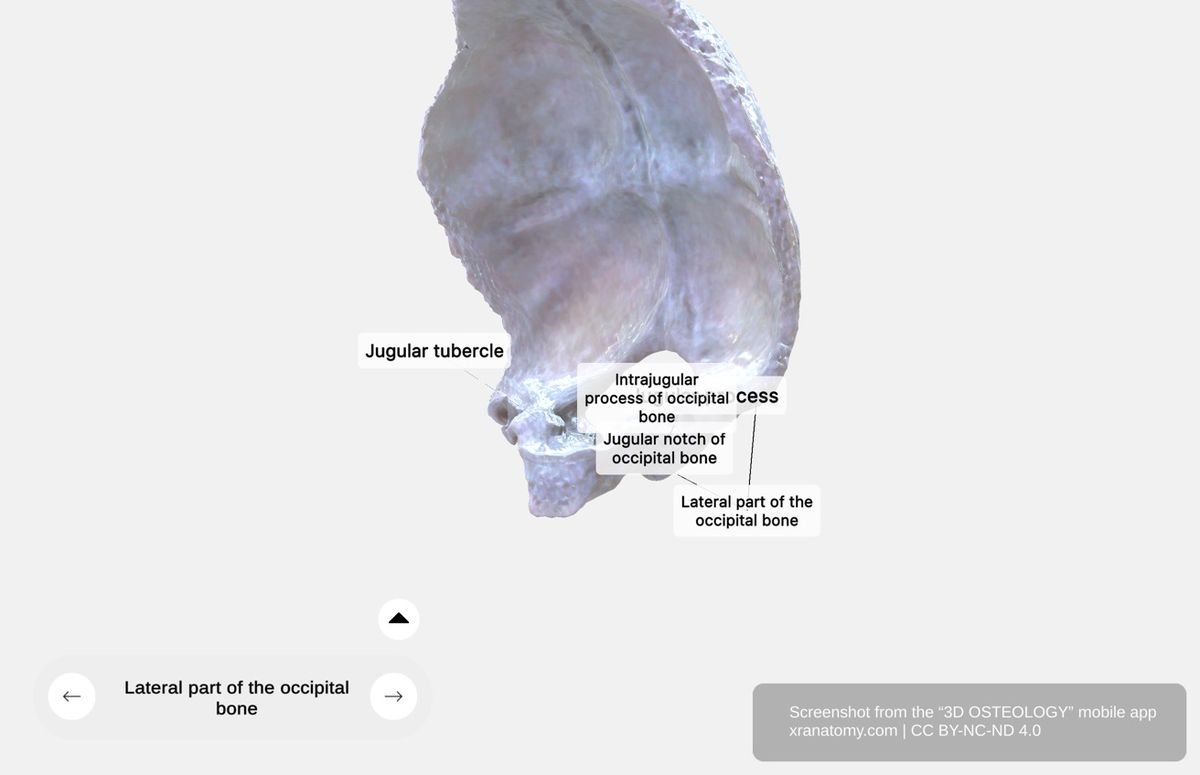
Lateral Parts of the Occipital Bone, Preview from the app. Download 3D OSTEOLOGY for full 3D control—multiple views, x-ray mode, and unlimited zoom.
The lateral parts sit on both sides of the foramen magnum. Their key features include the occipital condyles for articulation with the atlas, the hypoglossal canal for nerve passage, and several jugular landmarks contributing to the jugular foramen.
Occipital Condyles
The occipital condyles are oval prominences on the inferior surface that articulate with the atlas (C1), forming the atlanto-occipital joint for your head nodding. The condylar fossa is a depression posterior to each condyle that may contain the opening of the condylar canal, which transmits emissary veins.
Hypoglossal Canal
The hypoglossal canal is located superior to the foramen magnum and courses anterolaterally. It transmits your hypoglossal nerve (CN XII).
Jugular Landmarks
The jugular tubercle is an oval elevation on the superior surface that contributes to jugular foramen formation. The jugular notch forms part of the jugular foramen and transmits your internal jugular vein and cranial nerves. The jugular process extends laterally and provides attachment for muscles and ligaments. The intrajugular process is a bony projection that may divide the jugular notch and can form a septum within the jugular foramen.
SQUAMOUS PART
The squamous part is the largest and most posterior portion of the occipital bone, located posterior to the foramen magnum. It provides attachment sites for nuchal muscles and ligaments. Its two surfaces include the external surface with muscular landmarks and the internal surface with cranial fossae and venous sinus grooves.
External Surface
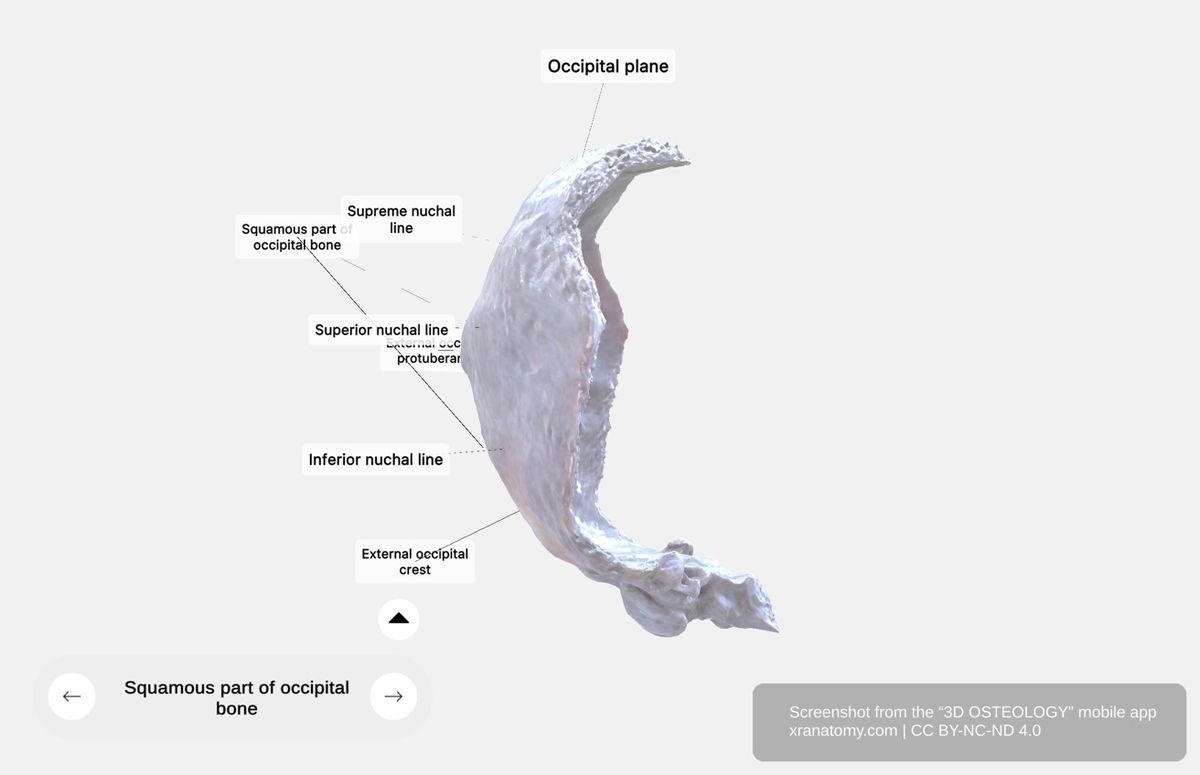
External Surface of the Squamous Part, Preview from the app. Download 3D OSTEOLOGY for full 3D control—multiple views, x-ray mode, and unlimited zoom.
External Occipital Protuberance and Crest
The external occipital protuberance is a midline prominence palpable through your scalp. The external occipital crest (median nuchal line) descends from the protuberance toward the foramen magnum and provides attachment for the nuchal ligament.
Nuchal Lines
The nuchal lines are horizontal ridges on the external surface. The supreme nuchal line is a faint ridge above the external occipital protuberance. The superior nuchal line is a horizontal ridge at the level of the protuberance that serves as a muscle attachment. The inferior nuchal line is a horizontal ridge below the superior line that provides additional muscle attachments.
Occipital Plane
The occipital plane is the region above the supreme nuchal line. It contributes to your posterior cranial curvature.
Internal Surface
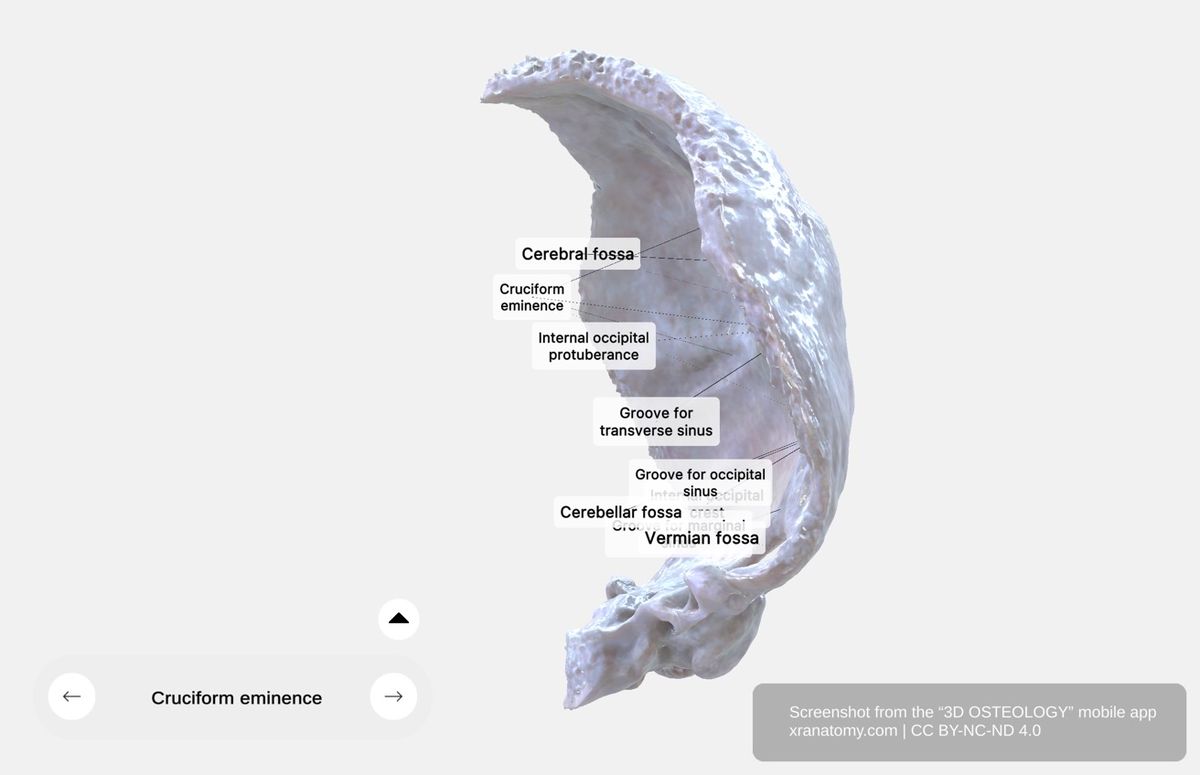
Internal Surface of the Squamous Part, Preview from the app. Download 3D OSTEOLOGY for full 3D control—multiple views, x-ray mode, and unlimited zoom.
Cruciform Eminence
The cruciform (cruciate) eminence is a cross-shaped elevation that divides the internal surface into four fossae, with the internal occipital protuberance at its center. The internal occipital crest descends from the protuberance and forms the inferior limb of the cruciform eminence.
Venous Sinus Grooves
The groove for the transverse sinuses consists of horizontal grooves accommodating your transverse dural venous sinuses. The groove for the occipital sinus follows the internal occipital crest and houses your occipital sinus. The groove for the marginal sinus traces the inferior margin of the foramen magnum.
Cranial Fossae
The cerebral fossae are the superior fossae accommodating the occipital lobes of your cerebrum. The cerebellar fossae are the inferior fossae housing your cerebellar hemispheres. The vermian fossa is a small depression accommodating the cerebellar vermis.
CHECK YOUR UNDERSTANDING
1. Name the four parts of the occipital bone.
Reveal Answer
The squamous part, the basilar part, and two lateral parts. All four surround the foramen magnum.
2. What structures pass through the foramen magnum?
Reveal Answer
The brainstem (at the junction of medulla oblongata and spinal cord), the vertebral arteries, the spinal root of the spinal accessory nerve (CN XI), and the meninges continuous between cranial and spinal coverings.
3. What is the cruciform eminence, and what does it divide?
Reveal Answer
The cruciform (cruciate) eminence is a cross-shaped elevation on the internal surface of the squamous part. It divides the surface into four fossae: two superior cerebral fossae and two inferior cerebellar fossae, with the internal occipital protuberance at its center.
WHAT'S NEXT
Next, explore the Temporal Bone. You will study its squamous, tympanic, and petrous parts, along with structures for hearing and balance, the mastoid process, and the carotid canal.
Review this page again in 3 days to reinforce what you have learned.
BIBLIOGRAPHY
1. Henry G, Warren HL. Osteology. In: Anatomy of the Human Body. 20th ed. Philadelphia: Lea & Febiger; 1918. p. 129–97.
2. Standring S, editor. Gray's Anatomy: The Anatomical Basis of Clinical Practice. 41st ed. London: Elsevier; 2016.
3. Moore KL, Agur AMR, Dalley AF. Essential Clinical Anatomy. 5th ed. Philadelphia: Wolters Kluwer; 2015.