CARPAL BONES ANATOMY
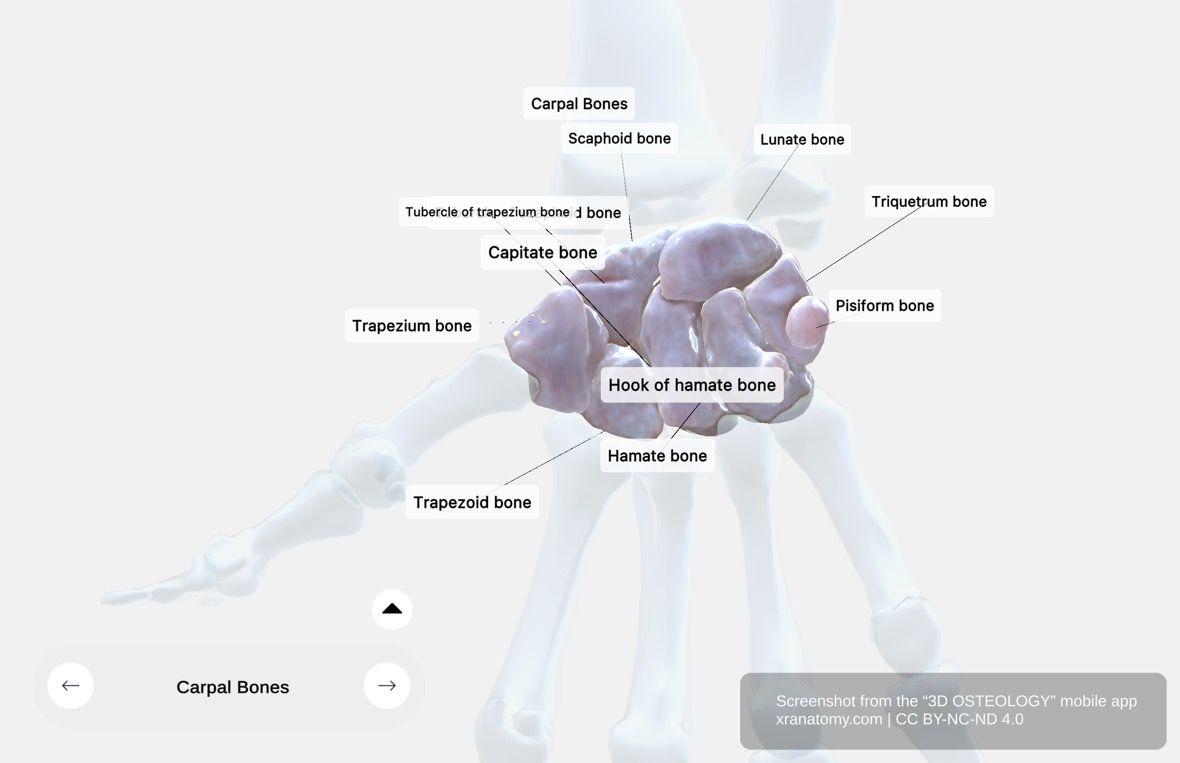
Carpal Bones - Overview, Preview from the app. Download 3D OSTEOLOGY for full 3D control—multiple views, x-ray mode, and unlimited zoom.
WHY THIS MATTERS
Your wrist relies on eight carpal bones arranged in two rows to provide both stability and flexibility. Understanding how the proximal row articulates with your radius and how the distal row connects to your metacarpals helps you see how your hand achieves its full range of motion.
TABLE OF CONTENTS
GENERAL CHARACTERISTICS
Overview of the Carpal Bones
The carpal bones consist of a total of eight bones arranged in two distinct rows. This arrangement provides stability and flexibility to your wrist joint.
The Two Rows of Carpal Bones
The proximal row contains the scaphoid, lunate, triquetral, and pisiform. The distal row contains the trapezium, trapezoid, capitate, and hamate.
PROXIMAL ROW OF CARPAL BONES
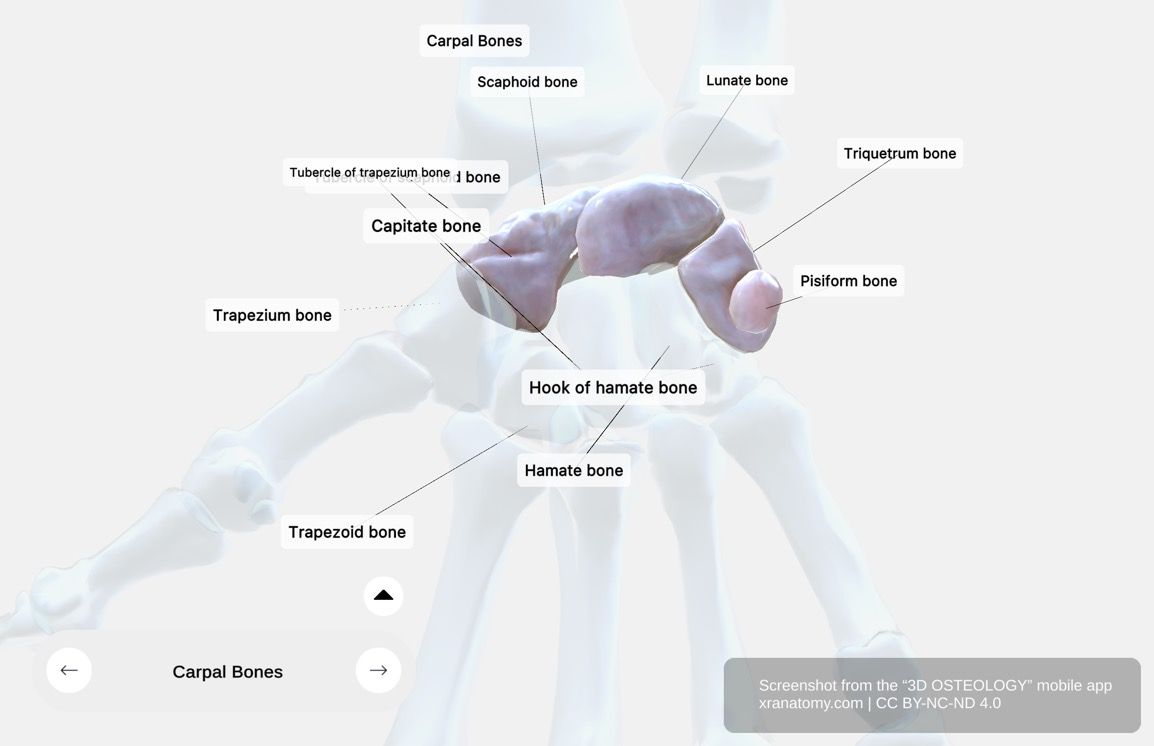
Proximal Row of Carpal Bones, Preview from the app. Download 3D OSTEOLOGY for full 3D control—multiple views, x-ray mode, and unlimited zoom.
The proximal row sits closer to your forearm and contains four bones. The scaphoid is the largest of this row and articulates with your radius. The lunate occupies the center, the triquetral sits on the ulnar side, and the pisiform is the smallest, positioned in front of the triquetral.
1. Scaphoid (Navicular)
Structure of the Scaphoid
The scaphoid is the largest bone of the proximal row, with a boat-shaped structure. Its proximal surface is convex, smooth, and triangular, and it articulates with the radius.
The Scaphoid Tubercle
The scaphoid features a tubercle located on the volar surface, directed forwards. This tubercle serves as an attachment point for the transverse carpal ligament and occasionally fibers of the Abductor pollicis brevis.
2. Lunate (Semilunar)
Structure of the Lunate
The lunate is deeply concave with a crescentic outline. It sits in the center of the proximal row, between the scaphoid and triquetral bones.
Surfaces of the Lunate
The proximal surface of the lunate is convex and articulates with the radius. The distal surface is deeply concave and articulates with the head of the capitate bone.
3. Triquetral (Cuneiform)
Structure of the Triquetral
The triquetral has a pyramidal shape and sits on the ulnar side of the proximal row.
Key Feature of the Triquetral
The triquetral has an oval facet for articulation with the pisiform bone.
4. Pisiform
Structure of the Pisiform
The pisiform is the smallest proximal carpal bone. It sits in front of the triquetral bone.
Key Feature of the Pisiform
The pisiform has a single oval facet on its dorsal surface for articulation with the triquetral bone.
DISTAL ROW OF CARPAL BONES
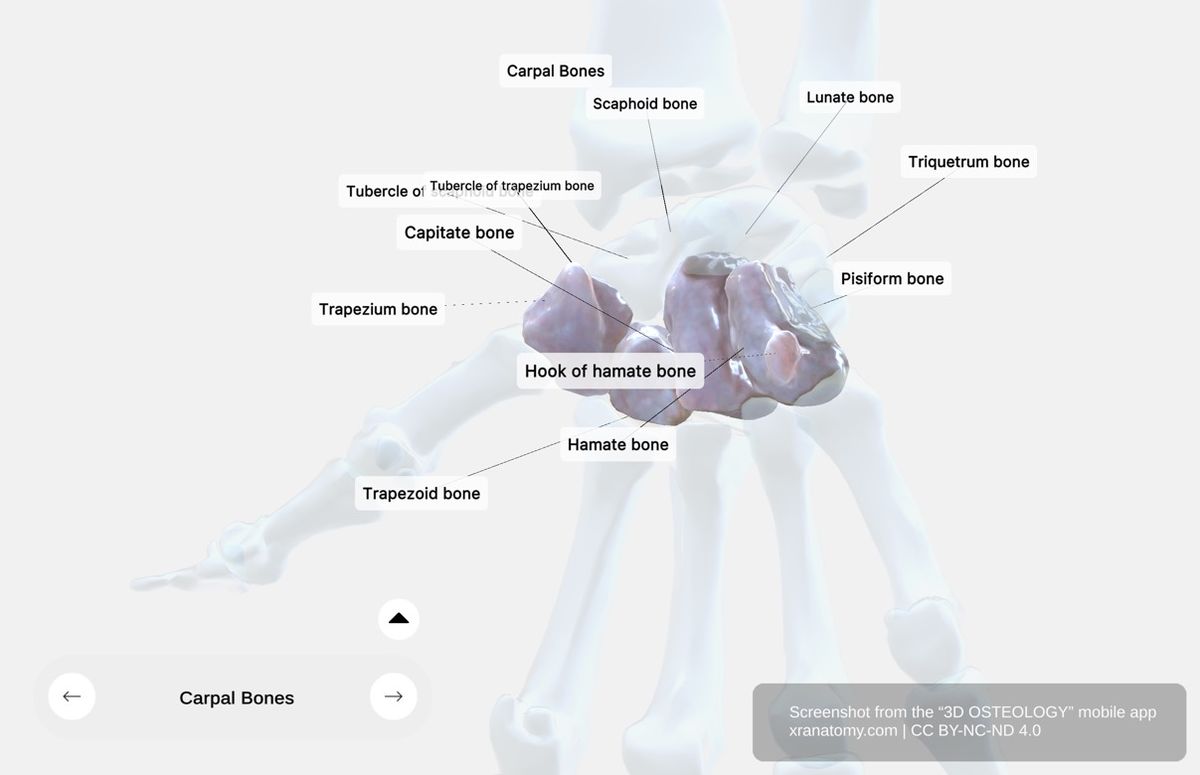
Distal Row of Carpal Bones, Preview from the app. Download 3D OSTEOLOGY for full 3D control—multiple views, x-ray mode, and unlimited zoom.
The distal row sits closer to your fingers and also contains four bones. The trapezium occupies the radial side and connects to your thumb. The trapezoid is the smallest of this row. The capitate is the largest carpal bone overall, positioned centrally. The hamate sits on the ulnar side and features a distinctive hook-like projection.
1. Trapezium (Greater Multangular)
Location of the Trapezium
The trapezium sits on the radial side of the carpus, between the scaphoid and your first metacarpal bone.
Features of the Trapezium
The trapezium has a deep groove on its volar surface. Its tubercle, located on the upper volar surface, serves as an attachment point for the transverse carpal ligament and your thumb muscles.
2. Trapezoid (Lesser Multangular)
Structure of the Trapezoid
The trapezoid is the smallest distal carpal bone, with a wedge-shaped structure.
Features of the Trapezoid
The trapezoid has four articular facets separated by sharp edges.
3. Capitate
Structure of the Capitate
The capitate is the largest carpal bone, positioned centrally in your wrist.
Features of the Capitate
The capitate has a rounded proximal head that articulates with the scaphoid and lunate bones. Below the head sit a neck and distal body.
4. Hamate (Unciform)
Structure of the Hamate
The hamate is wedge-shaped.
The Hamulus (Hook of Hamate)
The hamulus (Hook of Hamate) is a curved projection from the volar surface, directed forwards and laterally. It serves as an attachment point for the transverse carpal ligament and muscles.
CHECK YOUR UNDERSTANDING
1. How many carpal bones are there, and how are they arranged?
Reveal Answer
There are eight carpal bones arranged in two distinct rows: a proximal row (scaphoid, lunate, triquetral, pisiform) and a distal row (trapezium, trapezoid, capitate, hamate).
2. Which is the largest carpal bone, and which is the smallest in the proximal row?
Reveal Answer
The capitate is the largest carpal bone overall, positioned centrally in the wrist. The pisiform is the smallest bone of the proximal row.
3. What is the hamulus and where is it located?
Reveal Answer
The hamulus (Hook of Hamate) is a curved projection from the volar surface of the hamate, directed forwards and laterally. It serves as an attachment point for the transverse carpal ligament and muscles.
WHAT'S NEXT
Now that you know the eight carpal bones of your wrist, the next page covers the Metacarpal Bones. You will explore the five long bones that form the framework of your palm, including their base, body, and head structure, plus the distinctive styloid process of the third metacarpal.
Review this page again in 3 days to reinforce what you have learned.
BIBLIOGRAPHY
1. Henry G, Warren HL. Osteology. In: Anatomy of the Human Body. 20th ed. Philadelphia: Lea & Febiger; 1918. p. 129–97.
2. Standring S, editor. Gray's Anatomy: The Anatomical Basis of Clinical Practice. 41st ed. London: Elsevier; 2016.
3. Moore KL, Agur AMR, Dalley AF. Essential Clinical Anatomy. 5th ed. Philadelphia: Wolters Kluwer; 2015.