BONES OF THE HAND ANATOMY
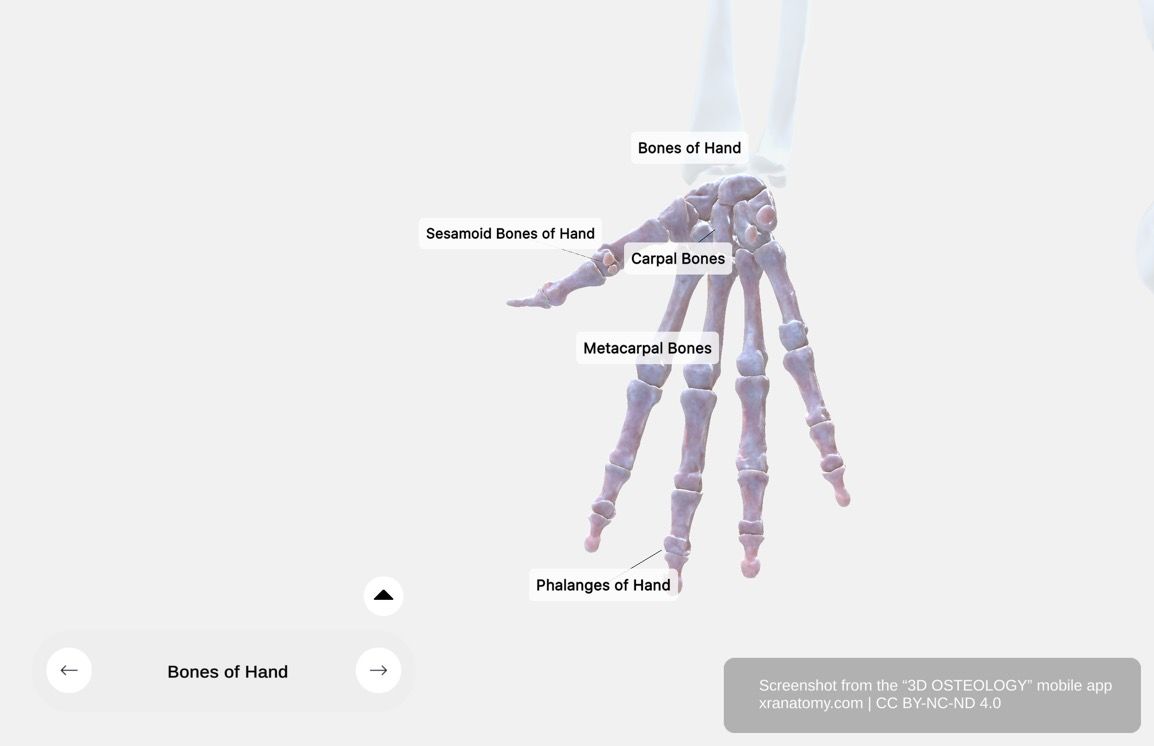
Bones of the Hand - X-ray View, Preview from the app. Download 3D OSTEOLOGY for full 3D control—multiple views, x-ray mode, and unlimited zoom.
WHY THIS MATTERS
Your hand contains 27 bones organized into three regions, plus variable sesamoid bones. Understanding how carpal bones, metacarpals, and phalanges work together helps you see how your hand provides both the structural support for gripping and the fine control for precise movements.
GENERAL CHARACTERISTICS
The skeleton of your hand is composed of distinct segments that work together to provide structure and functionality. Your hand consists of 27 bones grouped into three regions: carpal bones (8), metacarpal bones (5), and phalanges (14). Additional sesamoid bones, variable in number, sit within tendons near certain joints.
CARPAL BONES
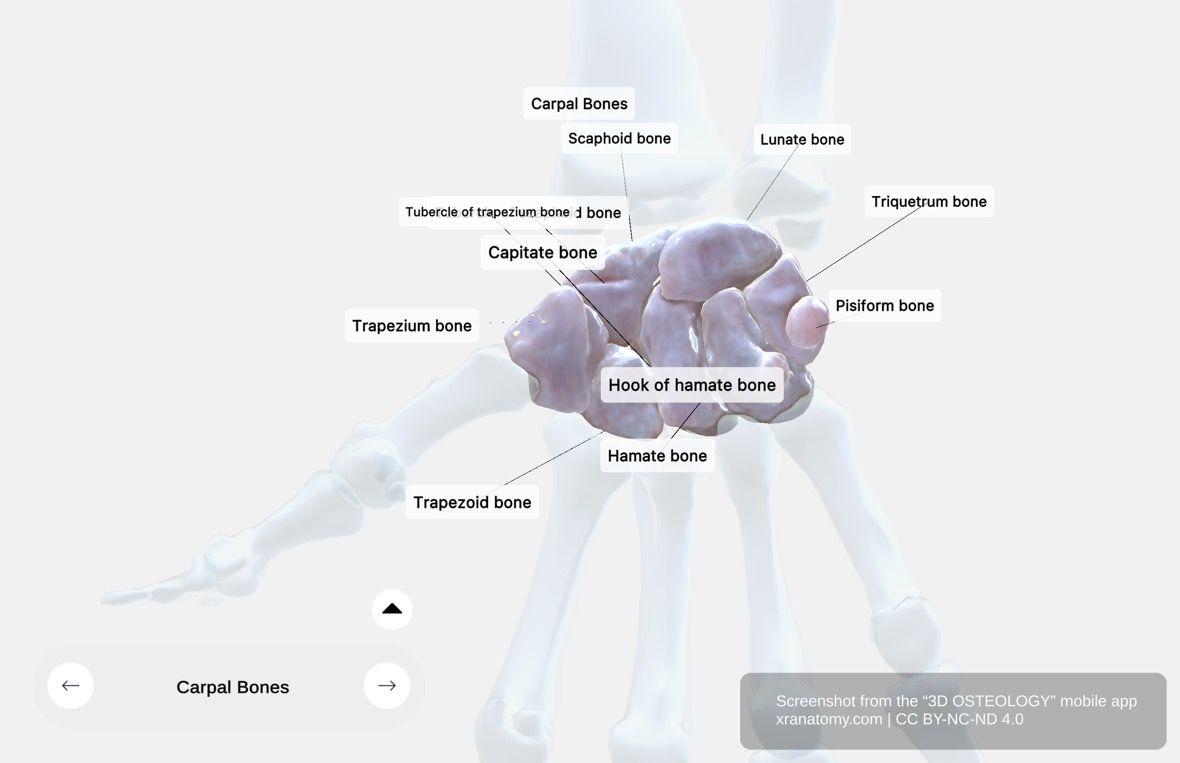
Carpal Bones, Preview from the app. Download 3D OSTEOLOGY for full 3D control—multiple views, x-ray mode, and unlimited zoom.
Your wrist contains eight carpal bones arranged in two rows. The proximal row sits closer to your forearm and includes the Scaphoid, Lunate, Triquetral, and Pisiform. The distal row sits closer to your palm and includes the Trapezium, Trapezoid, Capitate, and Hamate.
Proximal Row (Radial to Ulnar Side)
The proximal row of carpal bones, listed from the radial to ulnar side, includes the Scaphoid (also called Navicular), the Lunate, the Triquetral, and the Pisiform.
Distal Row
The distal row of carpal bones includes the Trapezium (also called Greater Multangular), the Trapezoid (also called Lesser Multangular), the Capitate, and the Hamate.
METACARPAL BONES
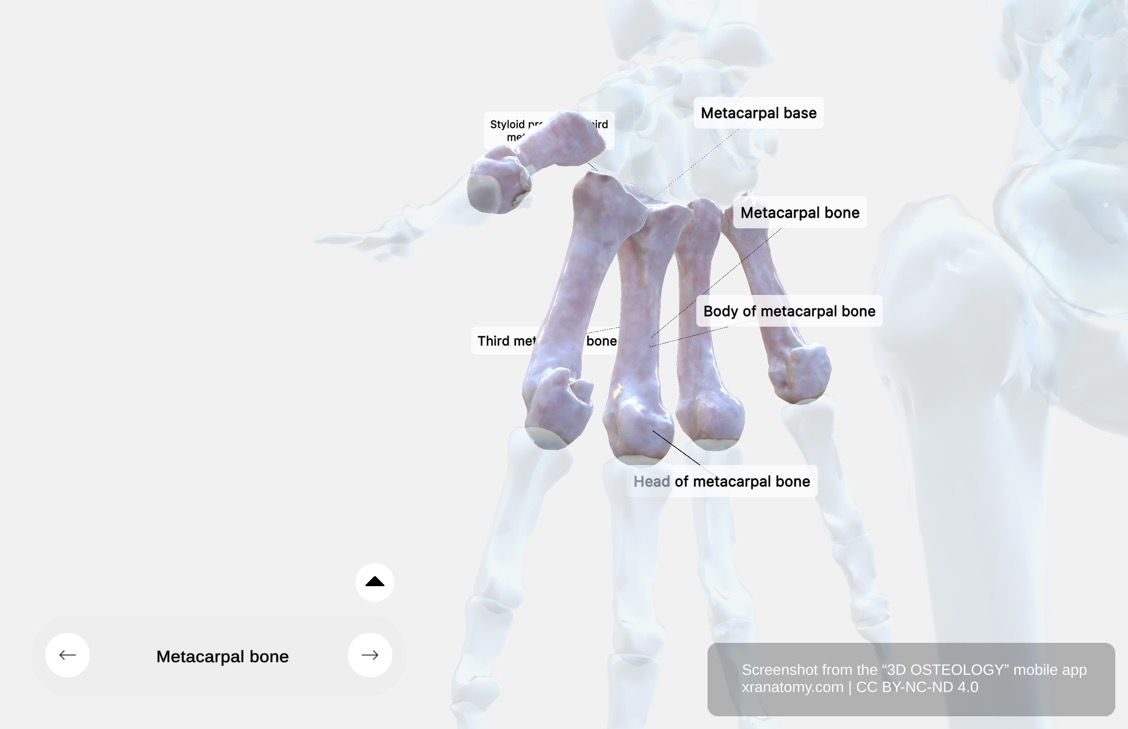
Metacarpal Bones, Preview from the app. Download 3D OSTEOLOGY for full 3D control—multiple views, x-ray mode, and unlimited zoom.
Your palm contains five metacarpal bones, enumerated laterally from your thumb. Each metacarpal has three parts: the body (shaft), the base (proximal end), and the head (distal end).
Structure of Metacarpal Bones
The body forms the shaft of the metacarpal. The base, or proximal end, articulates with the carpal bones. The head, or distal end, articulates with the proximal phalanges.
PHALANGES
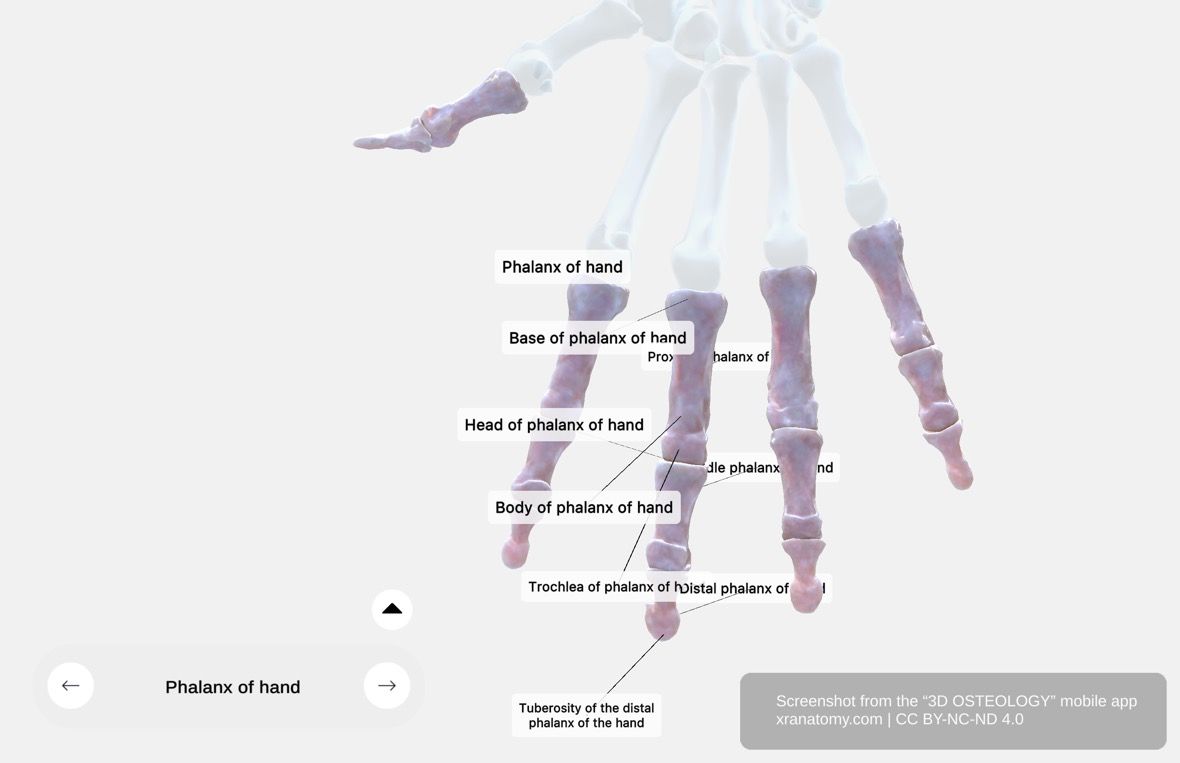
Phalanges of the Hand, Preview from the app. Download 3D OSTEOLOGY for full 3D control—multiple views, x-ray mode, and unlimited zoom.
Your hand contains fourteen phalanges. Each of your fingers has three phalanges (proximal, middle, and distal), while your thumb has only two (proximal and distal).
Structure of Phalanges
The body of each phalanx tapers distally. Its dorsal surface is convex, while its volar surface is concave. Each phalanx has two ends, proximal and distal extremities, for articulation.
SESAMOID BONES
Sesamoid bones sit on the palmar surface of your hand. You typically have two at the metacarpophalangeal joint of your thumb. Sometimes one is also present at the metacarpophalangeal joint of your little finger.
CHECK YOUR UNDERSTANDING
1. How many bones make up the hand skeleton, and what are the three main regions?
Reveal Answer
27 bones, grouped into carpal bones (8), metacarpal bones (5), and phalanges (14).
2. Name the four bones of the proximal carpal row from radial to ulnar side.
Reveal Answer
Scaphoid (Navicular), Lunate, Triquetral, and Pisiform.
3. What are the three parts of a metacarpal bone?
Reveal Answer
The body (shaft), the base (proximal end, articulating with carpal bones), and the head (distal end, articulating with the proximal phalanges).
WHAT'S NEXT
Now that you have an overview of all 27 hand bones, the next page takes a closer look at the Carpal Bones. You will explore each of the eight wrist bones in detail, including the proximal row (scaphoid, lunate, triquetral, pisiform) and the distal row (trapezium, trapezoid, capitate, hamate).
Review this page again in 3 days to reinforce what you have learned.
BIBLIOGRAPHY
1. Henry G, Warren HL. Osteology. In: Anatomy of the Human Body. 20th ed. Philadelphia: Lea & Febiger; 1918. p. 129–97.
2. Standring S, editor. Gray's Anatomy: The Anatomical Basis of Clinical Practice. 41st ed. London: Elsevier; 2016.
3. Moore KL, Agur AMR, Dalley AF. Essential Clinical Anatomy. 5th ed. Philadelphia: Wolters Kluwer; 2015.