METACARPAL BONES ANATOMY
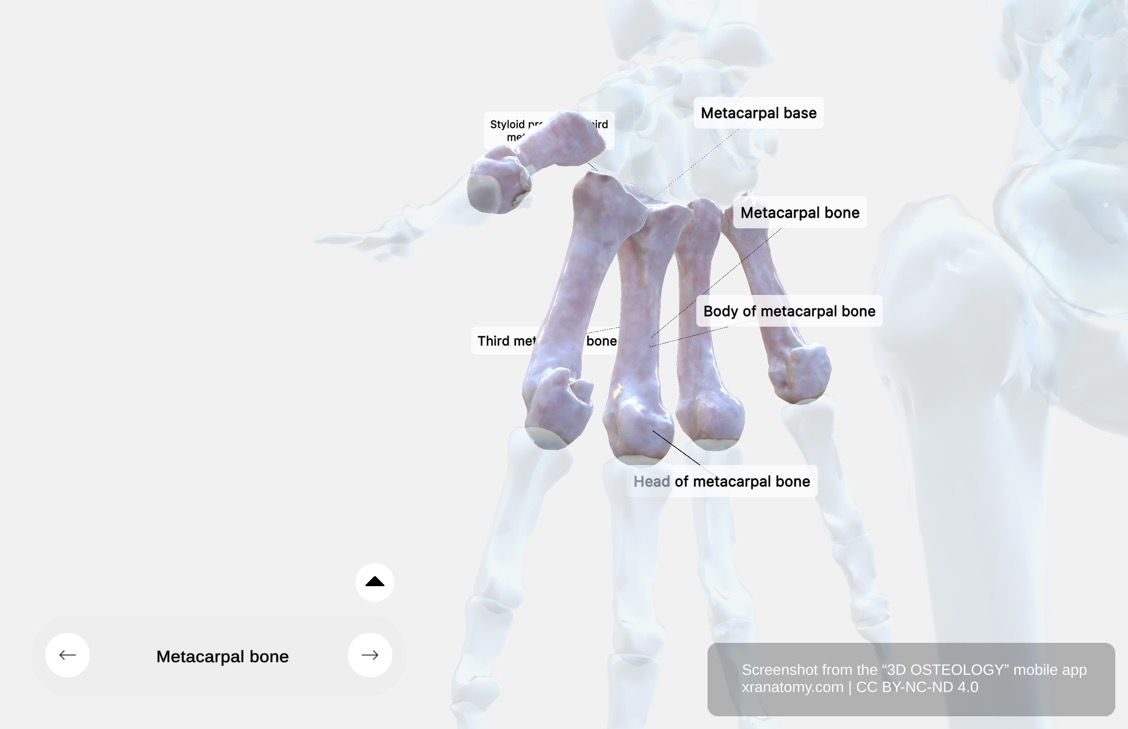
Metacarpal Bones - Overview, Preview from the app. Download 3D OSTEOLOGY for full 3D control—multiple views, x-ray mode, and unlimited zoom.
WHY THIS MATTERS
The metacarpal bones form the framework of your palm and give your hand its mobility and strength. Understanding their base, body, and head helps you see how your fingers connect to your wrist and how each metacarpal contributes to your grip and fine motor control.
GENERAL CHARACTERISTICS
The metacarpal bones are five in total, numbered I to V from your thumb to your little finger. Each metacarpal has a distinct structure consisting of a body (shaft), a base at the proximal end, and a head at the distal end. These bones form the framework of your palm and contribute to your hand's mobility and strength.
METACARPAL STRUCTURE
Each metacarpal consists of three distinct regions. The base (proximal end) articulates with your carpal bones and adjacent metacarpals. The body (shaft) forms the elongated middle portion with a curved, prismoid shape. The head (distal end) connects to the proximal phalanx of each finger.
Base (Proximal End)
The metacarpal base is cuboidal in shape and broader at the posterior than the anterior. It articulates with one or more carpal bones and with adjacent metacarpal bones. The dorsal and volar surfaces are rough, providing attachment for ligaments.
Body (Shaft)
The metacarpal body has a prismoid shape and curves longitudinally. The posterior surface is convex, while the anterior surface is concave. It presents three surfaces: medial, lateral, and dorsal.
Head (Distal End)
The metacarpal head is oblong in shape and convex from front to back, but less convex transversely. It articulates with the proximal phalanx of the corresponding finger.
THIRD METACARPAL BONE
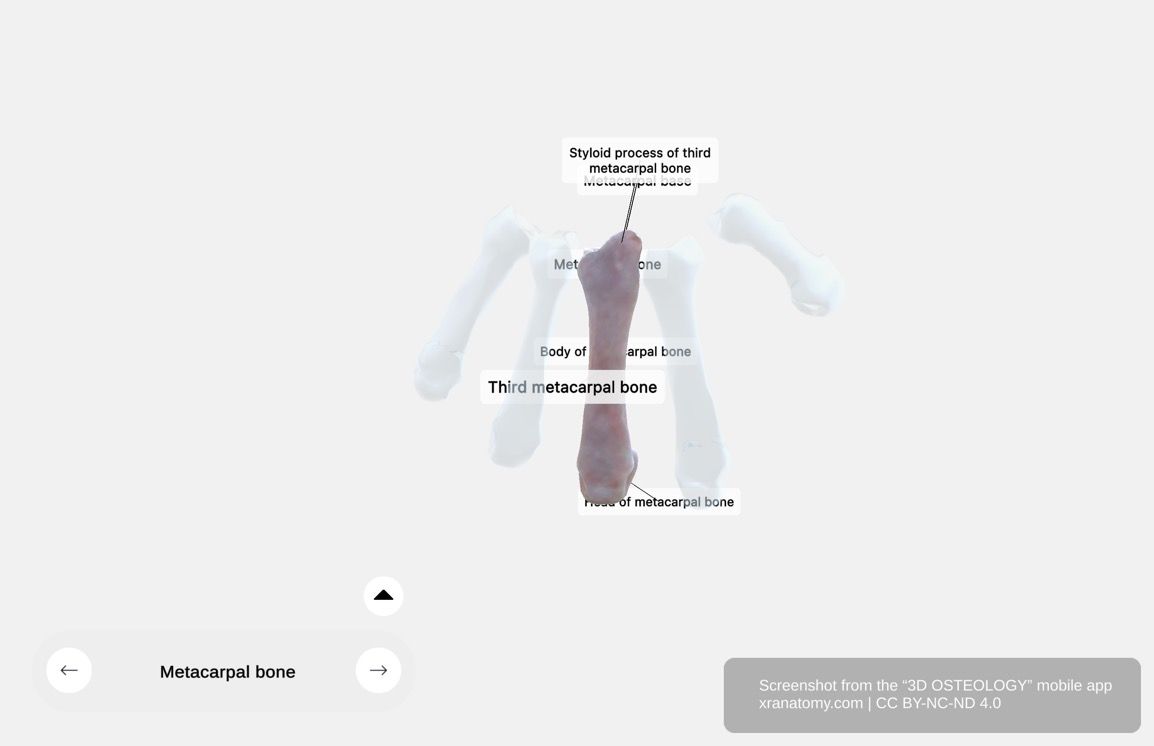
Third Metacarpal Bone, Preview from the app. Download 3D OSTEOLOGY for full 3D control—multiple views, x-ray mode, and unlimited zoom.
The third metacarpal is notable for its size and its distinctive styloid process.
Size
The third metacarpal is smaller than the second metacarpal.
Styloid Process
The styloid process is a pyramidal projection located on the lateral dorsal side of the base. It serves as the attachment point for the Extensor carpi radialis brevis muscle.
CHECK YOUR UNDERSTANDING
1. How many metacarpal bones are there, and how are they numbered?
Reveal Answer
There are five metacarpal bones, numbered I to V from the thumb to the little finger.
2. Name the three parts of a metacarpal bone.
Reveal Answer
The base (proximal end), body (shaft), and head (distal end).
3. What is the styloid process of the third metacarpal, and which muscle attaches to it?
Reveal Answer
The styloid process is a pyramidal projection on the lateral dorsal side of the base. It serves as the attachment point for the Extensor carpi radialis brevis muscle.
WHAT'S NEXT
Now that you understand the metacarpal bones, the next page covers the Phalanges of the Hand. You will explore the 14 finger bones, including the proximal, middle, and distal phalanges, along with their body, base, and head structures.
Review this page again in 3 days to reinforce what you have learned.
BIBLIOGRAPHY
1. Henry G, Warren HL. Osteology. In: Anatomy of the Human Body. 20th ed. Philadelphia: Lea & Febiger; 1918. p. 129–97.
2. Standring S, editor. Gray's Anatomy: The Anatomical Basis of Clinical Practice. 41st ed. London: Elsevier; 2016.
3. Moore KL, Agur AMR, Dalley AF. Essential Clinical Anatomy. 5th ed. Philadelphia: Wolters Kluwer; 2015.