AXIS (C2) ANATOMY
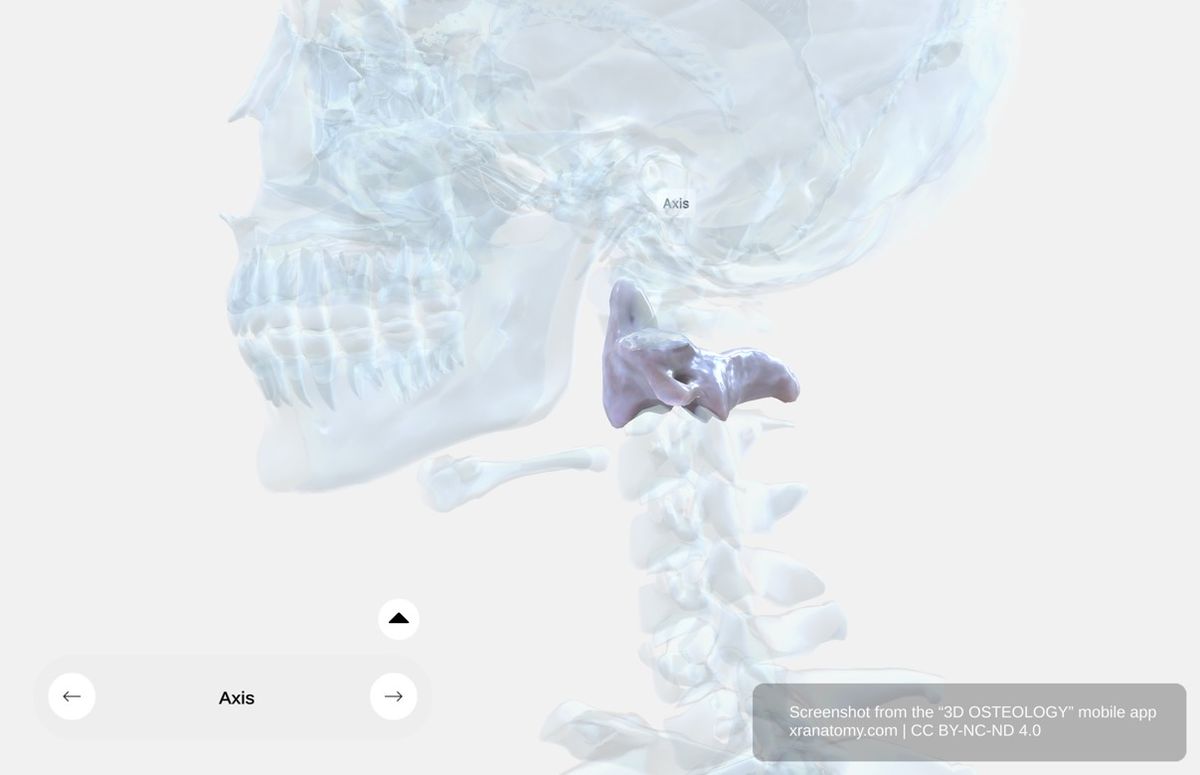
Axis (C2) - General Structure, Preview from the app. Download 3D OSTEOLOGY for full 3D control—multiple views, x-ray mode, and unlimited zoom.
WHY THIS MATTERS
The axis (C2) is the pivot that lets you turn your head left and right. Its odontoid process provides the axis of rotation, while its articular facets and the transverse ligament keep that rotation stable and controlled.
GENERAL CHARACTERISTICS
The axis is the second cervical vertebra and acts as the pivot for the rotation of the atlas (C1) and your skull. It is distinguished by its robust odontoid process, also called the dens. The dens provides the axis of rotation, allowing you to turn your head left and right.
DENS AXIS (ODONTOID PROCESS)
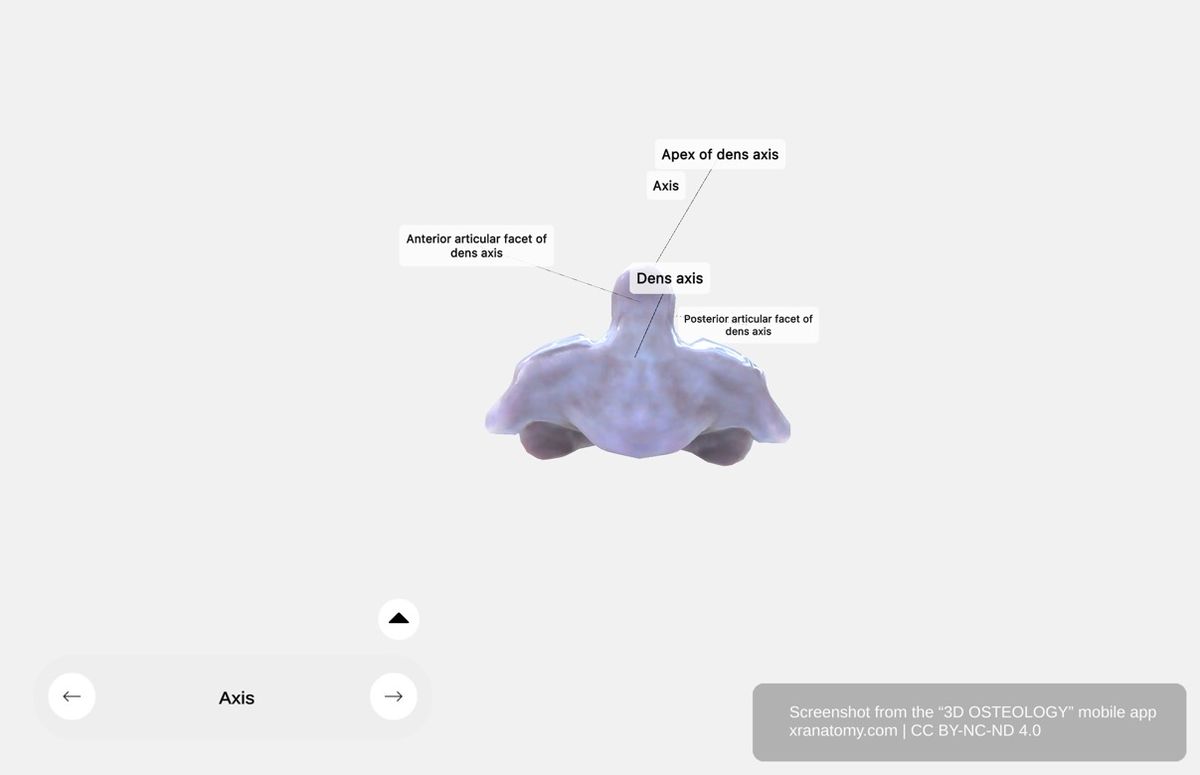
Axis - Dens (Odontoid Process), Preview from the app. Download 3D OSTEOLOGY for full 3D control—multiple views, x-ray mode, and unlimited zoom.
The odontoid process (dens) is a strong, tooth-like projection extending upward from the body of the axis. This cone-shaped structure allows the atlas and your skull to rotate around it. Its key landmark is the apex of the dens, which serves as a ligament attachment site at the tip.
Apex of the Dens
The apex of the dens is the pointed tip of the dens. It serves as the attachment site for the apical ligament, which connects to the basilar part of the occipital bone inside your skull.
ARTICULAR FACETS
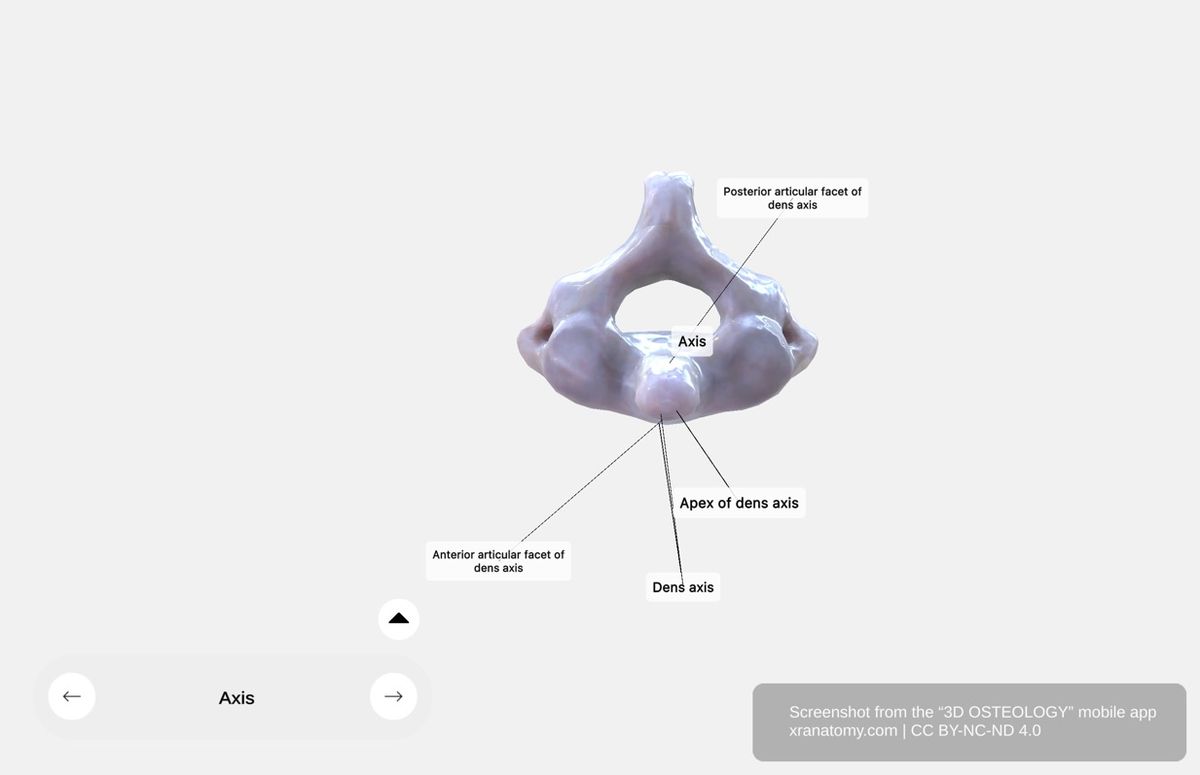
Axis - Articular Surfaces, Preview from the app. Download 3D OSTEOLOGY for full 3D control—multiple views, x-ray mode, and unlimited zoom.
The dens has two articular surfaces: the anterior articular facet on the front, which articulates with the atlas, and the groove for the transverse ligament on the back, which accommodates the transverse ligament.
Anterior Articular Facet
The anterior articular facet is an oval or nearly round smooth surface on the front of the dens. It articulates with the anterior arch of the atlas.
Groove for the Transverse Ligament
The groove for the transverse ligament is a broad shallow groove on the back of the dens. It accommodates the transverse ligament of the atlas, which is covered in cartilage, and stabilizes the dens in place, ensuring proper articulation.
CHECK YOUR UNDERSTANDING
1. What structure on the axis provides the pivot for head rotation?
Reveal Answer
The odontoid process (dens), a strong, cone-shaped, tooth-like projection extending upward from the body of the axis.
2. What does the apical ligament connect the apex of the dens to?
Reveal Answer
The basilar part of the occipital bone inside your skull.
3. Name the two articular facets of the dens and what each accommodates.
Reveal Answer
The anterior articular facet articulates with the anterior arch of the atlas. The posterior articular facet accommodates the transverse ligament of the atlas.
WHAT'S NEXT
Next, explore the Cervical Vertebrae. You will study the shared features of C3 to C6, including the vertebral body with uncinate processes, the foramen transversarium in each transverse process, and the bifid spinous process.
Review this page again in 3 days to reinforce what you have learned.
BIBLIOGRAPHY
1. Henry G, Warren HL. Osteology. In: Anatomy of the Human Body. 20th ed. Philadelphia: Lea & Febiger; 1918. p. 129–97.
2. Standring S, editor. Gray's Anatomy: The Anatomical Basis of Clinical Practice. 41st ed. London: Elsevier; 2016.
3. Moore KL, Agur AMR, Dalley AF. Essential Clinical Anatomy. 5th ed. Philadelphia: Wolters Kluwer; 2015.