ATLAS (C1) ANATOMY
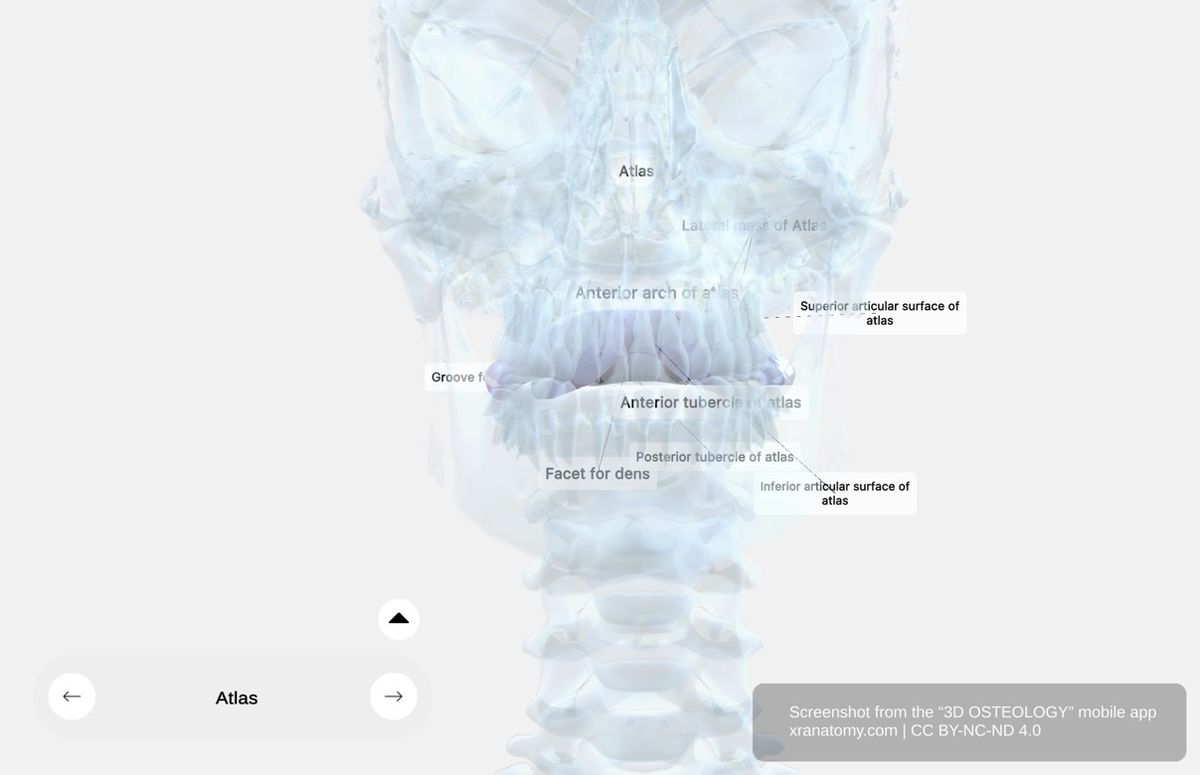
Atlas (C1) - General Structure, Preview from the app. Download 3D OSTEOLOGY for full 3D control—multiple views, x-ray mode, and unlimited zoom.
WHY THIS MATTERS
The atlas (C1) is the single vertebra that supports your entire head. Its unique ring-like structure, lacking both a vertebral body and spinous process, makes it unlike any other vertebra in your spine. Understanding its lateral masses, arches, and articular surfaces helps you see how your skull connects to your vertebral column.
GENERAL CHARACTERISTICS
The atlas is the first cervical vertebra and supports your head. It has a unique structure, lacking both a vertebral body and a spinous process. Instead, it forms a ring-like structure composed of an anterior arch, a posterior arch, and two lateral masses.
LATERAL MASS
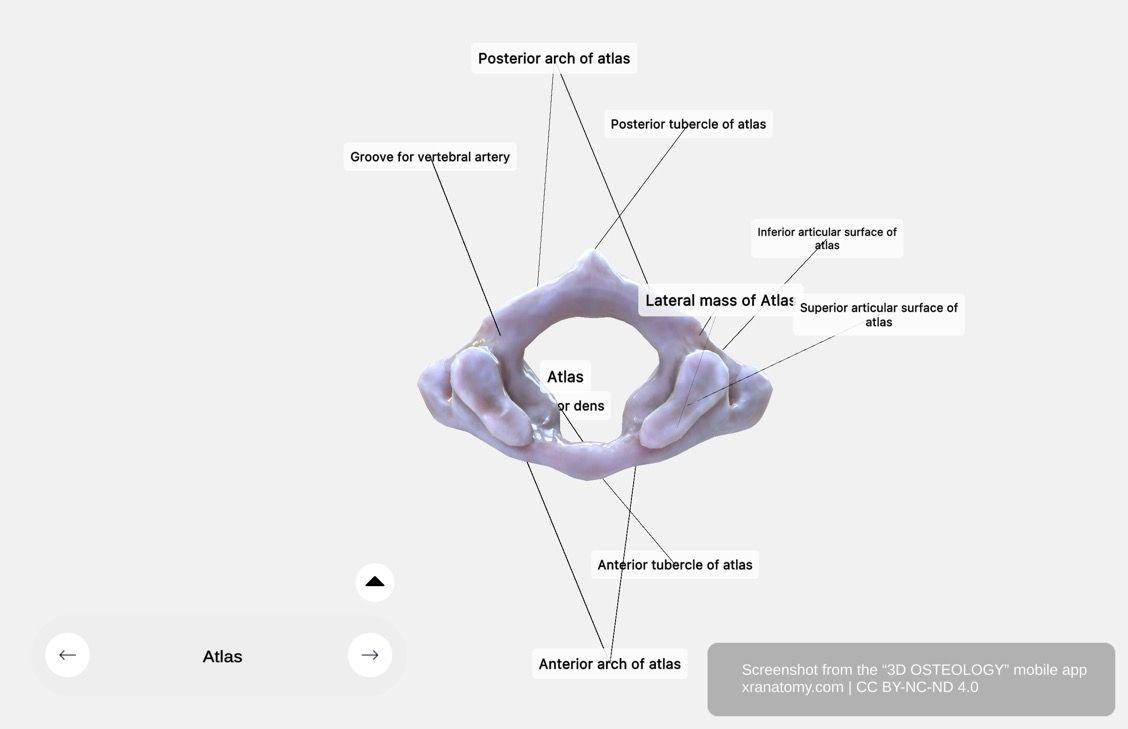
Atlas - Lateral Mass, Preview from the app. Download 3D OSTEOLOGY for full 3D control—multiple views, x-ray mode, and unlimited zoom.
The lateral mass comprises about one-fifth of the atlas' ring and supports the weight of your head. Its key features include the superior articular surface for articulation with the occipital condyles, the inferior articular surface for articulation with the axis, and the transverse ligament tubercle for attachment of the transverse ligament.
Superior Articular Surface
The superior articular surface consists of large, oval, concave facets that converge anteriorly and diverge posteriorly. These facets are oriented upwards, medially, and slightly backwards for articulation with the occipital condyles.
Inferior Articular Surface
The inferior articular surface is nearly circular, flat or slightly concave, and oriented downwards and medially. It forms joints with the axis' (C2) superior facets.
Transverse Ligament Tubercle
The transverse ligament tubercle is a small prominence located below the medial margin of the superior articular facet. It serves as an attachment point for the transverse ligament of the atlas.
ANTERIOR ARCH
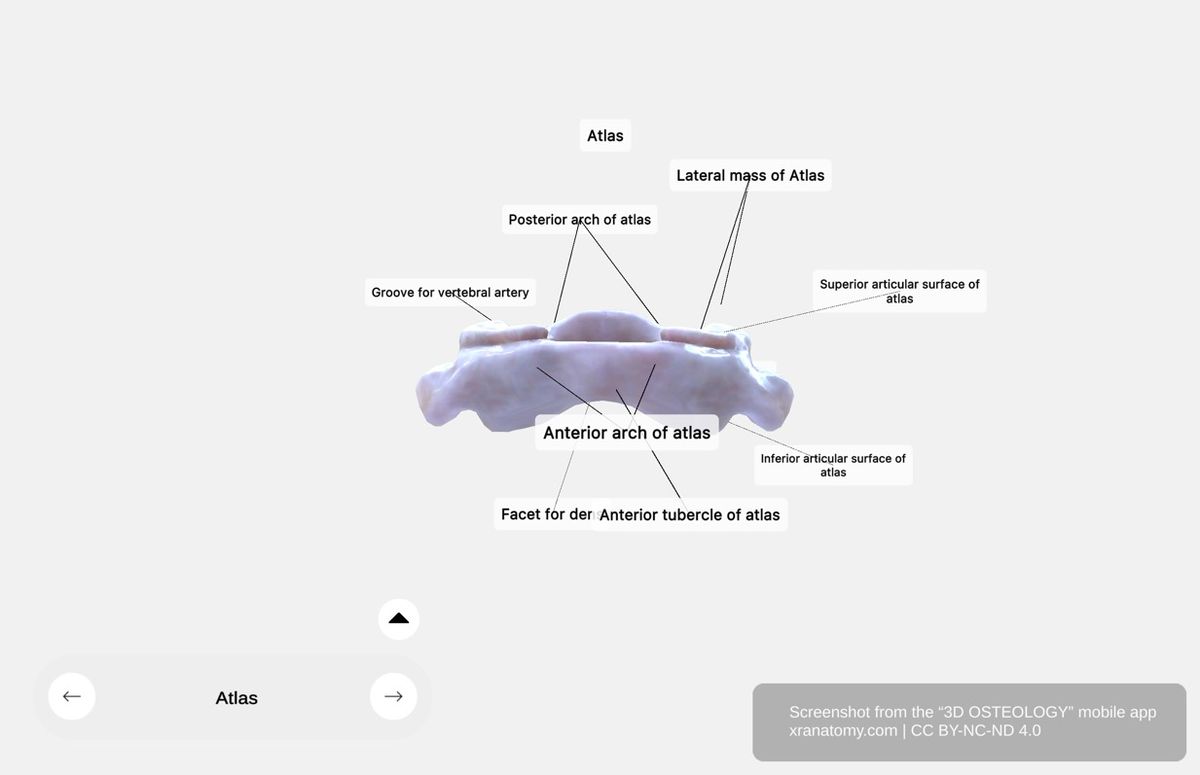
Atlas - Anterior and Posterior Arches, Preview from the app. Download 3D OSTEOLOGY for full 3D control—multiple views, x-ray mode, and unlimited zoom.
The anterior arch forms about one-fifth of the atlas' ring. Its front is convex with a smooth, oval or circular facet for articulation with the dens. The anterior arch features the facet for dens on its posterior surface and the anterior tubercle at its center.
Facet for Dens
The facet for dens is located on the concave posterior surface of the anterior arch. It ensures stability and movement by articulating with the dens of the axis.
Anterior Tubercle
The anterior tubercle is the central feature of the anterior arch. It serves as an attachment site for the longus colli muscles and the anterior longitudinal ligament.
POSTERIOR ARCH (ARCUS POSTERIOR ATLANTIS)
The posterior arch forms a large portion of the atlas' ring. Its key features include the posterior tubercle at its center and the groove for vertebral artery on its superior surface.
Posterior Tubercle
The posterior tubercle is a small bump at the center of the posterior arch. It represents a rudimentary spinous process and serves as a muscle attachment site.
Groove for Vertebral Artery (Sulcus Arteriae Vertebralis)
The groove for vertebral artery is a pathway on the superior surface of the posterior arch that accommodates your vertebral artery. The artery curves medially across the posterior arch after exiting the foramen transversarium of the atlas.
CHECK YOUR UNDERSTANDING
1. What three components make up the ring-like structure of the atlas?
Reveal Answer
The anterior arch, the posterior arch, and two lateral masses.
2. What structure on the lateral mass attaches to the transverse ligament of the atlas?
Reveal Answer
The transverse ligament tubercle, a small prominence below the medial margin of the superior articular facet.
3. What does the posterior tubercle of the atlas represent?
Reveal Answer
It represents a rudimentary spinous process and serves as a muscle attachment site.
WHAT'S NEXT
Now that you know the atlas, the next page covers the Axis (C2). You will explore the second cervical vertebra, which features the distinctive odontoid process (dens) that serves as the pivot for rotation of your head.
Review this page again in 3 days to reinforce what you have learned.
BIBLIOGRAPHY
1. Henry G, Warren HL. Osteology. In: Anatomy of the Human Body. 20th ed. Philadelphia: Lea & Febiger; 1918. p. 129–97.
2. Standring S, editor. Gray's Anatomy: The Anatomical Basis of Clinical Practice. 41st ed. London: Elsevier; 2016.
3. Moore KL, Agur AMR, Dalley AF. Essential Clinical Anatomy. 5th ed. Philadelphia: Wolters Kluwer; 2015.