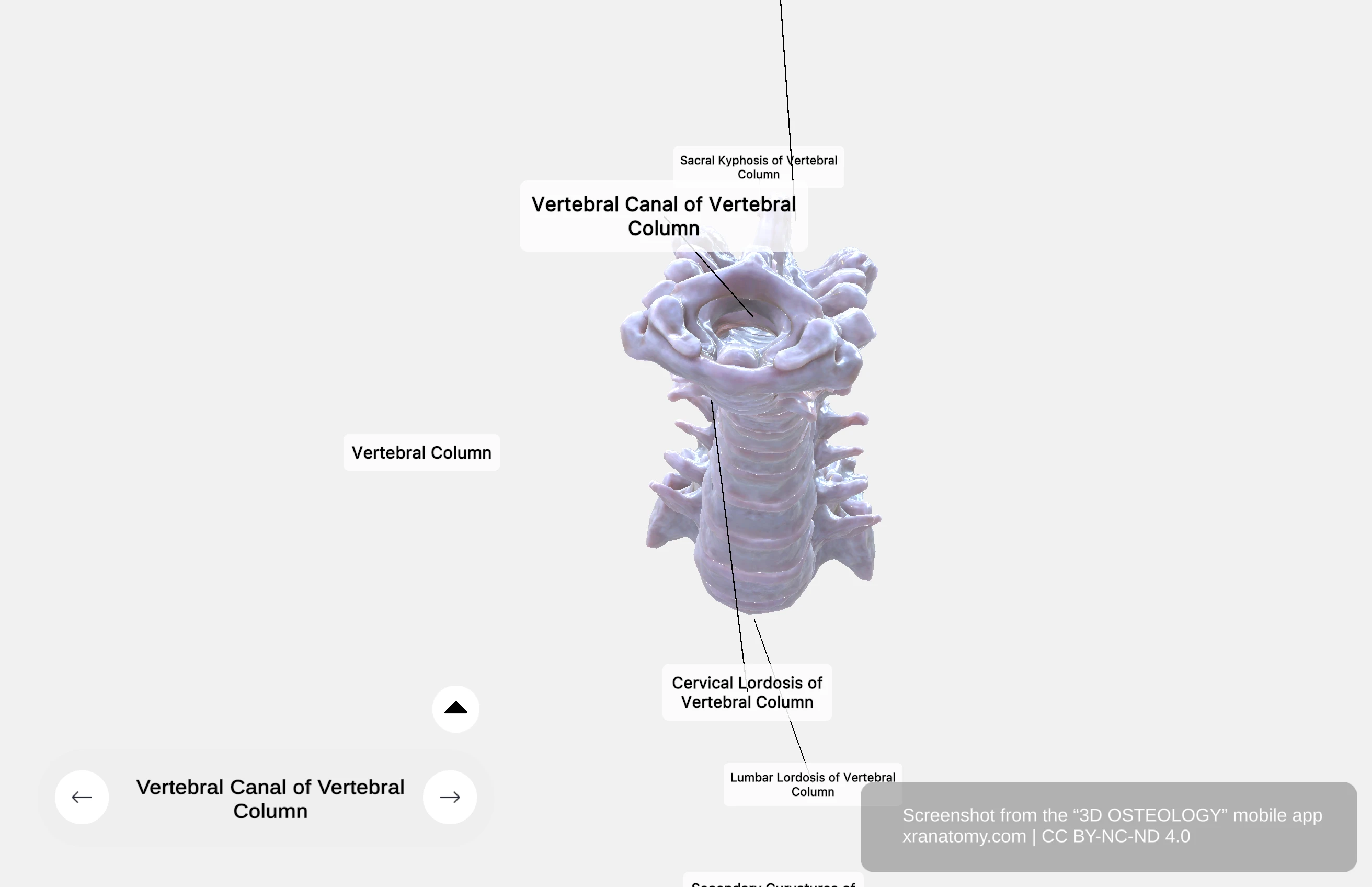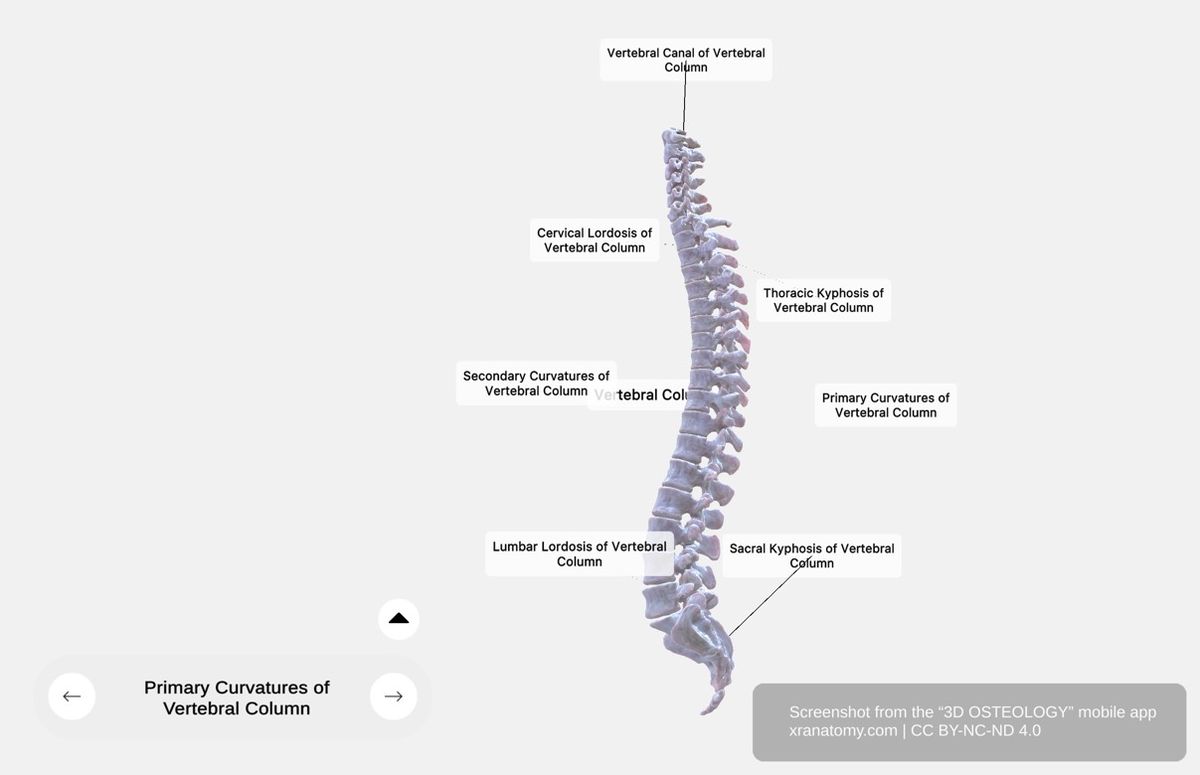
Primary Curvatures of the Vertebral Column, Preview from the app. Download 3D OSTEOLOGY for full 3D control—multiple views, x-ray mode, and unlimited zoom.
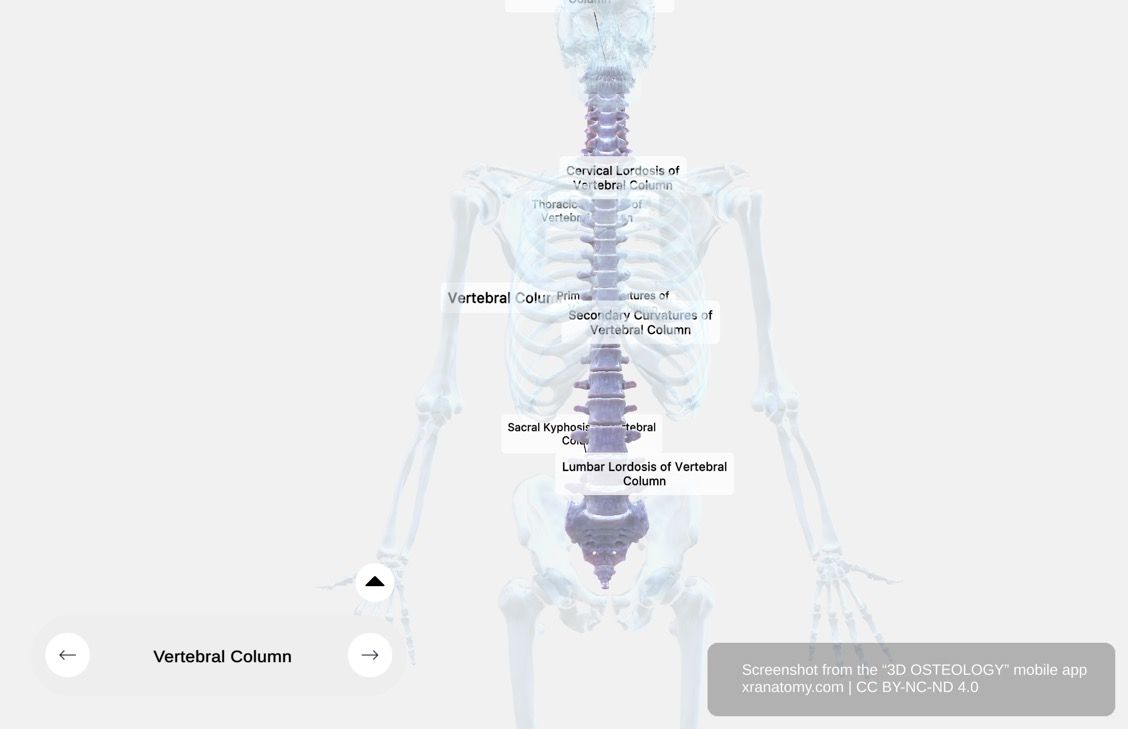
Vertebral Column - Overview, Preview from the app. Download 3D OSTEOLOGY for full 3D control—multiple views, x-ray mode, and unlimited zoom.
Your vertebral column is the structural core of your entire body. Every time you sit, stand, bend, or twist, you rely on 33 vertebrae, four spinal curvatures, and a canal that protects your spinal cord. Understanding this structure matters because spinal pathology, from herniated discs to scoliosis, is among the most common conditions you will encounter in clinical practice.
Your vertebral column (spine) runs from the base of your skull to the tip of your coccyx. It protects your spinal cord, supports your head, and anchors your ribs and back muscles. Four curvatures, two you were born with and two you developed, give your body balance, flexibility, and the ability to absorb shock.
Your spine divides into five distinct regions. Each region has a different number of vertebrae and serves a different mechanical role.
| Region | Vertebrae | Key Function |
|---|---|---|
| Cervical | 7 (C1–C7) | Supports your head and allows neck movement |
| Thoracic | 12 (T1–T12) | Articulates with your ribs |
| Lumbar | 5 (L1–L5) | Bears most of your body weight |
| Sacral | 5 fused | Forms the posterior wall of your pelvis |
| Coccygeal | 3–5 fused | Vestigial tailbone; anchors pelvic floor ligaments |
Together, these 33 vertebrae form a flexible yet strong column. The mobile regions (cervical, thoracic, lumbar) allow movement. The fused regions (sacrum, coccyx) provide a stable base for your pelvis.
Primary Curvatures of the Vertebral Column, Preview from the app. Download 3D OSTEOLOGY for full 3D control—multiple views, x-ray mode, and unlimited zoom.
Primary curvatures are the curves you were born with. They are present in the foetus and remain throughout life. Both curve backward (concave anteriorly) and involve the thoracic and sacral regions.
Your thoracic kyphosis is the outward curve of your upper back. It extends from the middle of the second thoracic vertebra down to the twelfth. This curve creates the space your heart and lungs need inside the thoracic cage.
Your sacral kyphosis curves your sacrum and coccyx backward. It extends from the sacrovertebral articulation to the tip of the coccyx. This curve shapes the posterior wall of your pelvic cavity.
Secondary curvatures are not present at birth. You developed them during infancy as you learned to hold your head up and take your first steps. Both curve forward (convex anteriorly) and involve the cervical and lumbar regions.
Your cervical lordosis is the forward curve of your neck. It extends from the atlas (C1) to the middle of the second thoracic vertebra. This curve developed when you first began to hold your head up as an infant. It supports the weight of your head and positions it over your centre of gravity.
Your lumbar lordosis is the forward curve of your lower back. It extends from the middle of the last thoracic vertebra to the sacrovertebral angle. This curve appeared when you started walking as a child. It bears the weight of your upper body and shifts your centre of gravity over your legs.
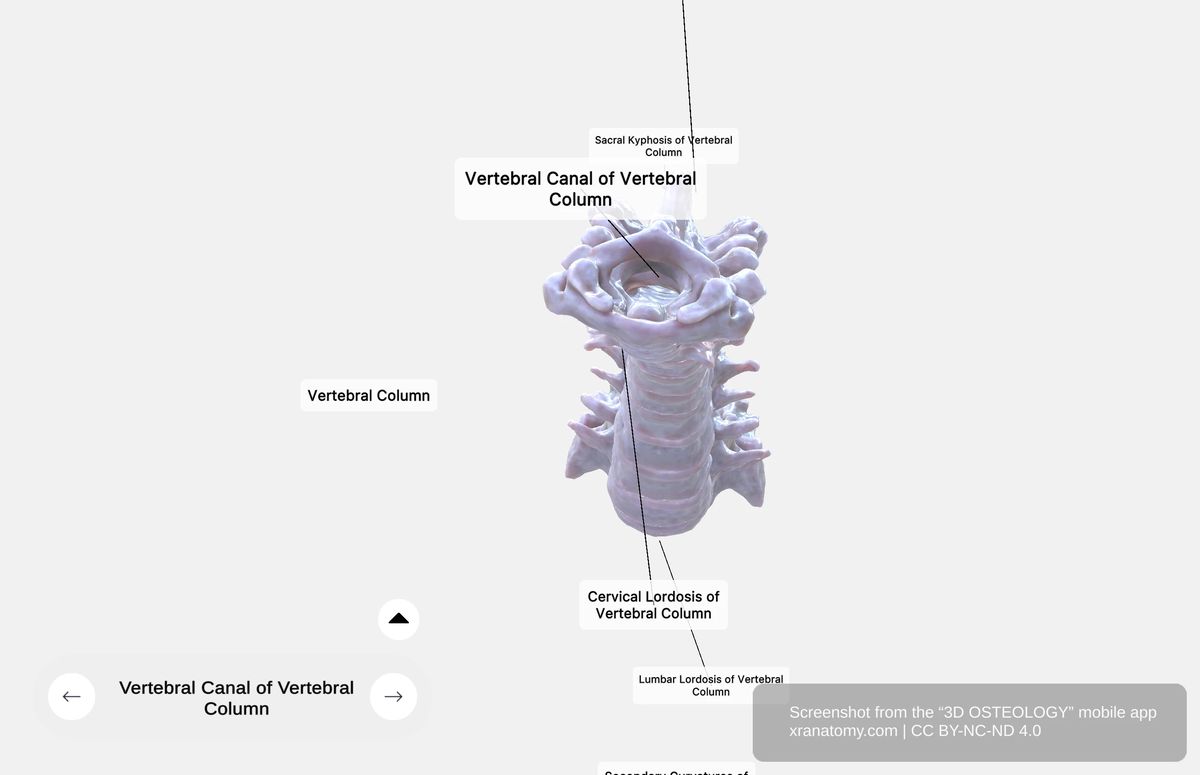
The vertebral canal is a hollow tube formed by the alignment of vertebral foramina, extending from the foramen magnum to the sacral hiatus. It houses and protects your spinal cord, meninges, and cerebrospinal fluid.
The canal is not uniform in size. It is wider in the cervical and lumbar regions where large groups of nerves branch out to supply your limbs. It narrows in the thoracic region where fewer nerves exit. This variation matches the functional demands of each spinal level.
1. The spine has four curvatures. Name the two you were born with and the two you developed after birth.
Born with: thoracic kyphosis and sacral kyphosis (primary). Developed: cervical lordosis and lumbar lordosis (secondary).
2. The vertebral canal is wider in the cervical and lumbar regions than in the thoracic region. Why?
These regions have greater nerve distribution. The cervical enlargement supplies the upper limbs and the lumbar enlargement supplies the lower limbs, so the canal widens to accommodate them.
3. A newborn's spine has only _______ curvatures. The two secondary curvatures develop when the infant begins to _______ and _______.
Primary curvatures. Hold their head up (cervical lordosis) and walk (lumbar lordosis).
Now that you understand the vertebral column as a whole, the next page zooms into a single vertebra. You will explore the vertebral body, arch, foramen, and processes that make up each individual bone in your spine.
Review this page again in 3 days to reinforce what you have learned.
BIBLIOGRAPHY
1. Henry G, Warren HL. Osteology. In: Anatomy of the Human Body. 20th ed. Philadelphia: Lea & Febiger; 1918. p. 129–97.
2. Standring S, editor. Gray's Anatomy: The Anatomical Basis of Clinical Practice. 41st ed. London: Elsevier; 2016.
3. Moore KL, Agur AMR, Dalley AF. Essential Clinical Anatomy. 5th ed. Philadelphia: Wolters Kluwer; 2015.