STERNUM ANATOMY
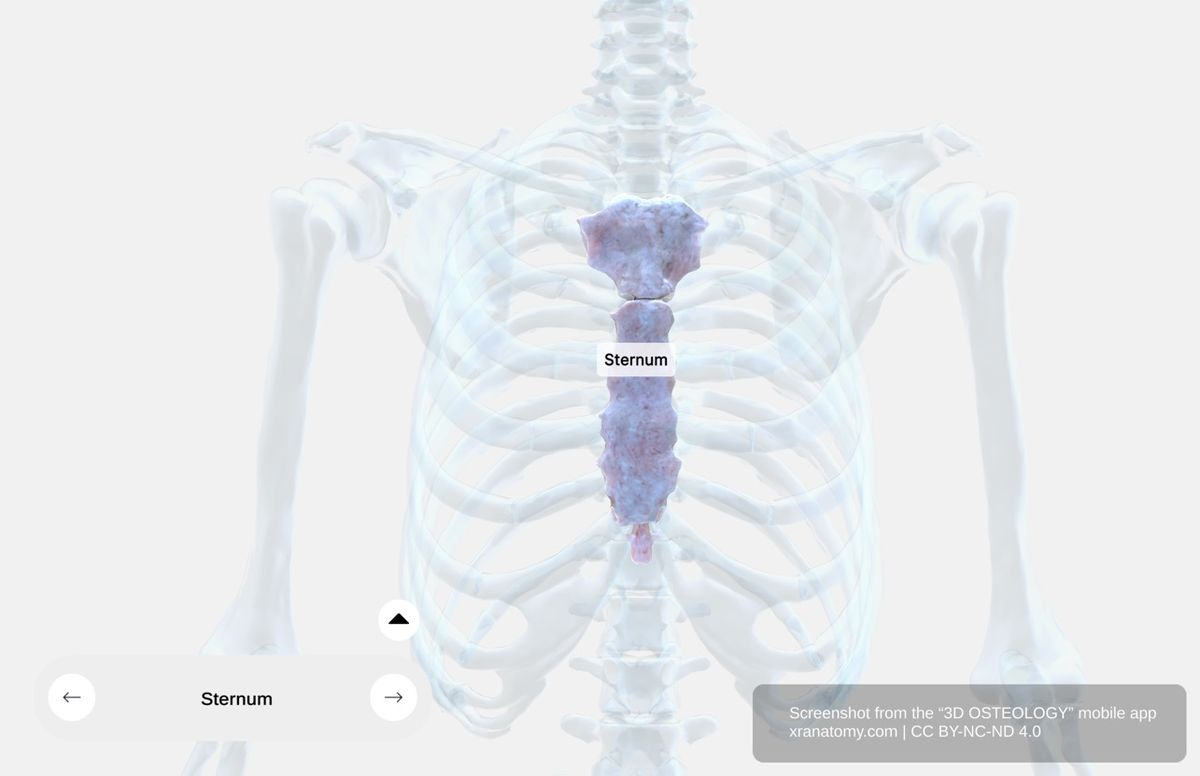
Sternum - General Structure, Preview from the app. Download 3D OSTEOLOGY for full 3D control—multiple views, x-ray mode, and unlimited zoom.
WHY THIS MATTERS
The sternum sits at the center of your anterior chest wall and protects your heart, lungs, and major blood vessels. It connects your clavicles and your first seven ribs, making it a central anchor point for your entire thoracic cage. Understanding its three parts and key landmarks helps you navigate the anatomy of your chest.
GENERAL CHARACTERISTICS
The sternum (breastbone) is a long, flat bone located in the center of your anterior thoracic wall. It is divided into three parts: the manubrium, body, and xiphoid process.
The sternum protects vital organs including your heart, lungs, and major blood vessels. It supports your respiratory movements by serving as a stable attachment point for your ribs. It also contributes to the flexibility and functionality of your thoracic cage.
MANUBRIUM
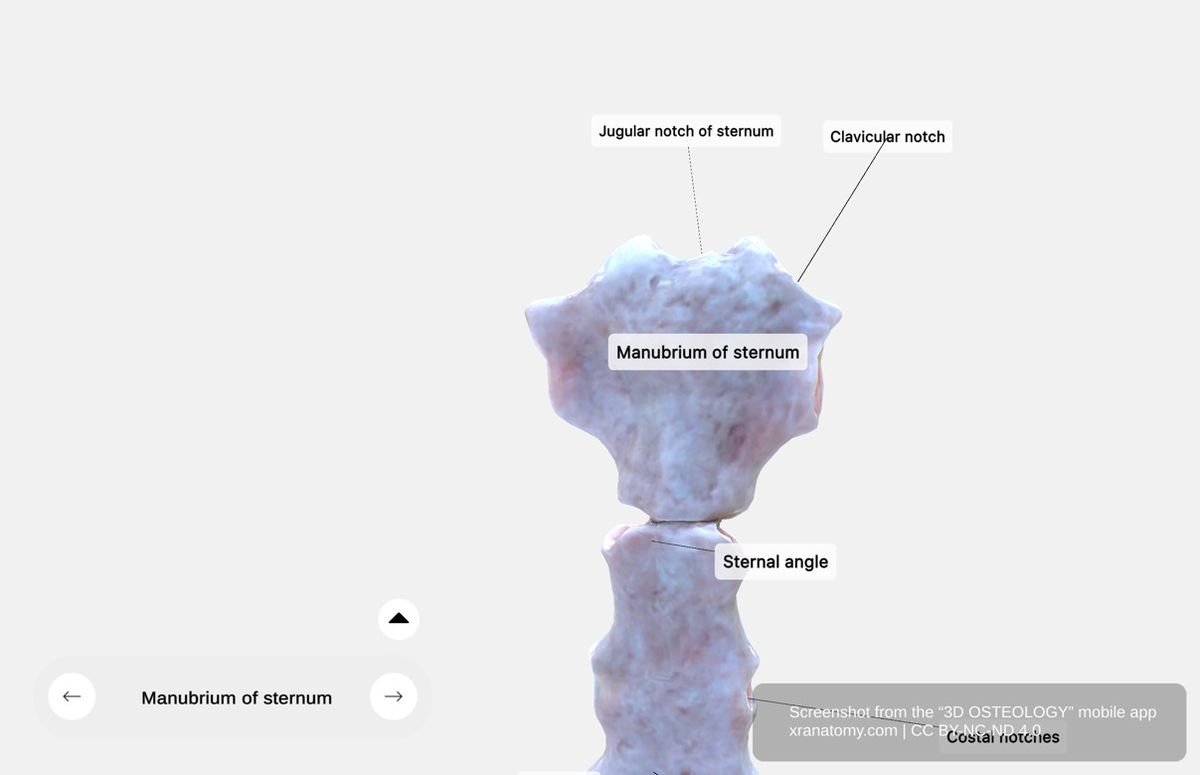
Manubrium of the Sternum, Preview from the app. Download 3D OSTEOLOGY for full 3D control—multiple views, x-ray mode, and unlimited zoom.
The manubrium is the upper section of the sternum, characterized by its quadrangular shape. It is wider and thicker at the top and gradually narrows toward the bottom. The manubrium connects with your clavicles and the first two pairs of ribs, providing structural support and facilitating your upper limb movement. Its key landmarks include the clavicular notches, the jugular notch, and the sternal angle.
Clavicular Notches
The clavicular notches are oval-shaped surfaces on the upper edge of the manubrium. They facilitate the joining of the manubrium with your clavicles and allow for your upper limb movement.
Jugular Notch
The jugular notch is a central dip at the top of the manubrium. It sits between the points where your clavicles meet the sternum and serves as an important anatomical landmark.
Sternal Angle
The sternal angle, also called the Angle of Louis, is a prominent ridge at the junction of the manubrium and the body of the sternum. It runs horizontally across your chest and serves as a key reference point for anatomical examination.
STERNAL BODY
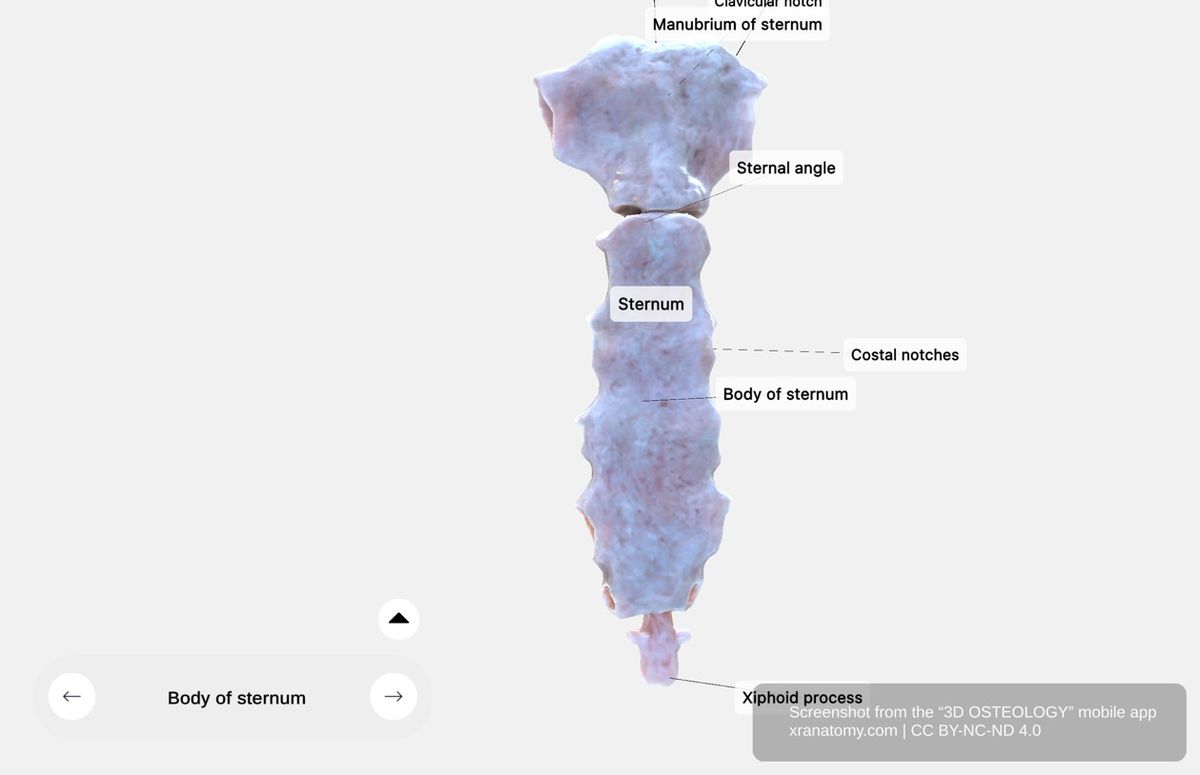
Body of the Sternum, Preview from the app. Download 3D OSTEOLOGY for full 3D control—multiple views, x-ray mode, and unlimited zoom.
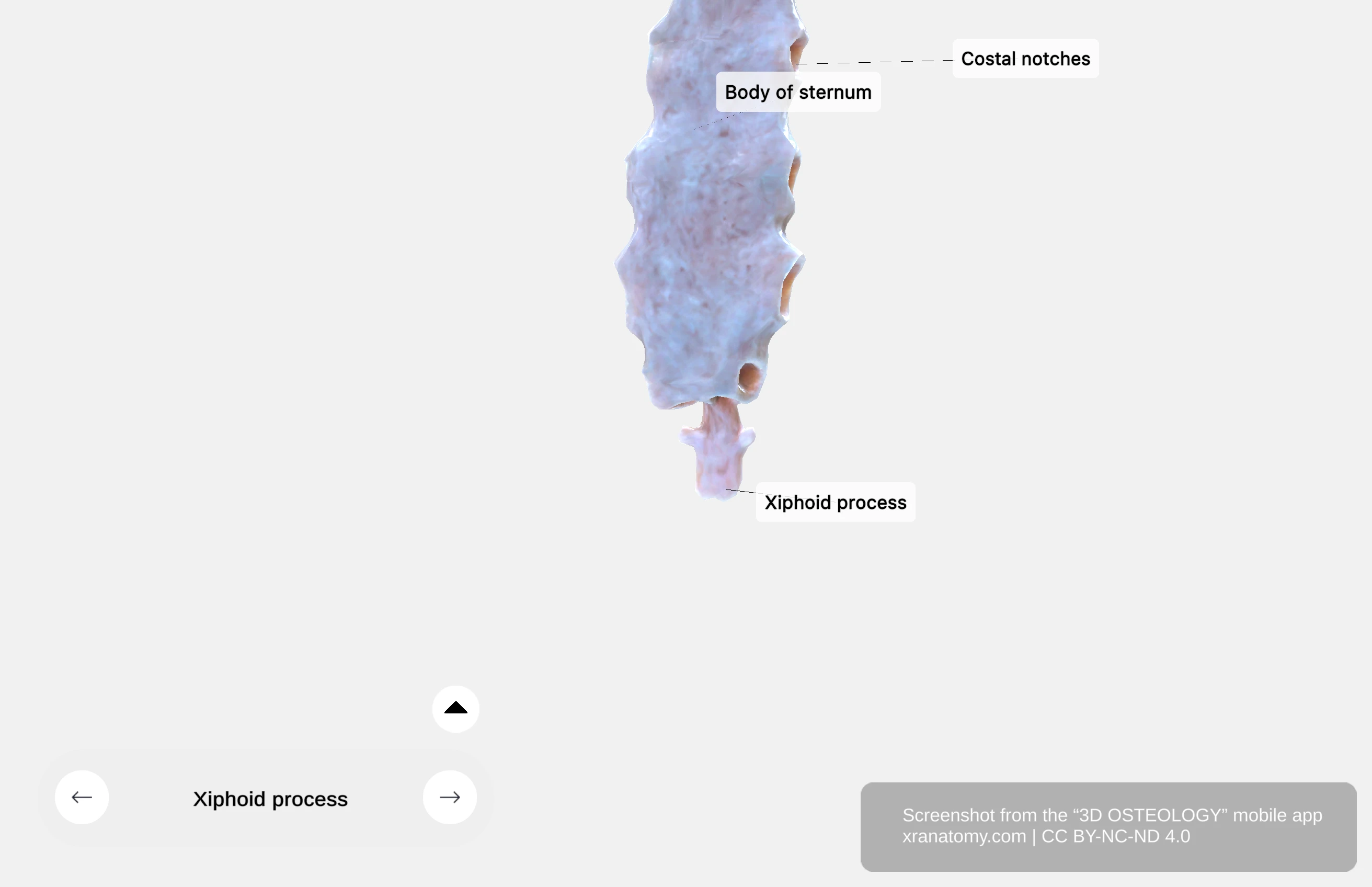
The sternal body is the elongated, thinner section located below the manubrium, extending down to the xiphoid process. It serves as a crucial attachment point for your third to seventh ribs via costal cartilages. The sternal body plays a key role in forming your thoracic cage and supporting your respiratory movements. It contributes to the overall stability and flexibility of your thoracic wall. Its main feature is the costal notches along its sides.
Costal Notches
The costal notches are indentations along the sides of the sternum. They provide attachment points for your rib cartilages and form a stable connection between your ribs and the sternum.
XIPHOID PROCESS
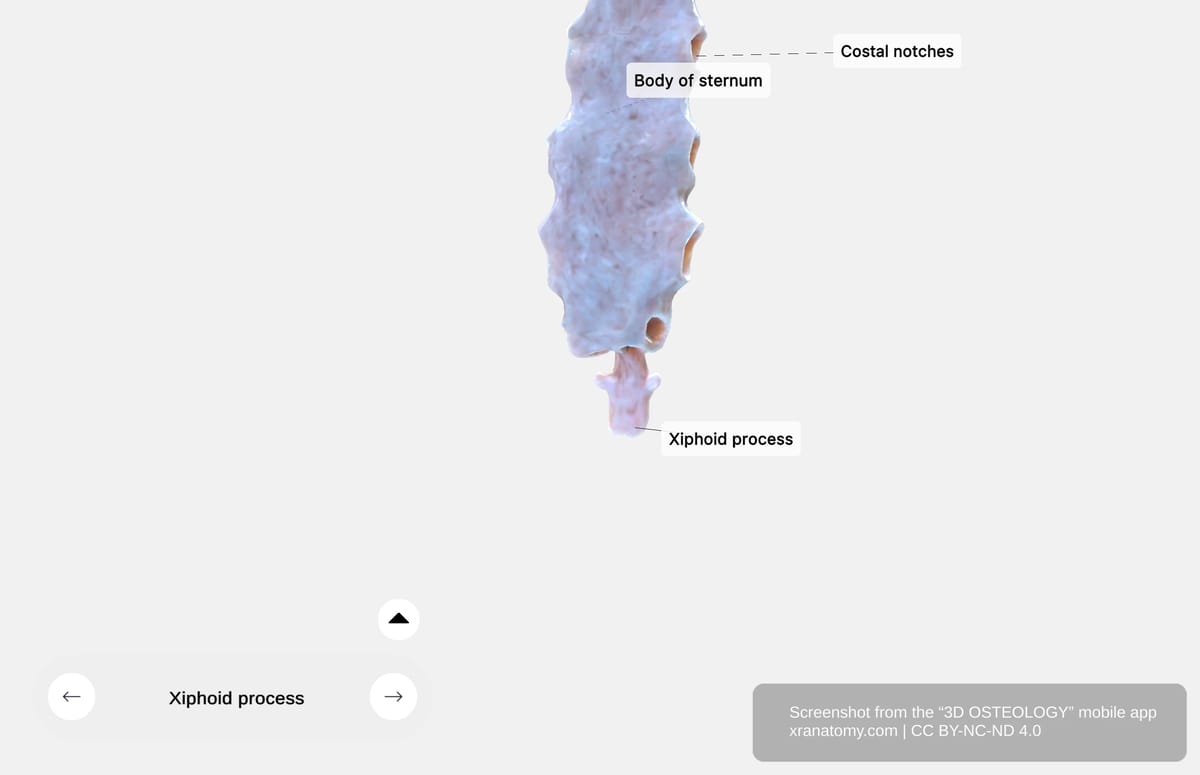
The xiphoid process is the smallest and most variable part of the sternum. It sits at the lowest point of the sternum. The xiphoid process is initially cartilaginous and ossifies with age to become rigid in adulthood.
CHECK YOUR UNDERSTANDING
1. What are the three parts of the sternum?
Reveal Answer
The manubrium (upper), body (middle), and xiphoid process (lower).
2. What is the sternal angle, and what is it also called?
Reveal Answer
The sternal angle is a prominent ridge at the junction of the manubrium and the body of the sternum. It is also called the Angle of Louis and serves as a key reference point for anatomical examination.
3. Which ribs attach to the sternal body?
Reveal Answer
The third to seventh ribs attach to the sternal body via costal cartilages at the costal notches.
WHAT'S NEXT
Now that you have studied the sternum, the next page covers the Bones of the Upper Limb. You will explore the pectoral girdle (scapula and clavicle) and the free upper limb bones (humerus, radius, ulna, and hand).
Review this page again in 3 days to reinforce what you have learned.
BIBLIOGRAPHY
1. Henry G, Warren HL. Osteology. In: Anatomy of the Human Body. 20th ed. Philadelphia: Lea & Febiger; 1918. p. 129–97.
2. Standring S, editor. Gray's Anatomy: The Anatomical Basis of Clinical Practice. 41st ed. London: Elsevier; 2016.
3. Moore KL, Agur AMR, Dalley AF. Essential Clinical Anatomy. 5th ed. Philadelphia: Wolters Kluwer; 2015.