BONES OF THE UPPER LIMB
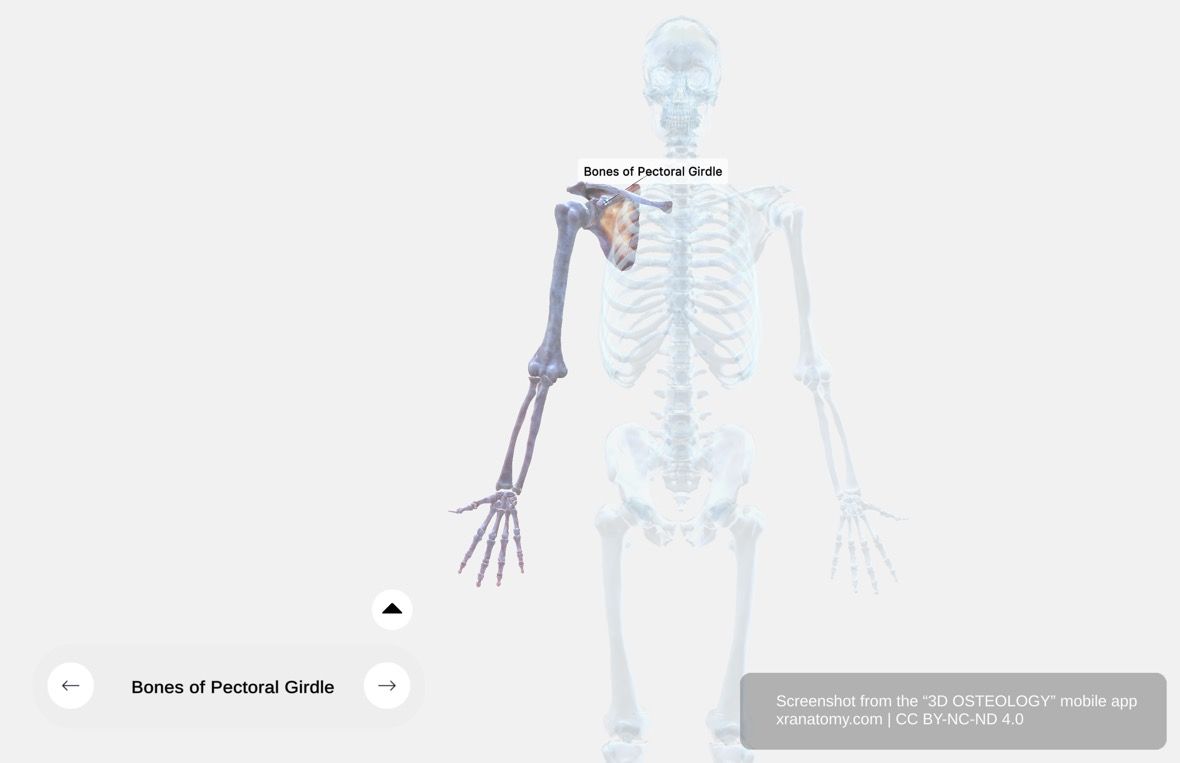
Bones of the Upper Limb - Pectoral Girdle Overview, Preview from the app. Download 3D OSTEOLOGY for full 3D control—multiple views, x-ray mode, and unlimited zoom.
WHY THIS MATTERS
Your upper limb bones form two main groups that work together to connect your arm to your trunk and enable everything from lifting to fine motor skills. The pectoral girdle anchors your limb, while the free upper limb bones give you reach and dexterity from shoulder to fingertip.
OVERVIEW
Your upper limb comprises two main bone groups: the pectoral girdle and the free part of the upper limb. The pectoral girdle includes the scapula and clavicle, which connect your limb to the trunk and provide support for your arm mobility. The free part of the upper limb consists of the humerus in your upper arm, the radius and ulna in your forearm, and the bones of your hand, including the carpal bones, metacarpals, and phalanges.
SHOULDER GIRDLE (PECTORAL GIRDLE)
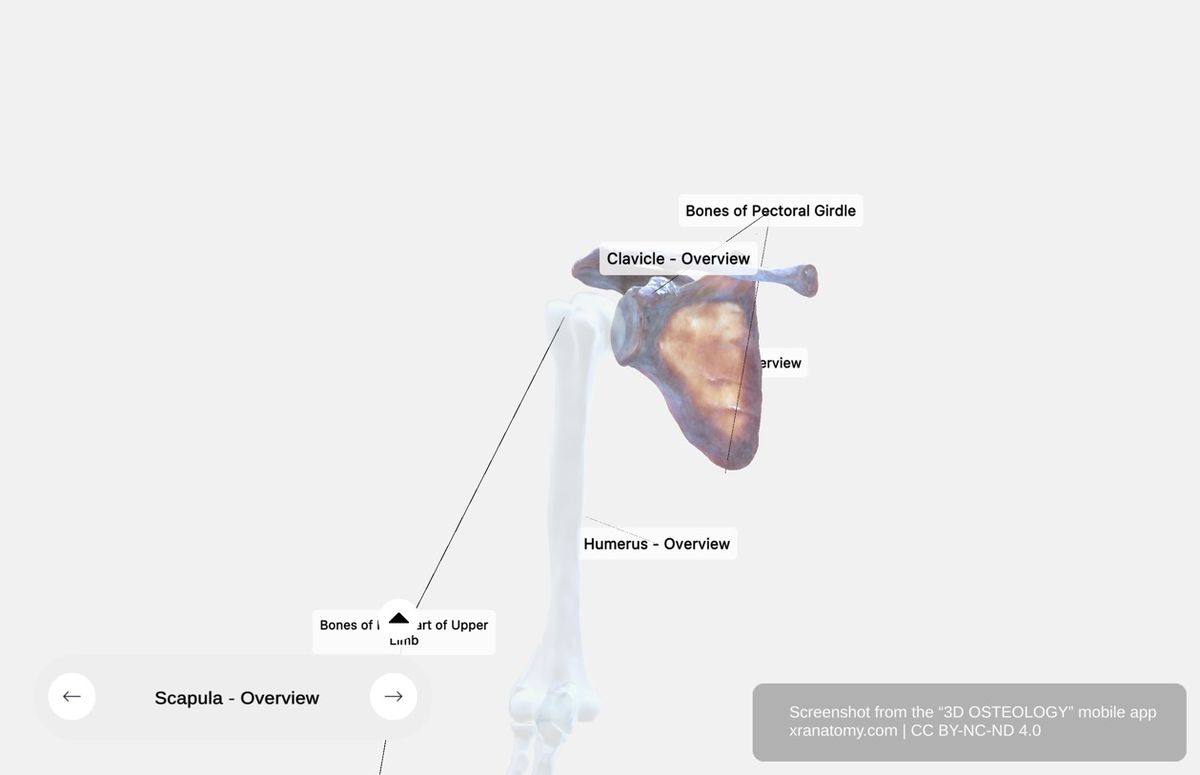
Shoulder Girdle, Preview from the app. Download 3D OSTEOLOGY for full 3D control—multiple views, x-ray mode, and unlimited zoom.
Your shoulder girdle consists of two bones: the scapula (shoulder blade) and the clavicle (collarbone). Together they connect your upper limb to your trunk and provide support for your arm mobility.
Scapula
The scapula is a flat, triangular bone. It features two broad surfaces with unique borders and angles. Its lateral angle forms the glenoid cavity, which is the socket for the humerus, creating your shoulder joint.
Clavicle
The clavicle is a slender, S-shaped bone lying horizontally across your chest. It articulates medially with the manubrium of the sternum and extends laterally to connect with the acromion of the scapula. The clavicle functions to keep your shoulder blade in place, allowing your arm mobility.
BONES OF THE FREE UPPER LIMB
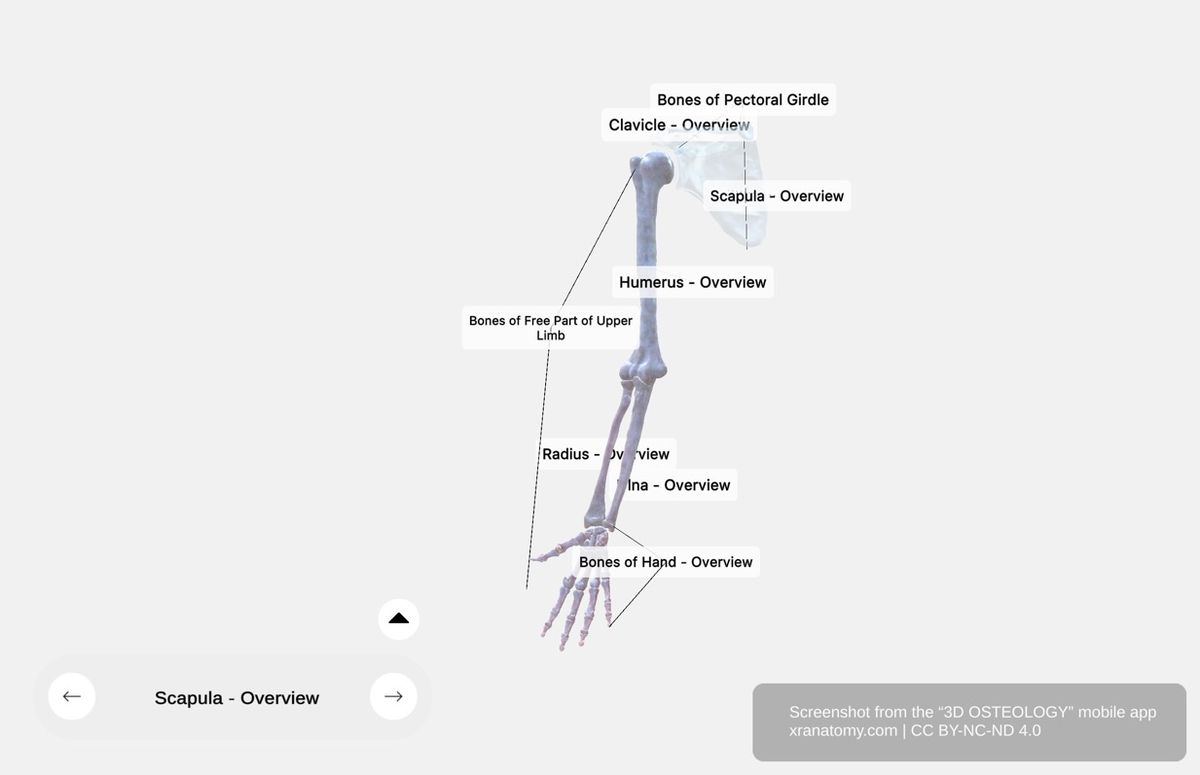
Bones of the Free Upper Limb, Preview from the app. Download 3D OSTEOLOGY for full 3D control—multiple views, x-ray mode, and unlimited zoom.
The free upper limb contains four main groups of bones. The humerus forms your upper arm. The radius and ulna run side by side in your forearm. The hand skeleton completes the limb with carpal bones, metacarpals, and phalanges.
Humerus
The humerus sits in your upper arm and is the longest and largest bone of your upper limb. It connects to the scapula at your shoulder joint and to the radius and ulna at your elbow joint.
Radius
The radius sits on the thumb side of your forearm. It has a large lower end with two joints: one articulating with your wrist bones and the other meeting with the ulna.
Ulna
The ulna runs parallel to the radius on the medial side of your forearm. It is larger at the upper end, forming a substantial portion of your elbow joint, and tapers to a smaller lower end. A triangular articular disc separates it from your wrist.
Hand Skeleton
Your hand skeleton has three sections. The carpal bones form your wrist, the metacarpal bones form your palm, and the phalanges are your finger bones.
CHECK YOUR UNDERSTANDING
1. What two bone groups make up your upper limb?
Reveal Answer
The pectoral girdle (scapula and clavicle) and the free part of the upper limb (humerus, radius, ulna, and hand bones).
2. Which bone is the longest and largest in your upper limb, and what joints does it connect?
Reveal Answer
The humerus. It connects to the scapula at the shoulder joint and to the radius and ulna at the elbow joint.
3. Name the three sections of the hand skeleton.
Reveal Answer
The carpal bones (wrist), metacarpal bones (palm), and phalanges (finger bones).
WHAT'S NEXT
Now that you have an overview of the upper limb bones, the next page takes a closer look at the Scapula. You will explore its costal and posterior surfaces, spine, acromion, coracoid process, glenoid cavity, borders, and angles in detail.
Review this page again in 3 days to reinforce what you have learned.
BIBLIOGRAPHY
1. Henry G, Warren HL. Osteology. In: Anatomy of the Human Body. 20th ed. Philadelphia: Lea & Febiger; 1918. p. 129–97.
2. Standring S, editor. Gray's Anatomy: The Anatomical Basis of Clinical Practice. 41st ed. London: Elsevier; 2016.
3. Moore KL, Agur AMR, Dalley AF. Essential Clinical Anatomy. 5th ed. Philadelphia: Wolters Kluwer; 2015.