SPHENOID BONE ANATOMY
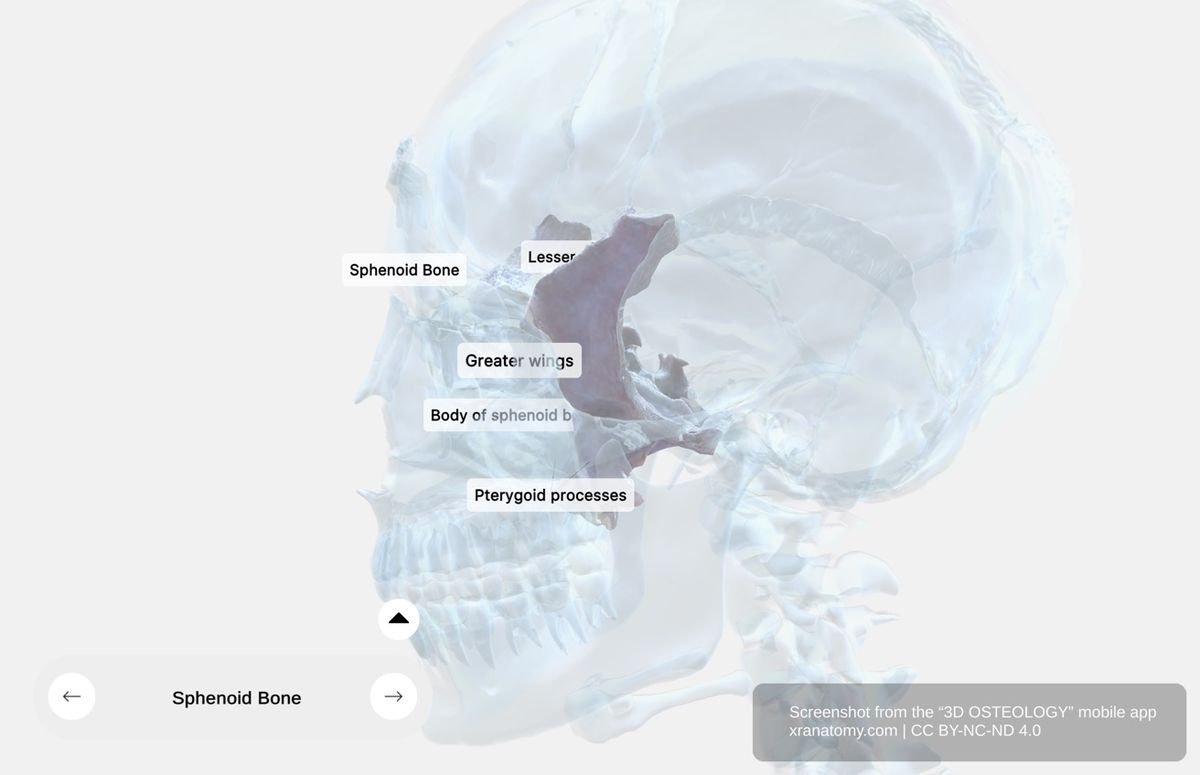
Sphenoid Bone - Structural Components, Preview from the app. Download 3D OSTEOLOGY for full 3D control—multiple views, x-ray mode, and unlimited zoom.
WHY THIS MATTERS
The sphenoid bone acts as a central wedge that unites your cranial and facial skeletons. Understanding its body, wings, and pterygoid processes helps you see how this single bone houses your pituitary gland, provides passage for critical cranial nerves and vessels, and articulates with all other cranial bones.
In-Depth AR Atlas Available
Read the comprehensive anatomy description with AR illustrations and videos
Read AR Atlas →GENERAL CHARACTERISTICS
The sphenoid is a complex cranial bone located at the base of the skull. It functions as a central wedge uniting the cranial and facial skeletons. The sphenoid articulates with 8 bones: the vomer, ethmoid, frontal, occipital, parietal, temporal, zygomatic, and palatine.
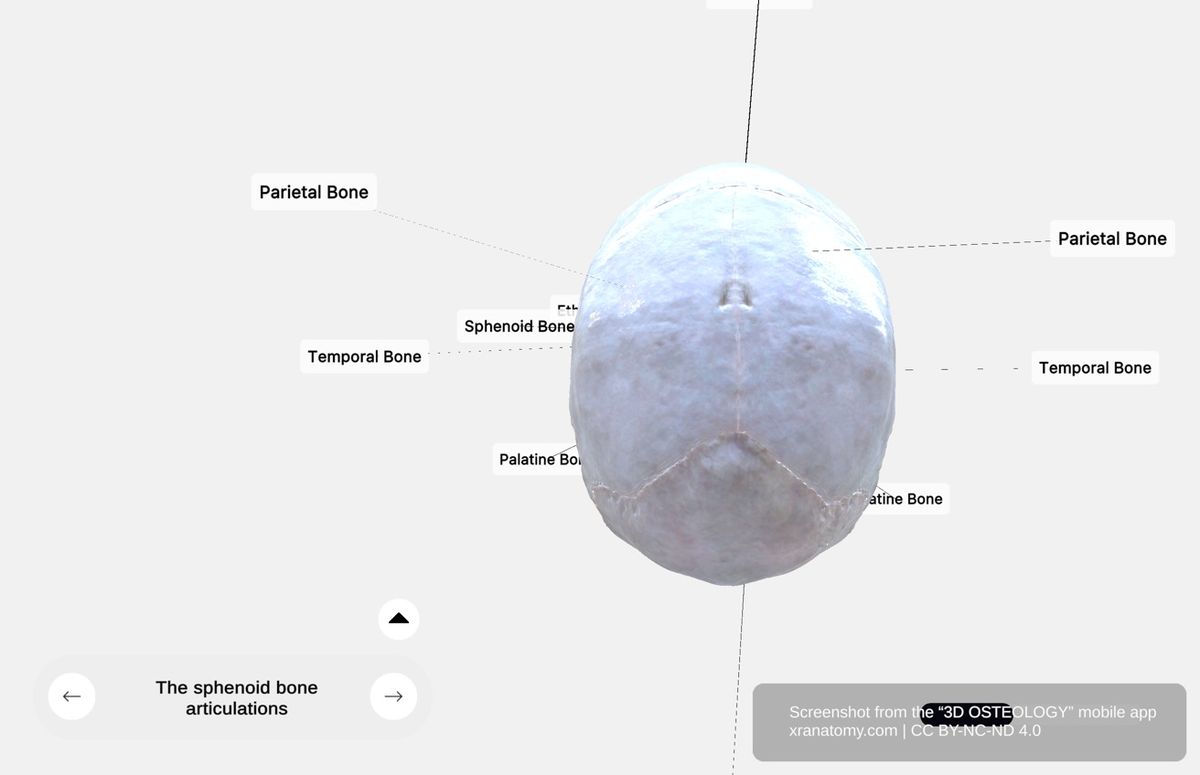
Sphenoid Bone - Articulations, Preview from the app. Download 3D OSTEOLOGY for full 3D control—multiple views, x-ray mode, and unlimited zoom.
Structural Components
The sphenoid consists of 4 structural components: a central body, two greater wings, two lesser wings, and two pterygoid processes.
Functional Significance
The sphenoid acts as a central wedge that unites the cranial and facial skeletons. It houses your pituitary gland within the sella turcica. It provides passage for critical cranial nerves and vessels through its multiple foramina. The sphenoid contributes to the anterior, middle, and lateral cranial fossae and supports the pterygoid muscles used in mastication.
BODY OF SPHENOID
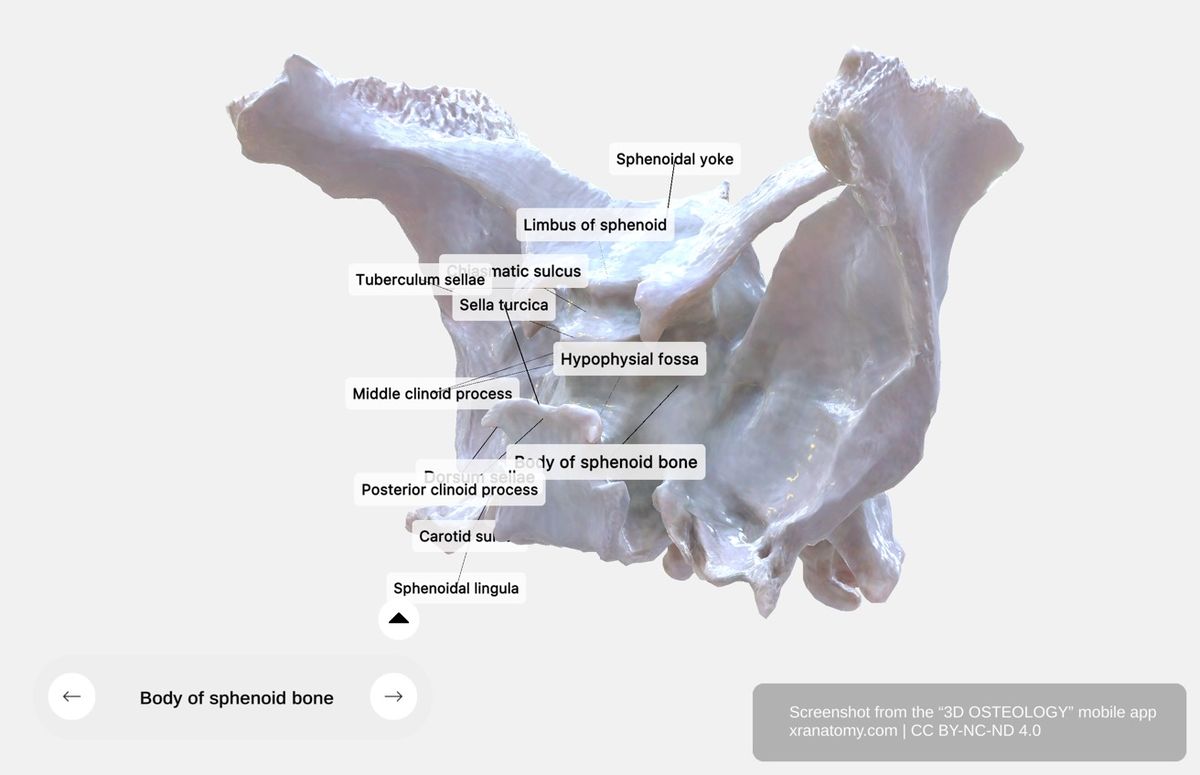
Body of Sphenoid Bone, Preview from the app. Download 3D OSTEOLOGY for full 3D control—multiple views, x-ray mode, and unlimited zoom.
The body of the sphenoid is the hollow cuboid-shaped central portion of the bone. Its key features span two regions: the superior surface (including the sphenoidal yoke, chiasmatic sulcus, sella turcica, and carotid sulcus), the anterior surface (including the sphenoidal crest and rostrum), and the sphenoidal sinuses within.
Superior Surface Features
The superior surface of the sphenoid body contains the sphenoidal yoke, limbus, chiasmatic sulcus, sella turcica, carotid sulcus, and sphenoidal lingula.
Sphenoidal Yoke
The sphenoidal yoke is an elevated midline region on the superior surface. It is the site where the lesser wings converge.
Limbus of Sphenoid
The limbus of sphenoid is the posterior boundary of the sphenoidal yoke.
Chiasmatic Sulcus
The chiasmatic sulcus is a horizontal groove located posterior to the limbus. It leads laterally to the optic canals, and the optic chiasm lies just above this sulcus.
Sella Turcica
The sella turcica is a saddle-shaped depression that houses your pituitary gland.
Hypophysial Fossa
The hypophysial fossa is the deepest portion of the sella turcica.
Tuberculum Sellae
The tuberculum sellae is the anterior boundary of the sella turcica.
Middle Clinoid Processes
The middle clinoid processes flank the tuberculum sellae bilaterally.
Dorsum Sellae
The dorsum sellae is the posterior wall of the sella turcica. It bears the posterior clinoid processes superiorly and provides dural attachment sites.
Carotid Sulcus
The carotid sulcus is a broad lateral groove that lodges your internal carotid artery and contains your cavernous sinus.
Sphenoidal Lingula
The sphenoidal lingula is a bony ridge that marks the lateral margin of the carotid sulcus.
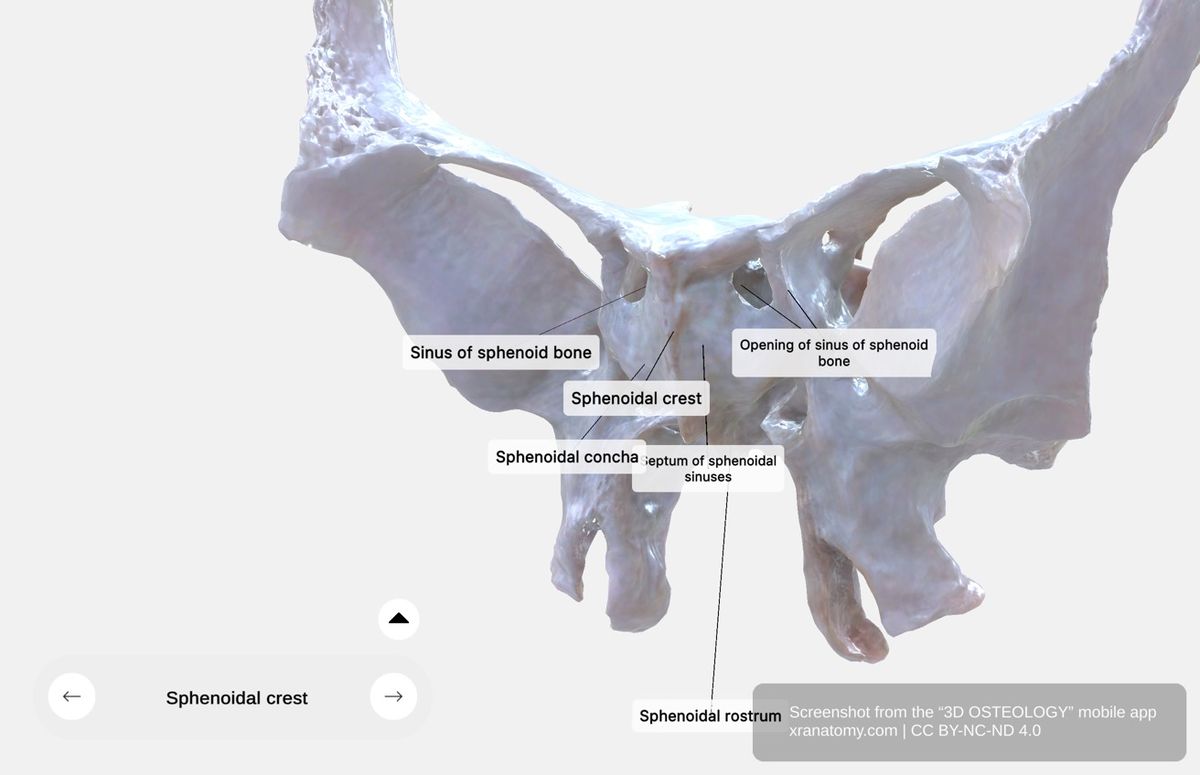
Body of Sphenoid - Anterior Surface, Preview from the app. Download 3D OSTEOLOGY for full 3D control—multiple views, x-ray mode, and unlimited zoom.
Anterior Surface Features
The anterior surface of the sphenoid body features the sphenoidal crest and the sphenoidal rostrum.
Sphenoidal Crest
The sphenoidal crest is a vertical midline ridge that articulates with the perpendicular plate of the ethmoid.
Sphenoidal Rostrum
The sphenoidal rostrum is an inferior extension of the crest that articulates with the vomer.
Sphenoidal Sinuses
The sphenoidal sinuses are two irregular cavities within the body, separated by a thin bony septum. They open into the nasal cavity via apertures beside the crest.
Sphenoidal Conchae
The sphenoidal conchae are thin curved bony plates that form part of the nasal cavity roof and contribute to the sinus walls.
LESSER WING
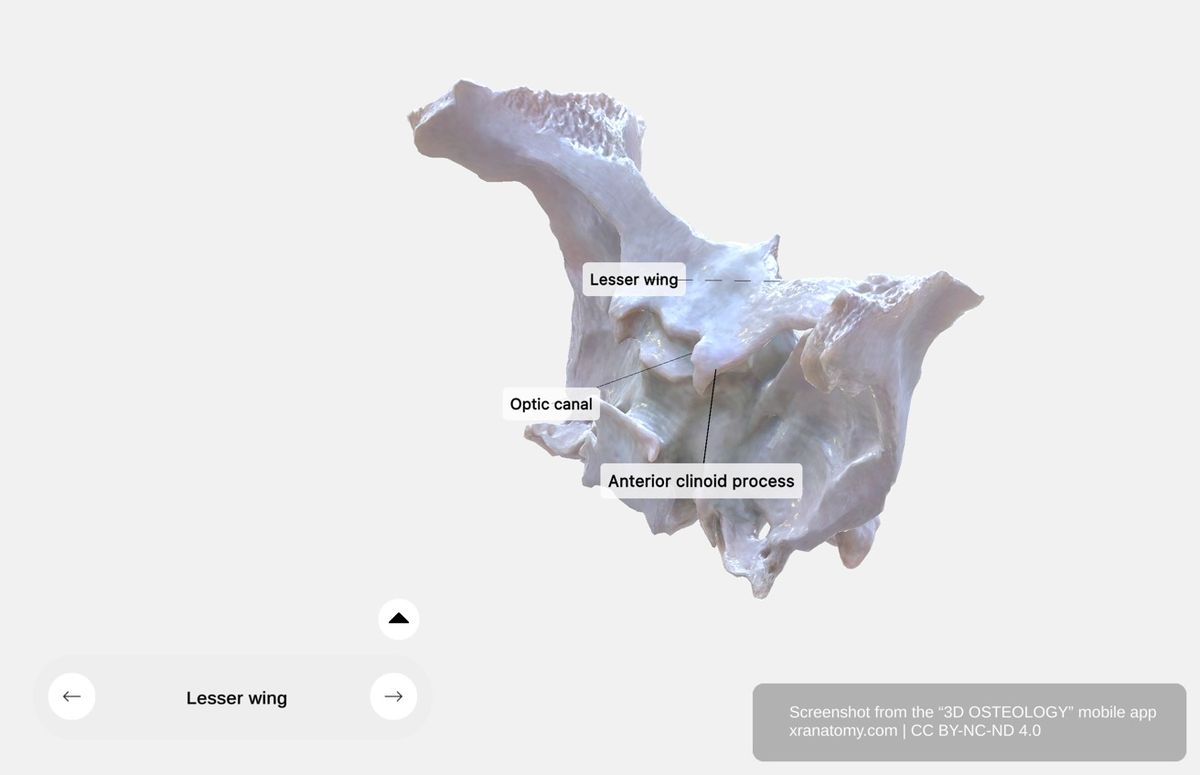
Lesser Wing of Sphenoid, Preview from the app. Download 3D OSTEOLOGY for full 3D control—multiple views, x-ray mode, and unlimited zoom.
The lesser wings are thin triangular plates extending laterally from the superior anterior part of the body. They contribute to the floor of the anterior cranial fossa and the posterior part of the orbital roof. Key features include the optic canal and the anterior clinoid processes.
Optic Canal
The optic canal is located at the base of the lesser wing. It transmits the optic nerve and the ophthalmic artery.
Anterior Clinoid Processes
The anterior clinoid processes arise from the posterior border of the lesser wing medially. They serve as an attachment for the tentorium cerebelli, which separates the cerebrum from the cerebellum.
GREATER WING
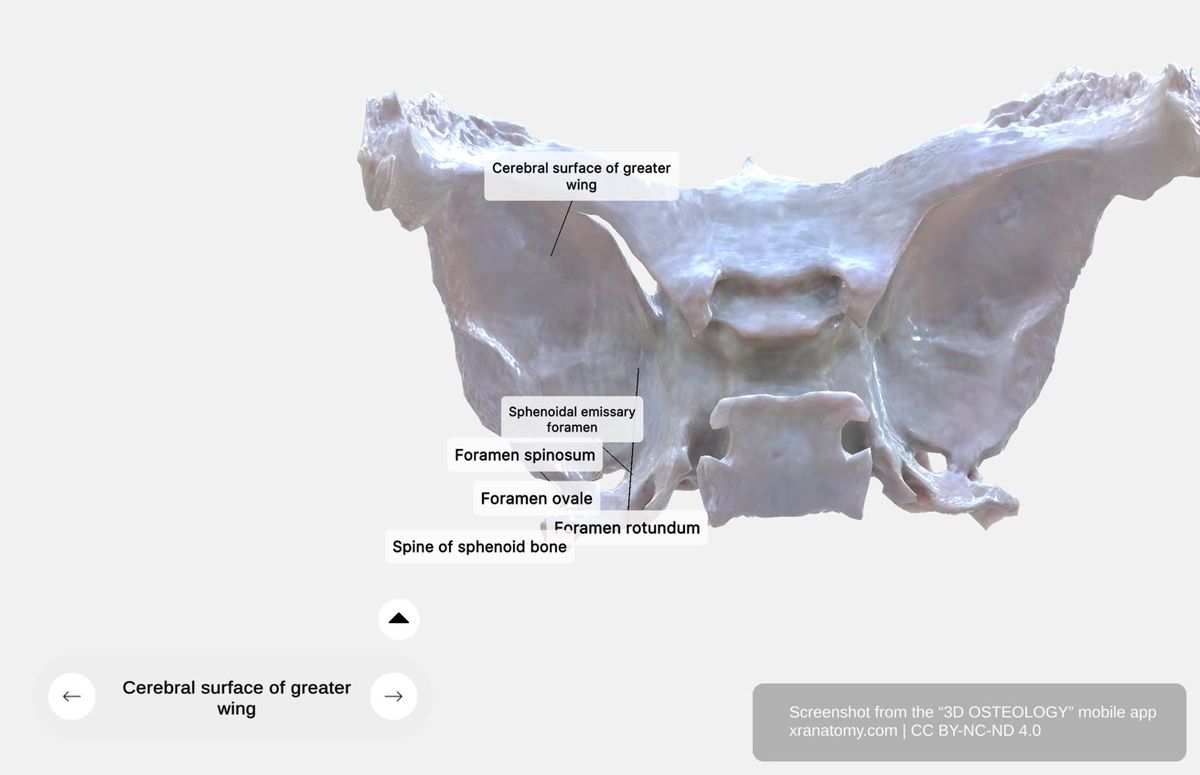
Greater Wing of Sphenoid, Preview from the app. Download 3D OSTEOLOGY for full 3D control—multiple views, x-ray mode, and unlimited zoom.
The greater wings are strong curved extensions from the lateral body. They contribute to the middle cranial fossa floor, the lateral skull wall, and the orbital lateral wall. The greater wing contains several foramina, multiple surfaces, and distinct margins and articulations.
Foramina
The greater wing contains several foramina: the foramen rotundum, foramen ovale, foramen spinosum, and the occasionally present sphenoidal emissary foramen and foramen petrosum.
| Foramen | Transmits | Notes |
|---|---|---|
| Foramen Rotundum | Maxillary nerve | |
| Foramen Ovale | Mandibular nerve | Also transmits accessory meningeal artery |
| Foramen Spinosum | Middle meningeal artery | |
| Sphenoidal Emissary Foramen | Emissary veins | Occasionally present |
| Foramen Petrosum | Lesser petrosal nerve | Occasionally present |
Spine of Sphenoid
The spine of sphenoid is located posterolateral to the foramen spinosum. It provides ligament attachment.
Sulcus of Auditory Tube
The sulcus of the auditory tube runs along the posterior margin laterally. It provides attachment for your cartilaginous auditory tube.
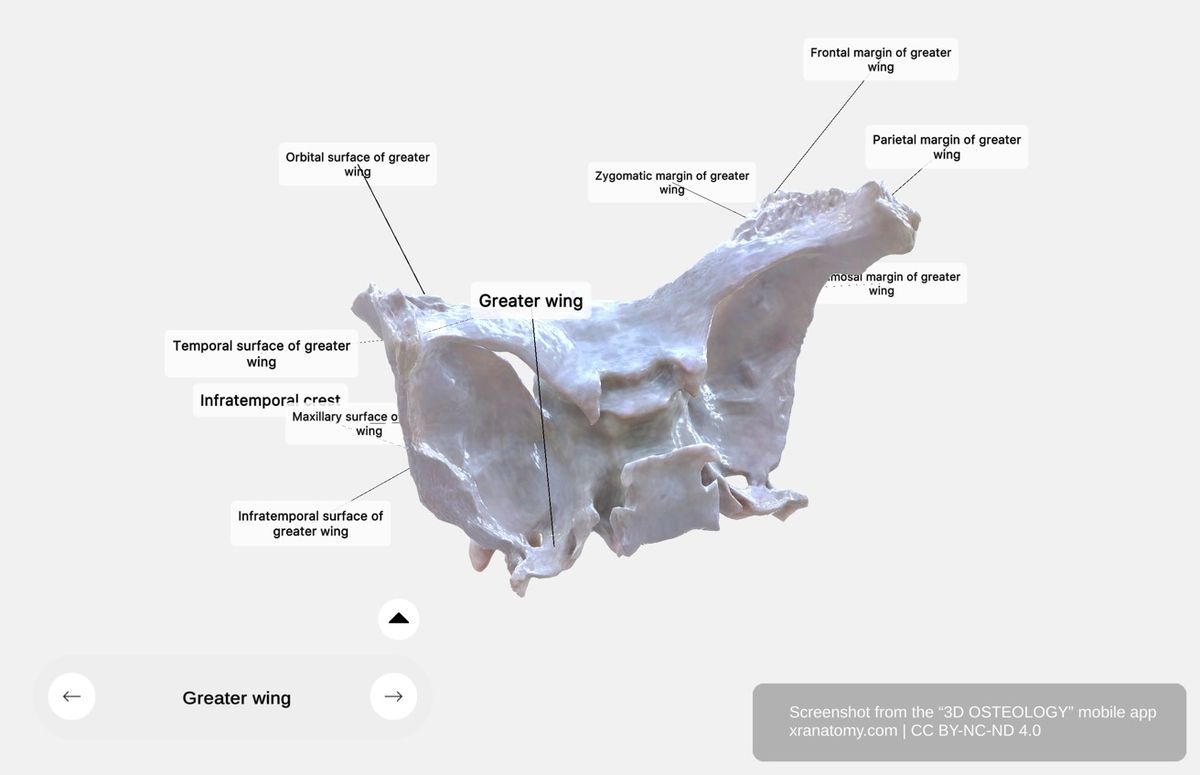
Greater Wing - Surfaces and Margins, Preview from the app. Download 3D OSTEOLOGY for full 3D control—multiple views, x-ray mode, and unlimited zoom.
Surfaces
The greater wing has 4 surfaces: the temporal surface, infratemporal surface, orbital surface, and cerebral surface.
The lateral surface is divided by the infratemporal crest. The temporal surface is the superior portion, forming part of the temporal fossa. The infratemporal surface is the inferior portion of the lateral surface, forming part of the infratemporal fossa.
The orbital surface is smooth and forms the lateral orbital wall. The cerebral surface is the superior aspect, forming the middle cranial fossa floor.
Margins and Articulations
The greater wing has 4 margins: the zygomatic margin, frontal margin, parietal margin, and squamosal margin.
| Margin | Articulates With |
|---|---|
| Zygomatic Margin | Zygomatic bone |
| Frontal Margin | Frontal bone |
| Parietal Margin | Parietal bone |
| Squamosal Margin | Temporal bone |
PTERYGOID PROCESS
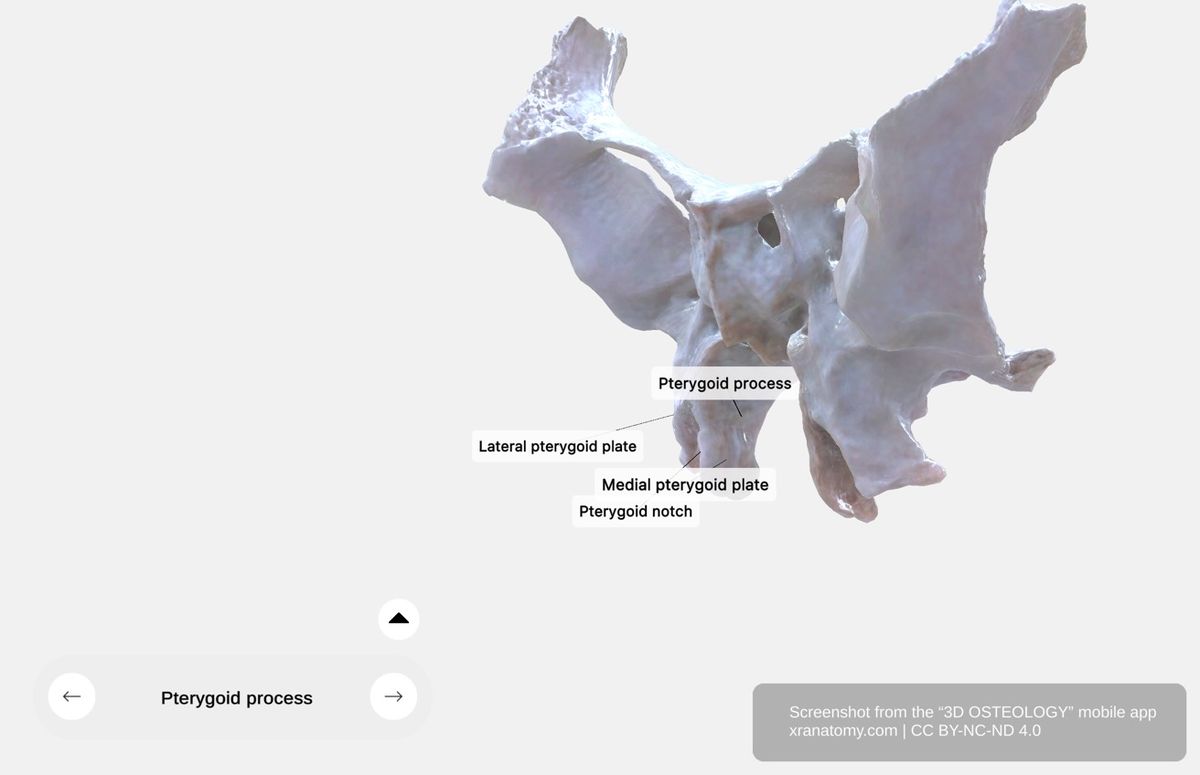
Pterygoid Process, Preview from the app. Download 3D OSTEOLOGY for full 3D control—multiple views, x-ray mode, and unlimited zoom.
The pterygoid processes extend inferiorly from the junction of the body and greater wings. Their plates are fused anteriorly. Key features include the lateral pterygoid plate, medial pterygoid plate, pterygoid hamulus, pterygoid notch, pterygoid fossa, and several posterior features.
Lateral Pterygoid Plate
The lateral pterygoid plate has two functional surfaces. Its lateral surface provides attachment for your lateral pterygoid muscle, and its medial surface provides attachment for your medial pterygoid muscle.
Medial Pterygoid Plate
The medial pterygoid plate contributes to the nasal cavity.
Pterygoid Hamulus
The pterygoid hamulus is a hook-like inferior projection of the medial pterygoid plate. It acts as a pulley for your tensor veli palatini tendon.
Pterygoid Notch
The pterygoid notch separates the lateral and medial plates inferiorly.
Pterygoid Fossa
The pterygoid fossa is located between the medial and lateral plates. It accommodates your soft palate muscles.
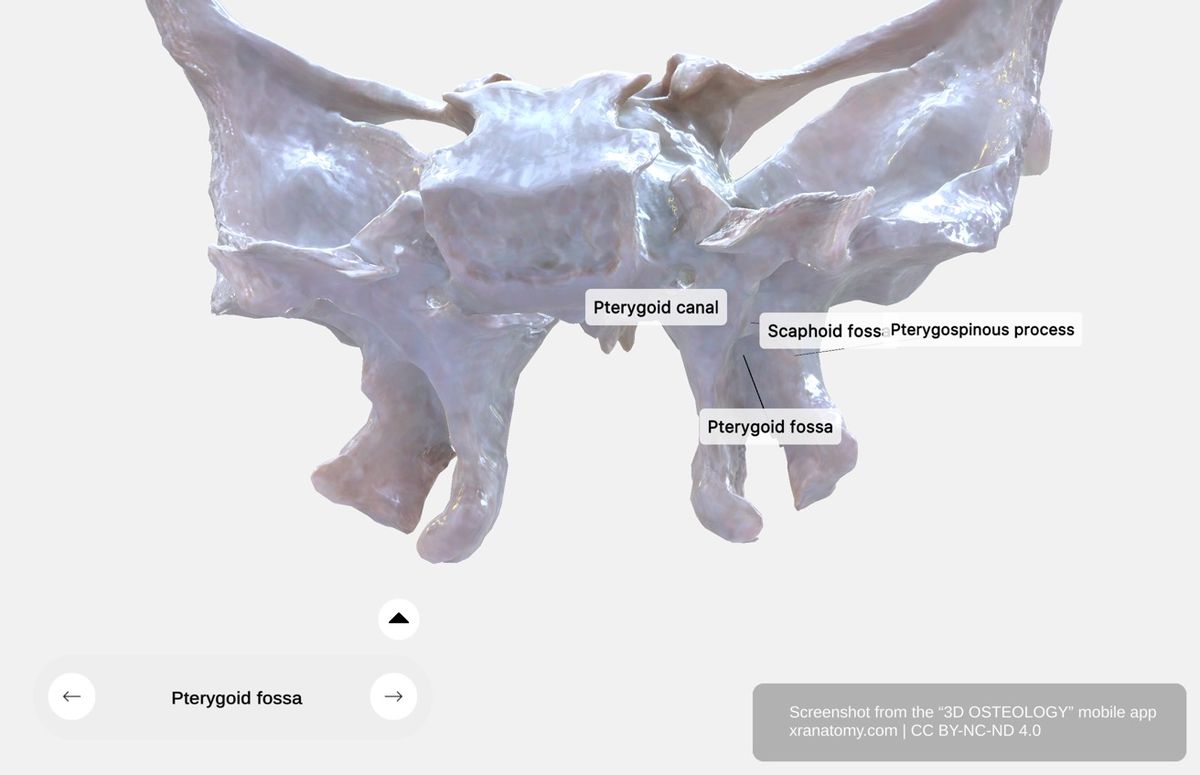
Pterygoid Process - Posterior View, Preview from the app. Download 3D OSTEOLOGY for full 3D control—multiple views, x-ray mode, and unlimited zoom.
Posterior Features
The posterior aspect of the pterygoid process features the scaphoid fossa, the pterygospinous process, and the pterygoid canal.
Scaphoid Fossa
The scaphoid fossa is located superior to the pterygoid fossa. It serves as the attachment site for your tensor veli palatini.
Pterygospinous Process
The pterygospinous process is a pointed projection located on the posterior border of the lateral plate. It may ossify to form a ligament.
Pterygoid Canal
The pterygoid canal traverses the base of the process. It transmits the nerve of the pterygoid canal and the artery of the pterygoid canal.
VAGINAL PROCESS
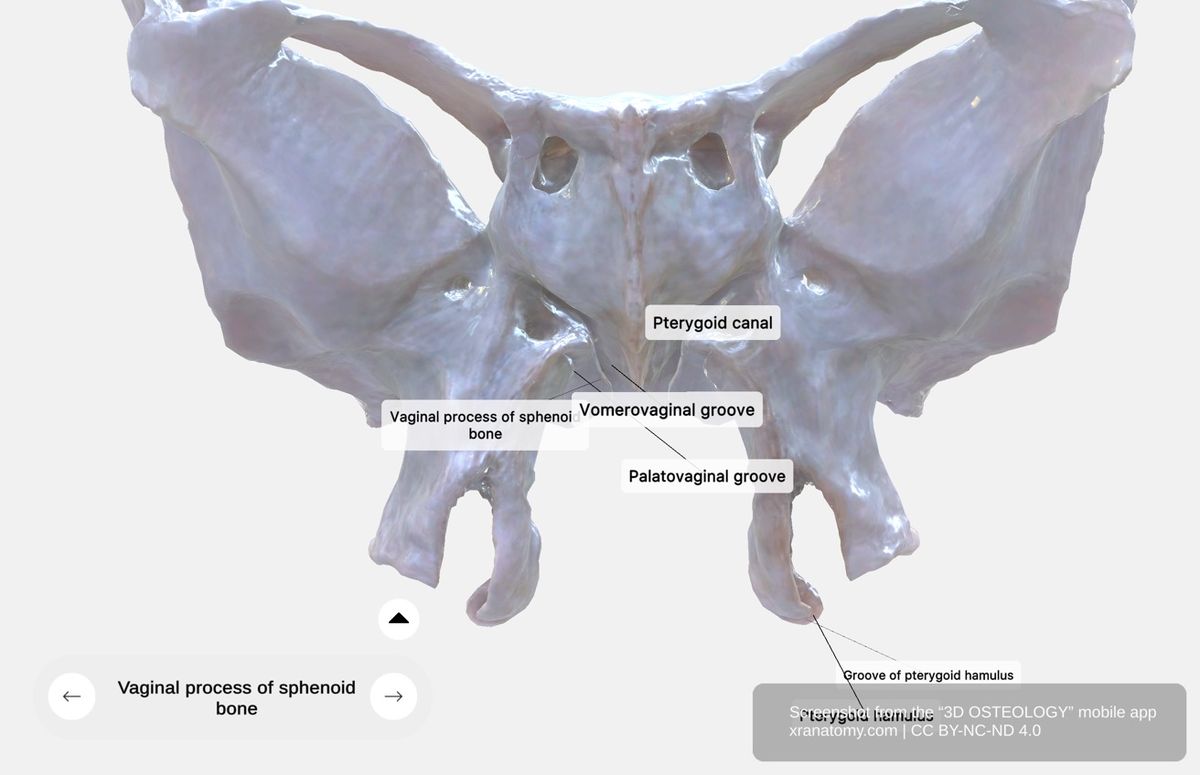
Vaginal Process of Sphenoid, Preview from the app. Download 3D OSTEOLOGY for full 3D control—multiple views, x-ray mode, and unlimited zoom.
The vaginal processes are small bony projections flanking the sphenoidal rostrum. They articulate with the sphenoidal process of the palatine bone and the ala of the vomer. Associated with these processes are two canals: the palatovaginal canal and the vomerovaginal canal.
Associated Canals
Palatovaginal Canal
The palatovaginal canal is formed with the palatine bone. It is derived from the palatovaginal groove. This canal transmits the pharyngeal nerve and pharyngeal vessels.
Vomerovaginal Canal
The vomerovaginal canal is formed with the vomer. It is derived from the vomerovaginal groove.
CHECK YOUR UNDERSTANDING
1. What are the four structural components of the sphenoid bone?
Reveal Answer
A central body, two greater wings, two lesser wings, and two pterygoid processes.
2. Name the three parts of the sella turcica from anterior to posterior.
Reveal Answer
The tuberculum sellae (anterior boundary), the hypophysial fossa (deepest portion), and the dorsum sellae (posterior wall).
3. Which structures pass through the foramen rotundum, foramen ovale, and foramen spinosum?
Reveal Answer
The foramen rotundum transmits the maxillary nerve. The foramen ovale transmits the mandibular nerve (and the accessory meningeal artery). The foramen spinosum transmits the middle meningeal artery.
WHAT'S NEXT
Next, explore the Ethmoid Bone, a delicate midline bone featuring the cribriform plate, perpendicular plate, ethmoidal labyrinth, nasal conchae, and crista galli, with 7 rotating 3D views.
Review this page again in 3 days to reinforce what you have learned.
BIBLIOGRAPHY
1. Henry G, Warren HL. Osteology. In: Anatomy of the Human Body. 20th ed. Philadelphia: Lea & Febiger; 1918. p. 129–97.
2. Standring S, editor. Gray's Anatomy: The Anatomical Basis of Clinical Practice. 41st ed. London: Elsevier; 2016.
3. Moore KL, Agur AMR, Dalley AF. Essential Clinical Anatomy. 5th ed. Philadelphia: Wolters Kluwer; 2015.