ROOT OF AORTA
In-Depth AR Atlas Available
Read the comprehensive anatomy description with AR illustrations and videos
Read AR Atlas →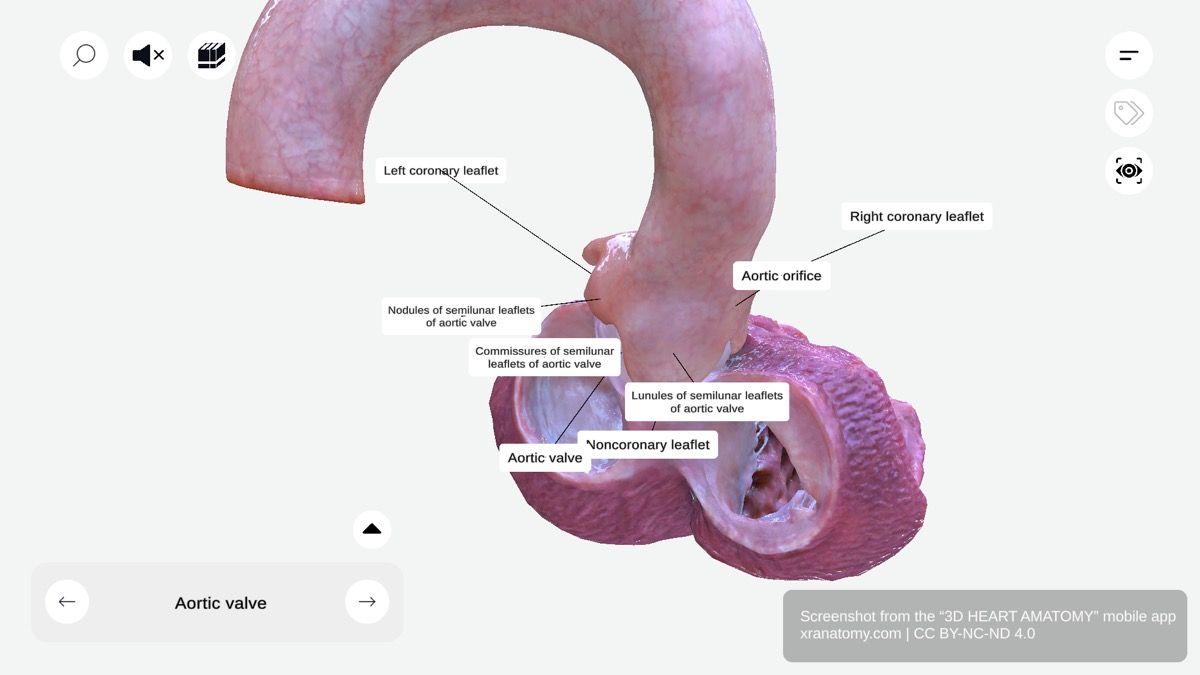
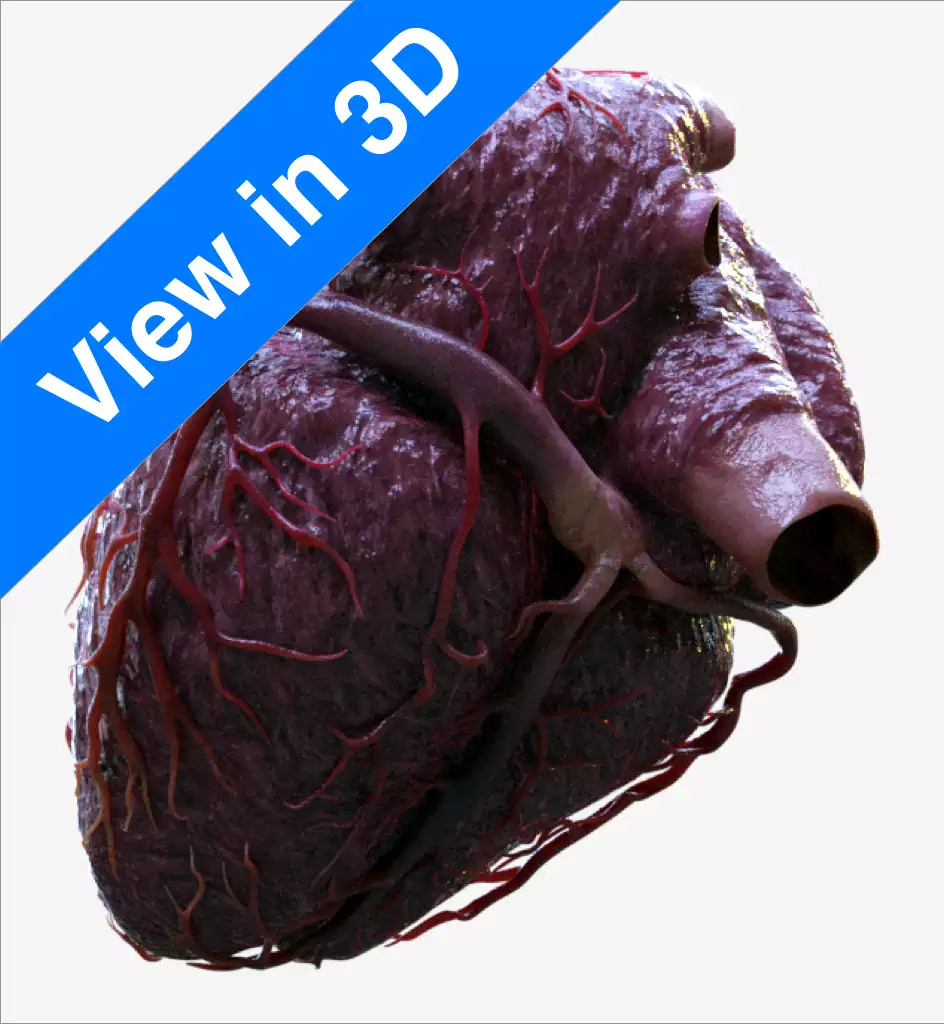
Root of Aorta - Overview, Preview from the app.
WHY THIS MATTERS
The aortic root is the gateway between your left ventricle and your entire systemic circulation. It houses the aortic valve, supports the coronary artery origins, and ensures that oxygen-rich blood flows forward into your aorta without leaking back. Understanding its components helps you see how your heart maintains efficient, one-directional blood flow to your body.
ROOT OF AORTA
The aortic root is the initial segment of the aorta emerging from your left ventricle. It encompasses a portion of the left ventricular outflow tract and supports your aortic valve leaflets. Its components include the aortic valve leaflets, sinuses of Valsalva, interleaflet triangles, and supravalvular ridge. The aortic root facilitates efficient blood flow into your systemic circulation.
AORTIC VALVE
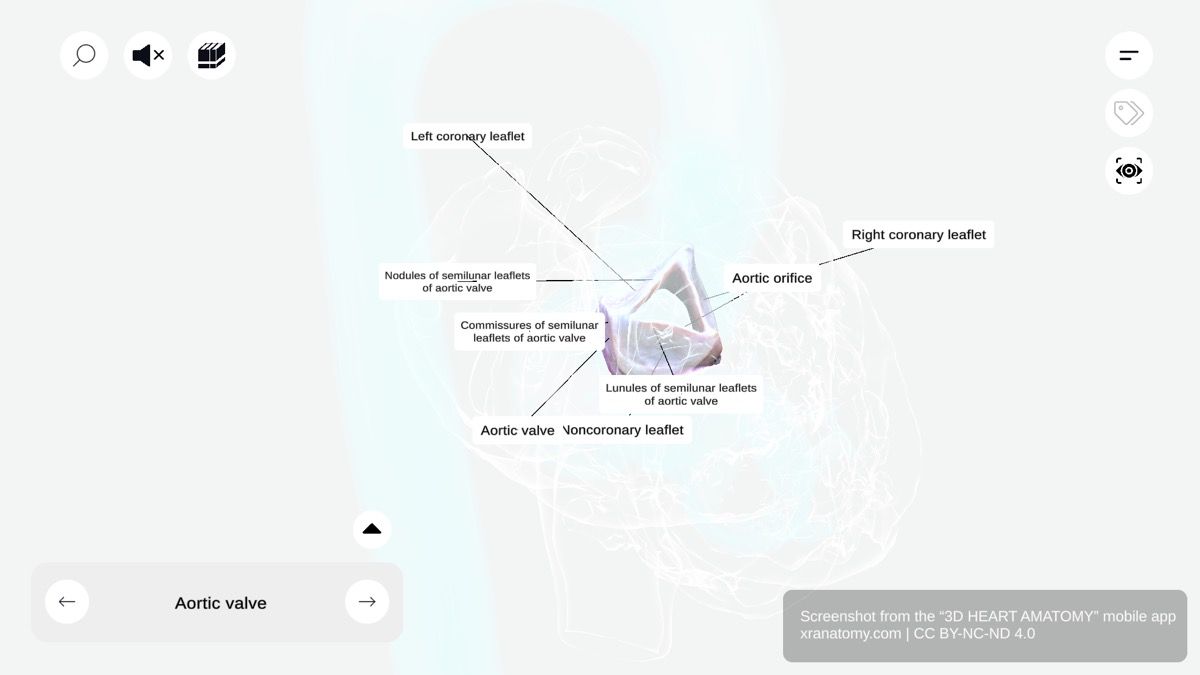
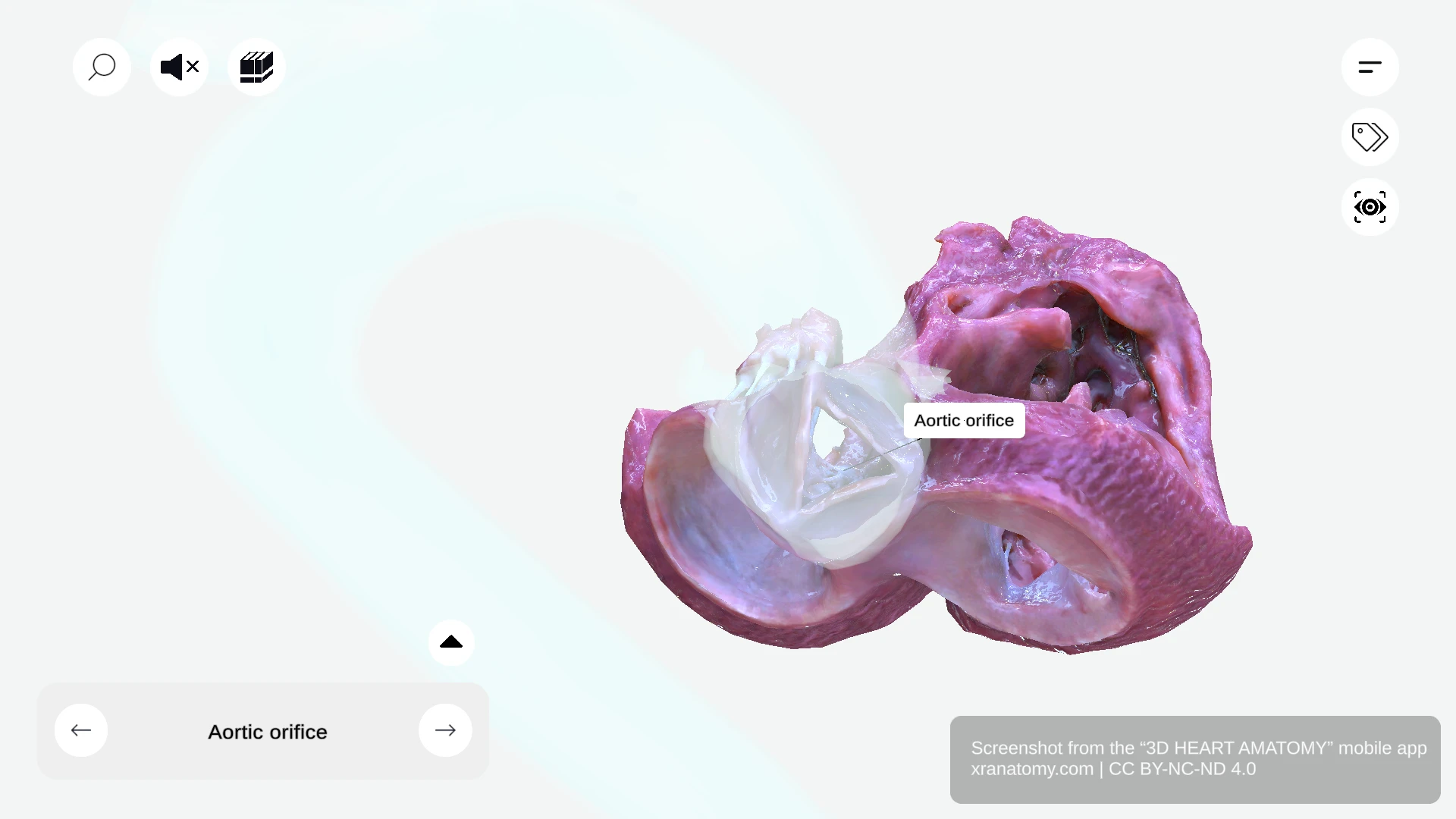
The aortic valve is a semilunar valve located between your left ventricle and the ascending aorta. It regulates blood flow from your heart into the aorta, delivering oxygen-rich blood to your body. During diastole, the valve prevents backflow into your left ventricle. It consists of three crescent-shaped leaflets: the right coronary leaflet, left coronary leaflet, and noncoronary leaflet.
AORTIC ORIFICE
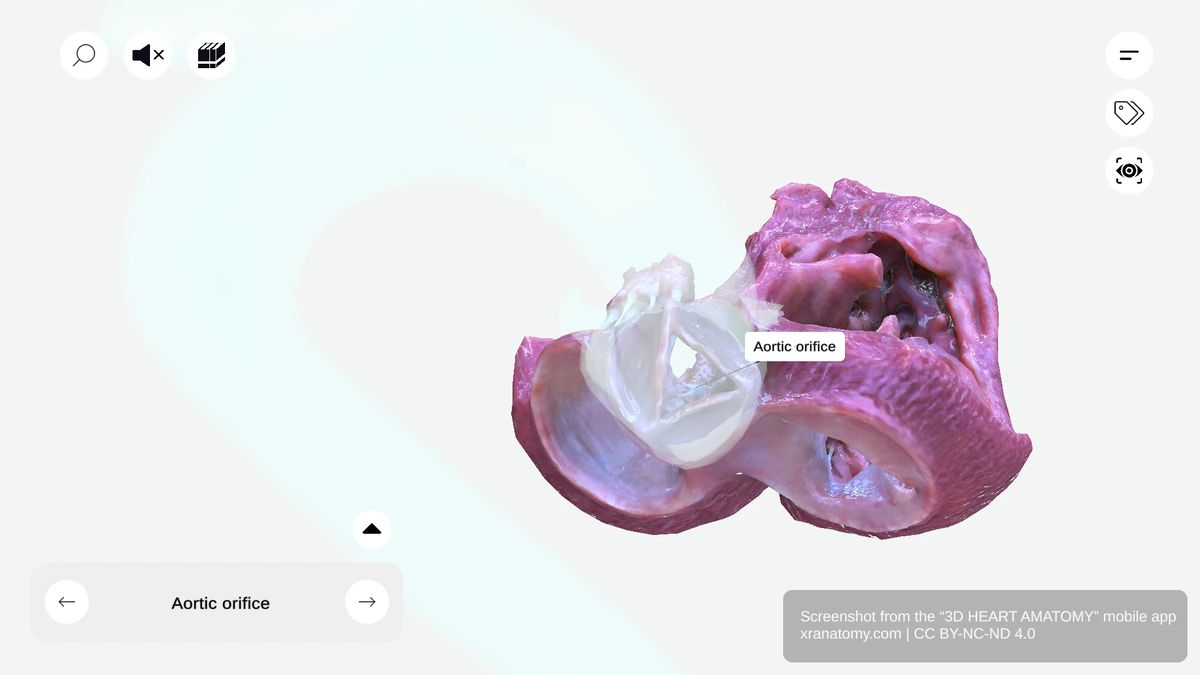
The aortic orifice is the opening through which blood exits your left ventricle. Three aortic valve leaflets guard this opening. These leaflets open and close with each heartbeat, maintaining proper blood flow direction.
AORTIC VALVE LEAFLETS
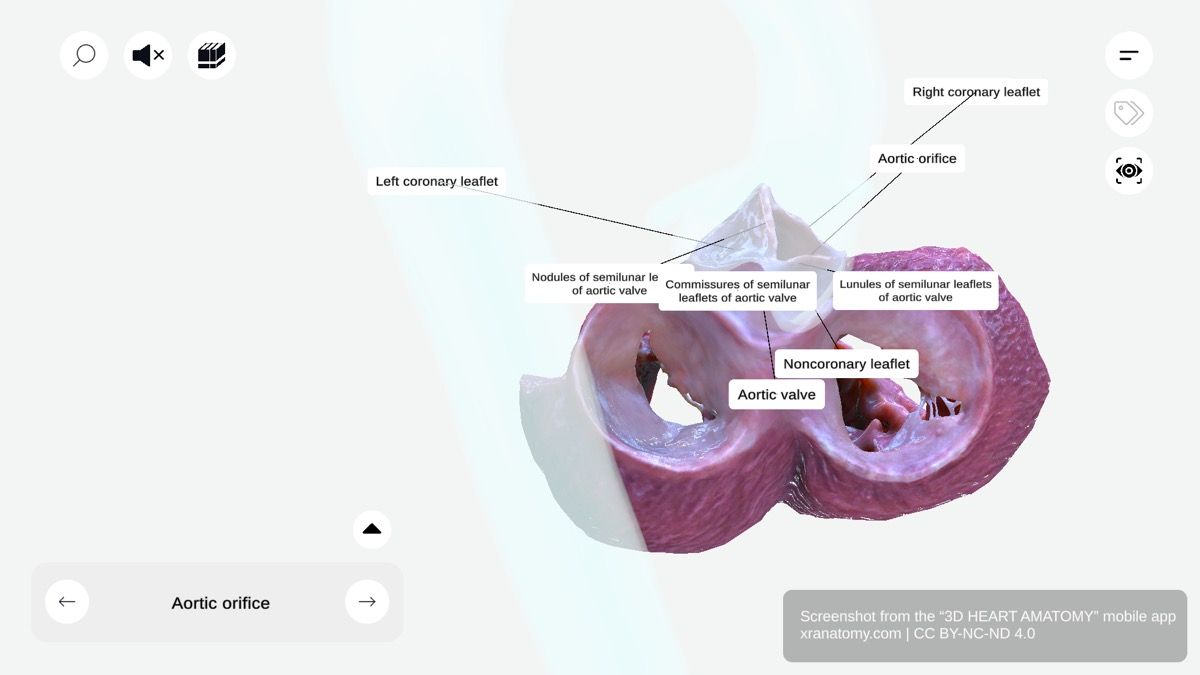
Aortic Valve Leaflets, Preview from the app.
The aortic valve has three leaflets, each named by its relationship to a coronary artery. The right coronary leaflet gives rise to the right coronary artery. The left coronary leaflet gives rise to the left coronary artery. The noncoronary leaflet is not associated with a coronary artery but is essential for completing the valve structure.
Right Coronary Leaflet
The right coronary leaflet is associated with the right coronary artery and gives rise to the right coronary artery origin.
Left Coronary Leaflet
The left coronary leaflet is associated with the left coronary artery and gives rise to the left coronary artery origin.
Noncoronary Leaflet
The noncoronary leaflet is not associated with a coronary artery. It is essential for completing the valve structure and contributes to overall valve function.
AORTIC SINUSES
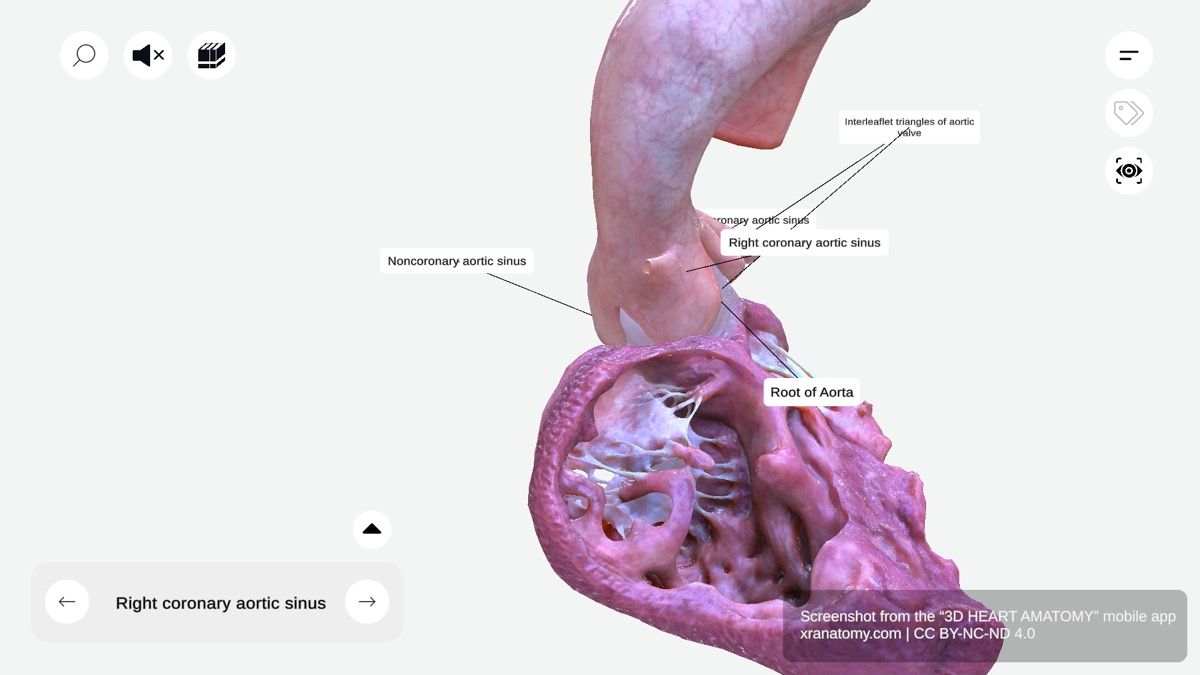
Aortic Sinuses (Sinuses of Valsalva), Preview from the app.
The aortic sinuses, also known as the sinuses of Valsalva, are three small dilations of the aortic wall. Located at the level of the aortic valve leaflets, they are dilatations of the aortic lumen. They are composed of elastic tissue and positioned behind each valve leaflet. The sinuses assist in valve closure and facilitate coronary artery blood flow. They are named according to their coronary artery association: the right coronary sinus, left coronary sinus, and noncoronary sinus.
Right Coronary Sinus
The right coronary sinus gives rise to the right coronary artery.
Left Coronary Sinus
The left coronary sinus gives rise to the left coronary artery.
Noncoronary Sinus
The noncoronary sinus does not give rise to a coronary artery.
INTERLEAFLET TRIANGLES
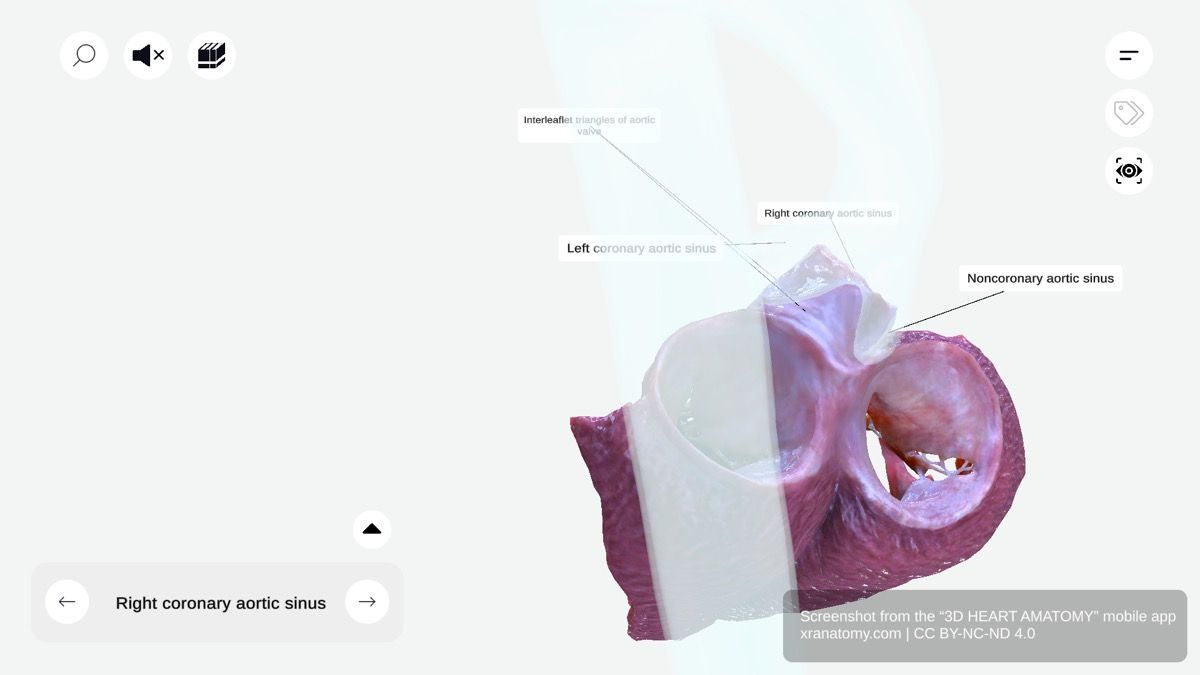
Interleaflet Triangles, Preview from the app.
The interleaflet triangles are fibrous structures located between your aortic valve leaflet attachments. These triangular areas form where adjacent leaflets meet. They are integral to aortic root structural integrity and allow flexibility of your valve leaflets. The interleaflet triangles enable proper leaflet movement during your cardiac cycle and contribute to efficient valve opening and closing.
SUPRAVALVULAR RIDGE
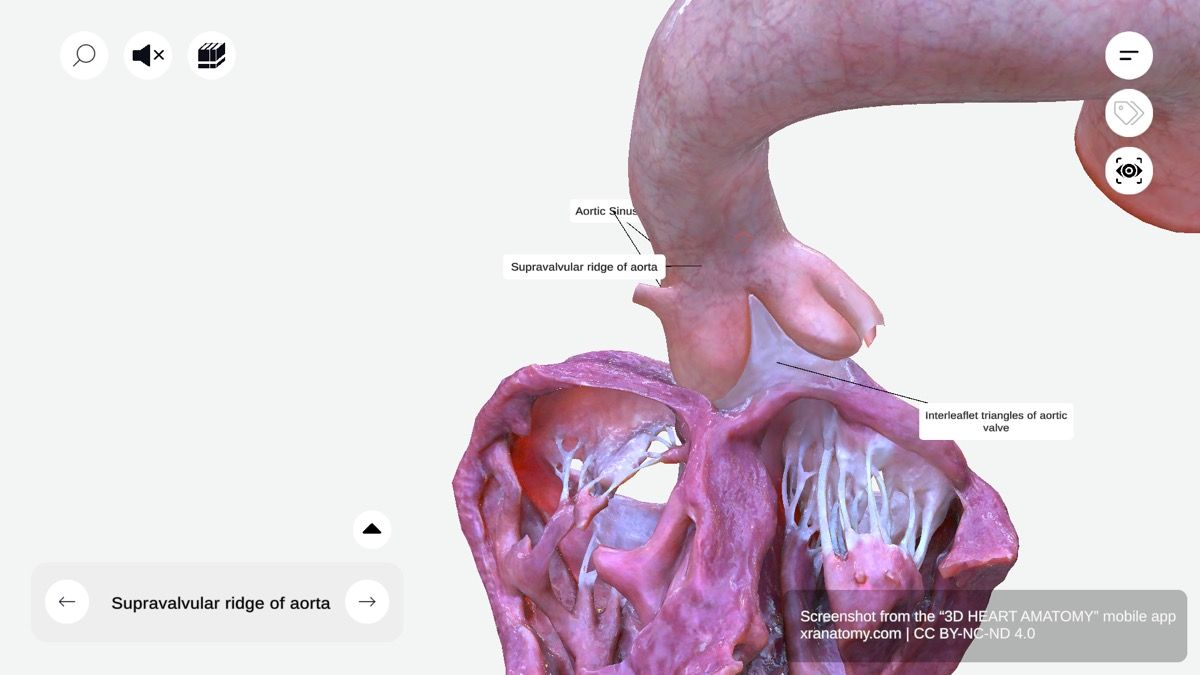
The supravalvular ridge is a fibrous ring at the junction of the aortic root and the ascending aorta. It marks the transition to the ascending aorta, provides structural support, and maintains aortic integrity as the vessel courses upward.
CHECK YOUR UNDERSTANDING
1. Name the four components of the aortic root.
Reveal Answer
Aortic valve leaflets, sinuses of Valsalva, interleaflet triangles, and supravalvular ridge.
2. Which two aortic sinuses give rise to coronary arteries, and which one does not?
Reveal Answer
The right coronary sinus gives rise to the right coronary artery and the left coronary sinus gives rise to the left coronary artery. The noncoronary sinus does not give rise to a coronary artery.
3. What role do the interleaflet triangles play in aortic root function?
Reveal Answer
The interleaflet triangles are integral to aortic root structural integrity. They allow flexibility of the valve leaflets, enable proper leaflet movement during the cardiac cycle, and contribute to efficient valve opening and closing.
WHAT'S NEXT
Next, explore the Root of Pulmonary Trunk. You will study the initial segment of the pulmonary artery arising from your right ventricle, including the pulmonary valve, its leaflets, and the sinuses of the pulmonary trunk.
Review this page again in 3 days to reinforce what you have learned.
BIBLIOGRAPHY
1. Gray H, Lewis W. Angiology. In: Anatomy of the Human Body. 1918. p. 526–542.
2. Gosling JA, Harris PF, Humpherson JR, Whitmore I, Willan PLT. Human anatomy: color atlas and textbook. 6th ed. 2017. 45–58 p.
3. Anderson RH, Spicer DE, Hlavacek AM, Cook AC, Backer CL. (2013). Anatomy of the cardiac chambers. In Wilcox’s Surgical Anatomy of the Heart (4th ed., pp. 13–50). Cambridge University Press.
4. Fritsch H, Kuehnel W. Color Atlas of Human Anatomy. Vol. Volume 2, Color Atlas and Textbook of Human Anatomy. 2005. 10–42 p.
5. Moore K, Dalley A, Agur A. Clinically Oriented Anatomy. Vol. 7ed, Clinically Oriented Anatomy. 2014. 132–151 p.
6. Ho SYen. Anatomy for Cardiac Electrophysiologists: A Practical Handbook. Cardiotext Pub; 2012. 5–27 p.
7. Standring S, editor. Gray's Anatomy: The Anatomical Basis of Clinical Practice. 41st ed. London: Elsevier; 2016.
8. Moore KL, Agur AMR, Dalley AF. Essential Clinical Anatomy. 5th ed. Philadelphia: Wolters Kluwer; 2015.