HYOID BONE ANATOMY
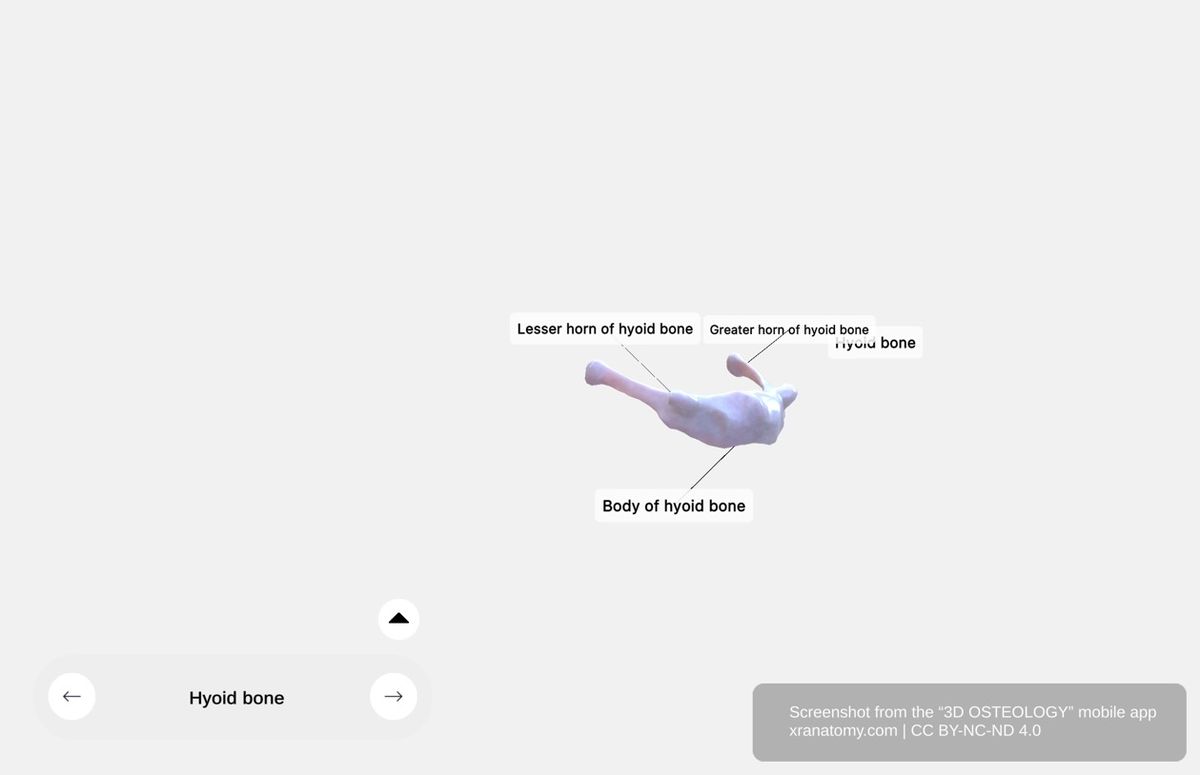
Hyoid Bone - General Structure, The hyoid bone is U-shaped and consists of a body, two greater cornua, and two lesser cornua. Preview from the app. Download 3D OSTEOLOGY for full 3D control—multiple views, x-ray mode, and unlimited zoom.
WHY THIS MATTERS
The hyoid bone is the only bone in your body that does not articulate with any other bone. Understanding its body, greater cornua, and lesser cornua helps you see how this unique U-shaped structure supports your tongue and anchors the muscles you use for swallowing and speech.
BODY
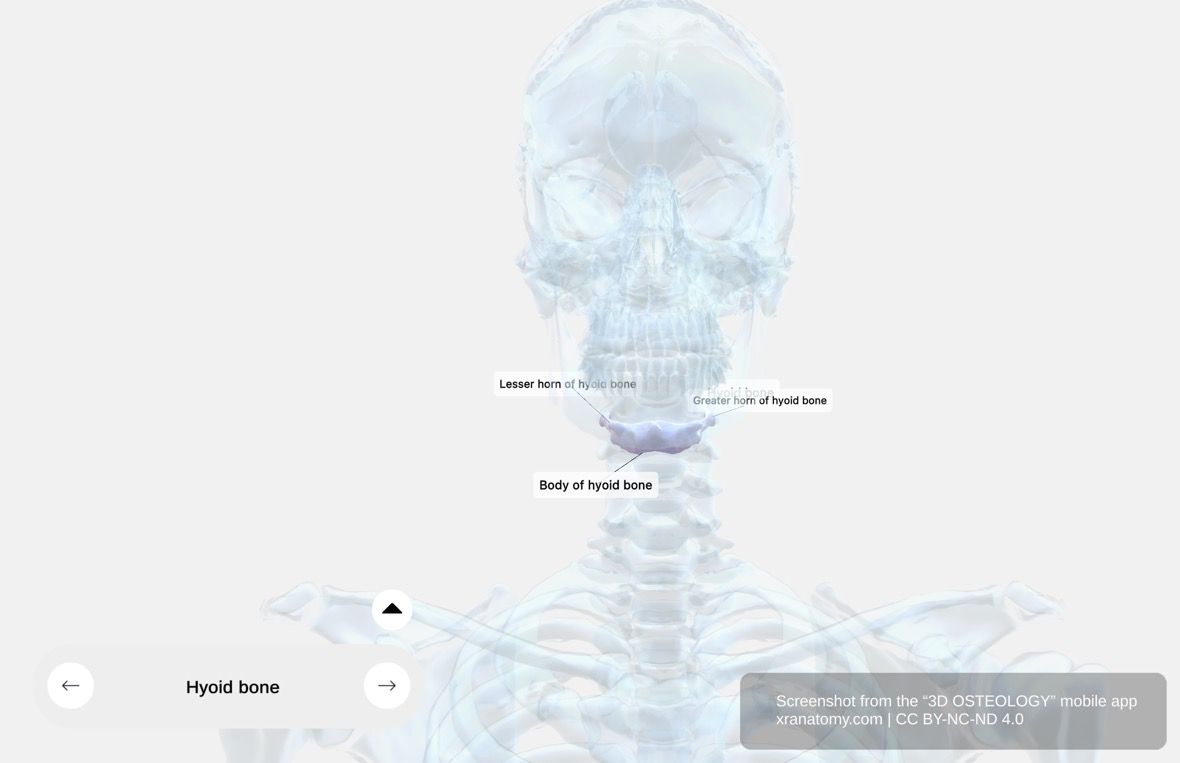
Hyoid Bone - X-Ray View, Preview from the app. Download 3D OSTEOLOGY for full 3D control—multiple views, x-ray mode, and unlimited zoom.
The body of the hyoid bone is quadrilateral in form. Its anterior surface is convex and directed forwards and upwards. A transverse ridge crosses the anterior surface. The body provides attachment points for several of your neck muscles.
LESSER HORNS (CORNUA)
The lesser horns (cornua) are small conical eminences located at the junction of the body and the greater horns. They are connected to the body by fibrous tissue, and sometimes by joints. The apex of each lesser horn attaches to your stylohyoid ligament.
GREATER HORNS (CORNUA)
The greater horns (cornua) project backwards from the body. They are flattened in structure. The greater horns provide attachment points for several of your neck muscles.
CHECK YOUR UNDERSTANDING
1. What are the three parts of the hyoid bone?
Reveal Answer
The body, the greater cornua (horns), and the lesser cornua (horns).
2. What makes the hyoid bone unique compared to every other bone in your body?
Reveal Answer
The hyoid bone does not articulate with any other bone. It is the only bone in your body with this characteristic.
3. What structure attaches to the apex of the lesser horns?
Reveal Answer
The stylohyoid ligament attaches to the apex of each lesser horn.
WHAT'S NEXT
Now that you understand the hyoid bone and its three components, the next page focuses on the Thoracic Skeleton. You will explore the bony framework of the thorax through interactive 360-degree 3D views.
Review this page again in 3 days to reinforce what you have learned.
BIBLIOGRAPHY
1. Henry G, Warren HL. Osteology. In: Anatomy of the Human Body. 20th ed. Philadelphia: Lea & Febiger; 1918. p. 129–97.
2. Standring S, editor. Gray's Anatomy: The Anatomical Basis of Clinical Practice. 41st ed. London: Elsevier; 2016.
3. Moore KL, Agur AMR, Dalley AF. Essential Clinical Anatomy. 5th ed. Philadelphia: Wolters Kluwer; 2015.