HUMERUS ANATOMY
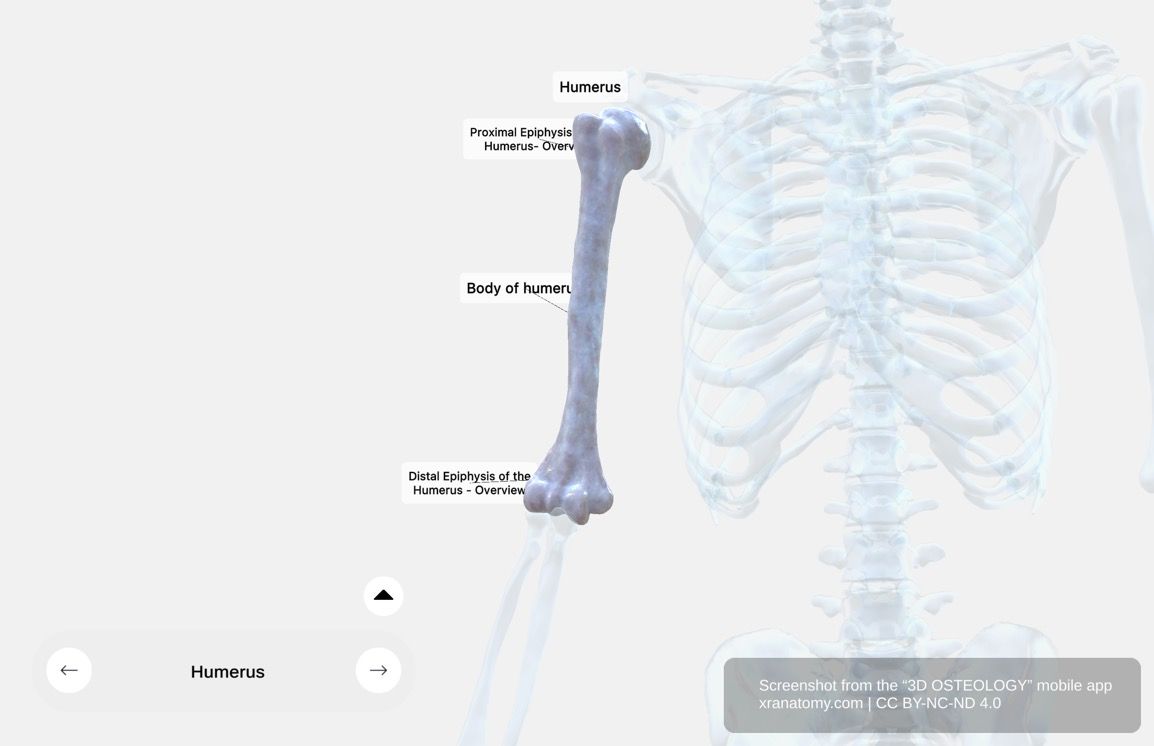
Humerus - X-ray Overview, Preview from the app. Download 3D OSTEOLOGY for full 3D control—multiple views, x-ray mode, and unlimited zoom.
WHY THIS MATTERS
The humerus is the longest and largest bone of your upper limb. It connects your shoulder joint to your elbow joint, and every movement of your arm depends on it. Understanding its head, tubercles, shaft, and distal articular surfaces helps you see how your upper limb achieves its full range of motion.
GENERAL CHARACTERISTICS
The humerus is the longest and largest bone of your upper limb. It is divided into three main parts: the body (shaft), the proximal epiphysis (upper end), and the distal epiphysis (lower end). The humerus forms part of your shoulder joint and elbow joint, and it plays a crucial role in your arm movement.
PROXIMAL EPIPHYSIS (UPPER END)
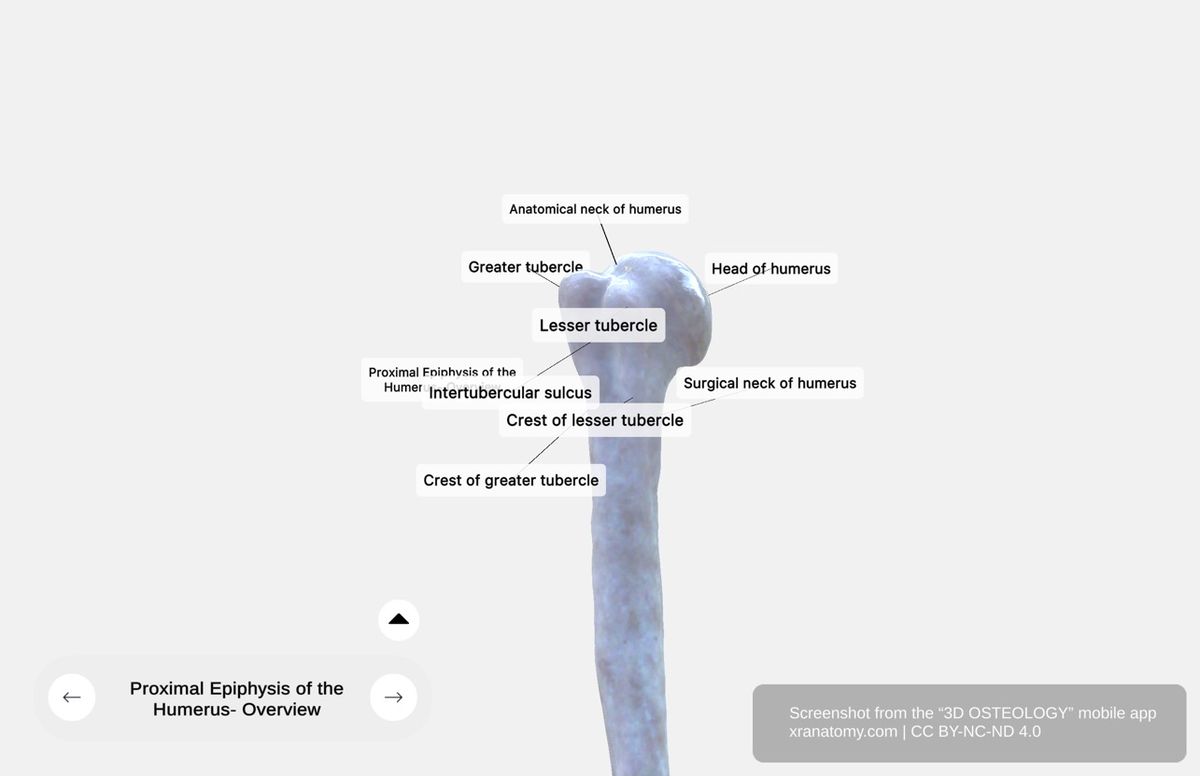
Proximal Epiphysis of the Humerus, Preview from the app. Download 3D OSTEOLOGY for full 3D control—multiple views, x-ray mode, and unlimited zoom.
The proximal epiphysis includes the head, which forms the ball of your ball-and-socket shoulder joint and articulates with the glenoid cavity of the scapula. It also features the anatomical neck, the surgical neck, the greater and lesser tubercles, the intertubercular sulcus (bicipital groove), and the crests of both tubercles. These structures provide attachment sites for muscles and contribute to your shoulder stability and movement.
Head of the Humerus
The head of the humerus is rounded and ball-like. It articulates with the glenoid cavity of the scapula and forms your ball-and-socket shoulder joint, enabling a wide range of motion.
Anatomical Neck
The anatomical neck sits below the head. It separates the head from the greater and lesser tubercles and serves as an attachment point for the capsule of your shoulder joint.
Surgical Neck
The surgical neck is located below the tubercles. It is a common site of fractures, especially in older adults. Fractures here may damage nearby nerves or blood vessels.
Greater Tubercle
The greater tubercle is a protrusion with a convex upper surface and three indentations. The highest point attaches to the supraspinatus muscle. The middle indentation attaches to the infraspinatus muscle. The lowest indentation (2-5 cm down) attaches to the teres minor muscle.
Lesser Tubercle
The lesser tubercle is a smaller bony projection on the front part of the humerus. It serves as an attachment point for a muscle in your rotator cuff and aids in internal rotation of your arm.
Intertubercular Sulcus (Bicipital Groove)
The intertubercular sulcus lies between the greater and lesser tubercles. It provides a passage for the long tendon of the Biceps brachii muscle and serves as an attachment site for muscles.
Crest of the Greater Tubercle
The crest of the greater tubercle is a bony ridge extending downward from the greater tubercle. It serves as the attachment site for the Pectoralis major muscle.
Crest of the Lesser Tubercle
The crest of the lesser tubercle is a ridge extending downward from the lesser tubercle. It provides the attachment site for the Teres major muscle and aids in internal rotation and extension of your arm.
DISTAL EPIPHYSIS (LOWER END)
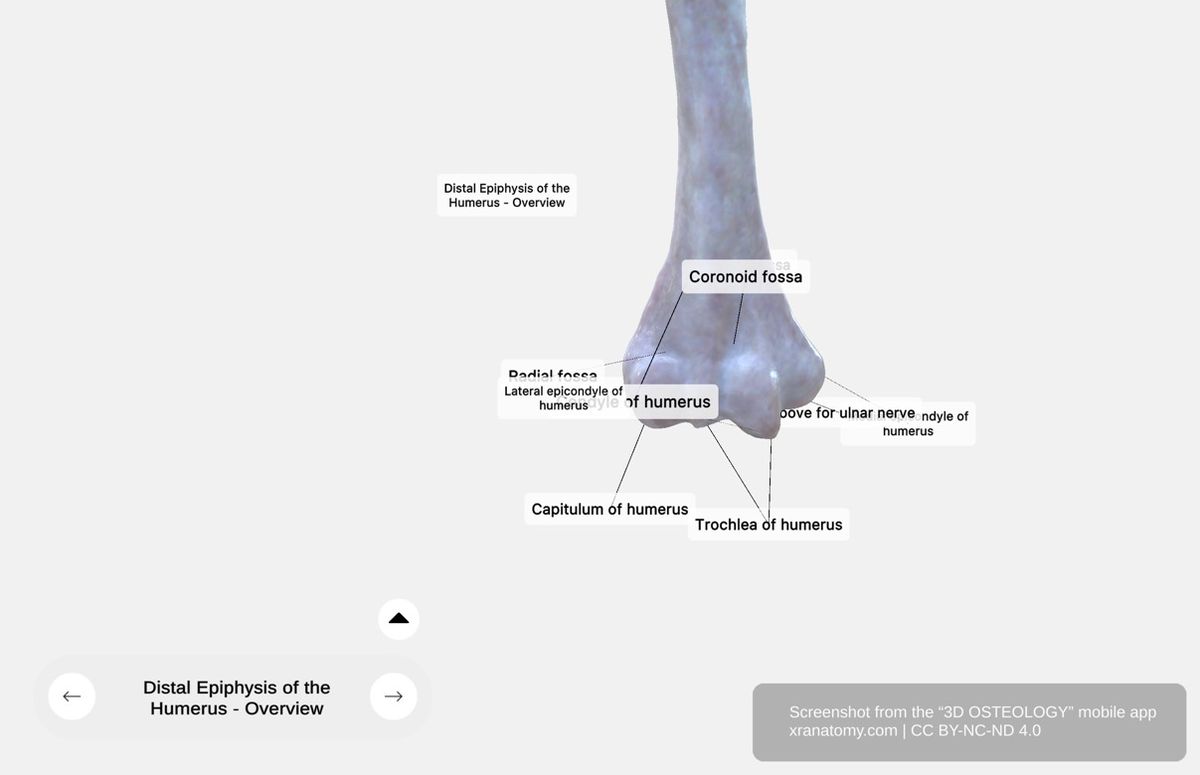
Distal Epiphysis of the Humerus, Preview from the app. Download 3D OSTEOLOGY for full 3D control—multiple views, x-ray mode, and unlimited zoom.
The distal epiphysis forms part of your elbow joint. It features two key articular surfaces, the capitulum and the trochlea, which facilitate articulation and movement at your elbow. It also includes the condyle, three fossae (olecranon, coronoid, and radial), and the medial and lateral epicondyles with the groove for the ulnar nerve.
Articular Surfaces
Capitulum
The capitulum sits on the lateral side of the humeral condyle. It articulates with the head of the radius and allows rotation and flexion of your forearm at the elbow joint.
Trochlea
The trochlea is a pulley-like articular surface on the medial side of the humeral condyle. It articulates with the trochlear notch of the ulna and allows hinge movements like bending and extending your forearm.
Condyle of the Humerus
The condyle is a large, rounded structure at the distal end near your elbow. A smooth ridge divides it into the capitulum and trochlea. The condyle connects the humerus to your elbow joint.
Fossae
Olecranon Fossa
The olecranon fossa is located on the posterior aspect of the distal humerus. It accommodates the olecranon process of the ulna when you extend your forearm.
Coronoid Fossa
The coronoid fossa sits on the anterior surface above the trochlea. It receives the coronoid process of the ulna when you flex your forearm.
Radial Fossa
The radial fossa is located on the anterior surface above the capitulum. It accommodates the head of the radius when you flex your forearm.
Epicondyles
Medial Epicondyle
The medial epicondyle is a prominent bony projection on the medial side. It provides an attachment point for the ulnar collateral ligament and flexor muscles of your forearm.
Groove for the Ulnar Nerve
This groove, also known as the sulcus for the ulnar nerve, lies behind the medial epicondyle. It houses your ulnar nerve, often referred to as the "funny bone."
Lateral Epicondyle
The lateral epicondyle is a smaller, tuberculated bony projection on the lateral side. It serves as an attachment point for extensor muscles and ligaments of your forearm.
BODY (SHAFT)
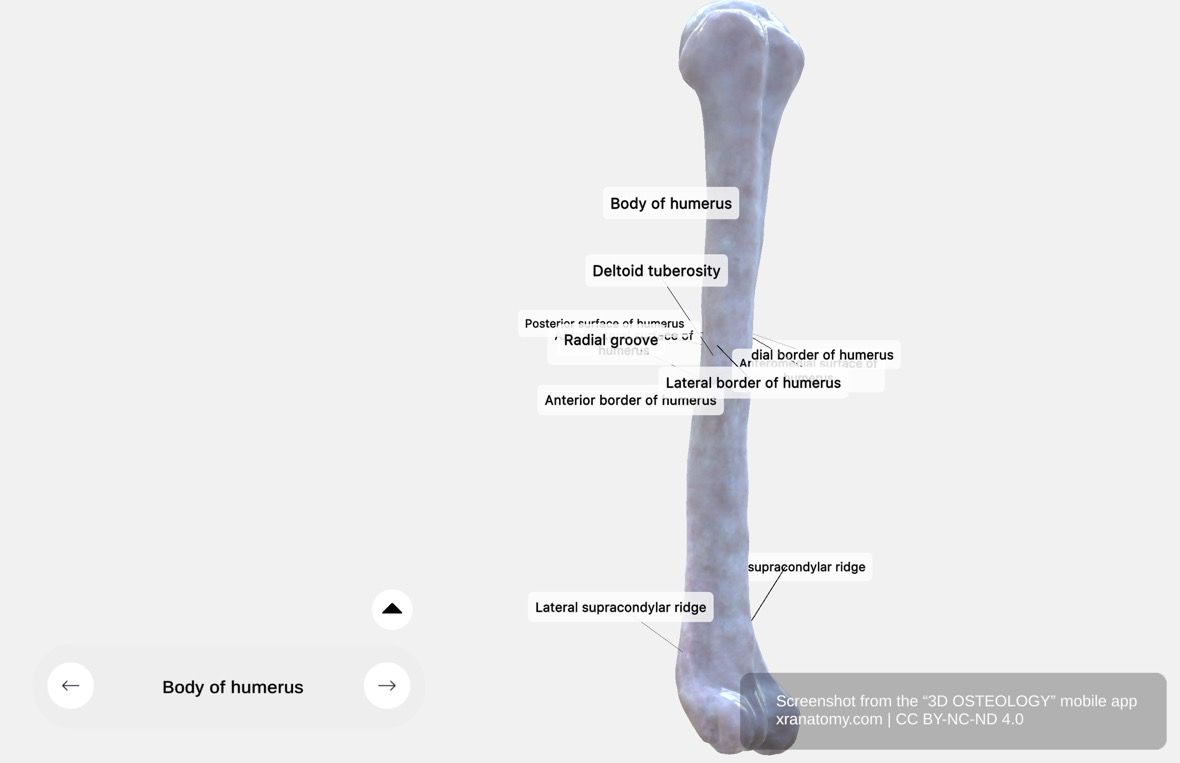
Body of the Humerus, Preview from the app. Download 3D OSTEOLOGY for full 3D control—multiple views, x-ray mode, and unlimited zoom.
The shaft has a cylindrical shape and is composed of compact bone that is thicker in the center and tapers toward the ends. It encloses a large medullary canal. The shaft features three surfaces (anteromedial, anterolateral, and posterior), three borders (anterior, lateral, and medial), and toward the distal end, the supracondylar ridges and the occasional supracondylar process.
Surfaces
Anteromedial Surface
The anteromedial surface faces forward and upward in the upper part, then turns inward and downward. It provides attachment sites for muscles.
Anterolateral Surface
The anterolateral surface is directed outward with a smooth, rounded contour. The deltoid muscle covers it. About halfway down the humerus, you find the deltoid tuberosity, a rough, triangular elevation that serves as the attachment site for the deltoid muscle, aiding your arm movement.
Posterior Surface
The posterior surface is covered by the lateral and medial heads of the Triceps brachii, which is responsible for extending your forearm at the elbow. The radial groove (sulcus nervi radialis) runs obliquely across this surface and transmits a nerve and artery to the posterior arm compartment.
Borders
Anterior Border
The anterior border extends from the greater tubercle to the coronoid fossa. It separates the anteromedial and anterolateral surfaces.
Lateral Border
The lateral border extends from the greater tubercle to the lateral epicondyle. It separates the anterolateral and posterior surfaces.
Medial Border
The medial border extends from the lesser tubercle to the medial epicondyle. It separates the anteromedial and posterior surfaces.
Supracondylar Ridges
Lateral Supracondylar Ridge
The lateral supracondylar ridge occupies the lower portion of the lateral border. It serves as the attachment site for the lateral intermuscular septum.
Medial Supracondylar Ridge
The medial supracondylar ridge occupies the lower third of the medial border. It provides attachment for muscles contributing to your forearm movement and stability.
Supracondylar Process
The supracondylar process is a small bony projection occasionally found on the anteromedial surface above the medial epicondyle.
CHECK YOUR UNDERSTANDING
1. Name the three main parts of the humerus.
Reveal Answer
The body (shaft), proximal epiphysis (upper end), and distal epiphysis (lower end).
2. Which three rotator cuff muscles attach to the greater tubercle, and in what order from top to bottom?
Reveal Answer
Supraspinatus (highest point), infraspinatus (middle indentation), and teres minor (lowest indentation, 2-5 cm down).
3. What structure lies behind the medial epicondyle and is commonly known as the "funny bone"?
Reveal Answer
The groove for the ulnar nerve (sulcus for the ulnar nerve), which houses your ulnar nerve.
WHAT'S NEXT
Next, you will study the Ulna, the medial bone of your forearm. You will explore its olecranon, coronoid process, trochlear notch, and how it forms your elbow joint and works with the radius for forearm rotation.
Review this page again in 3 days to reinforce what you have learned.
BIBLIOGRAPHY
1. Henry G, Warren HL. Osteology. In: Anatomy of the Human Body. 20th ed. Philadelphia: Lea & Febiger; 1918. p. 129–97.
2. Standring S, editor. Gray's Anatomy: The Anatomical Basis of Clinical Practice. 41st ed. London: Elsevier; 2016.
3. Moore KL, Agur AMR, Dalley AF. Essential Clinical Anatomy. 5th ed. Philadelphia: Wolters Kluwer; 2015.