CLAVICLE ANATOMY
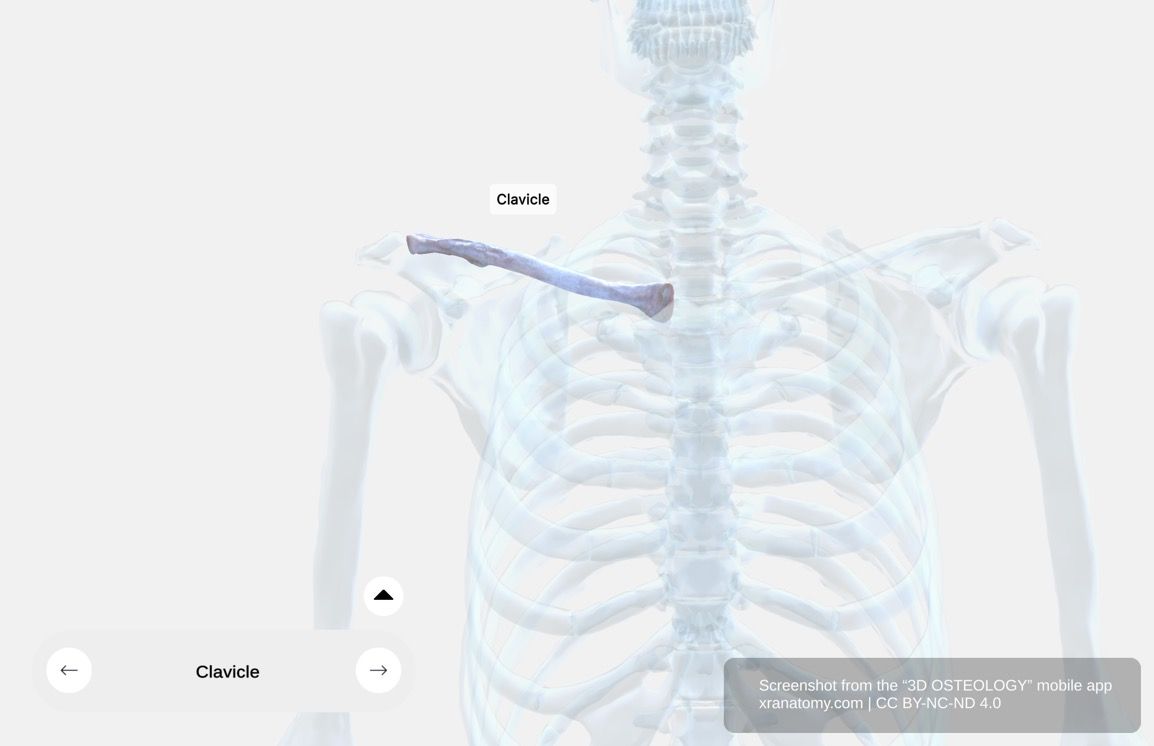
Clavicle - General Overview, Preview from the app. Download 3D OSTEOLOGY for full 3D control—multiple views, x-ray mode, and unlimited zoom.
WHY THIS MATTERS
Your clavicle (collarbone) is the only bony connection between your arm and trunk. This slender, S-shaped bone keeps your shoulder in position and transmits forces from your upper limb to your axial skeleton. Understanding its sternal end, body, and acromial end helps you see how your shoulder stays stable during movement.
CONNECTIONS
Your clavicle connects to two structures. At the medial (inner) end, it articulates with the manubrium of your breastbone. At the lateral (outer) end, it articulates with the acromion of your scapula.
Medial (Inner) End
The medial end articulates with the manubrium of your breastbone. Together they form the sternoclavicular joint with the articular disc.
Lateral (Outer) End
The lateral end articulates with the acromion of your scapula (acromial end).
STERNAL END
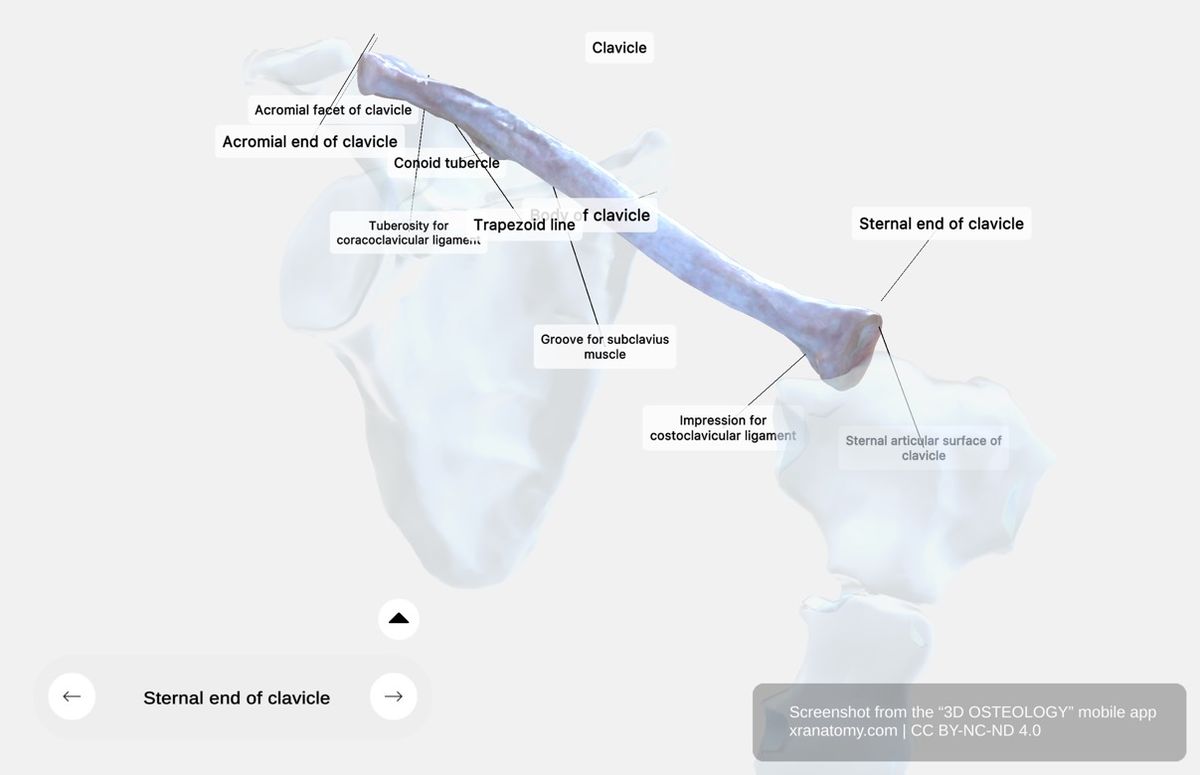
Sternal End of the Clavicle, Preview from the app. Download 3D OSTEOLOGY for full 3D control—multiple views, x-ray mode, and unlimited zoom.
The sternal end has several key features: its shape, a smooth articular surface, its function at the sternoclavicular joint, and a rough patch for ligament attachment.
Shape
The sternal end is triangular and tilts slightly inward.
Features
It presents a smooth, joint-like surface for articulation with the sternoclavicular disc.
Function
The sternal end forms the sternoclavicular joint, transmitting forces from your upper limb to your axial skeleton.
Rough Patch
On the inner side, you will find a rough area more than 2 cm in length. This serves as the attachment point for the costoclavicular ligament, which stabilizes your clavicle.
BODY OF THE CLAVICLE
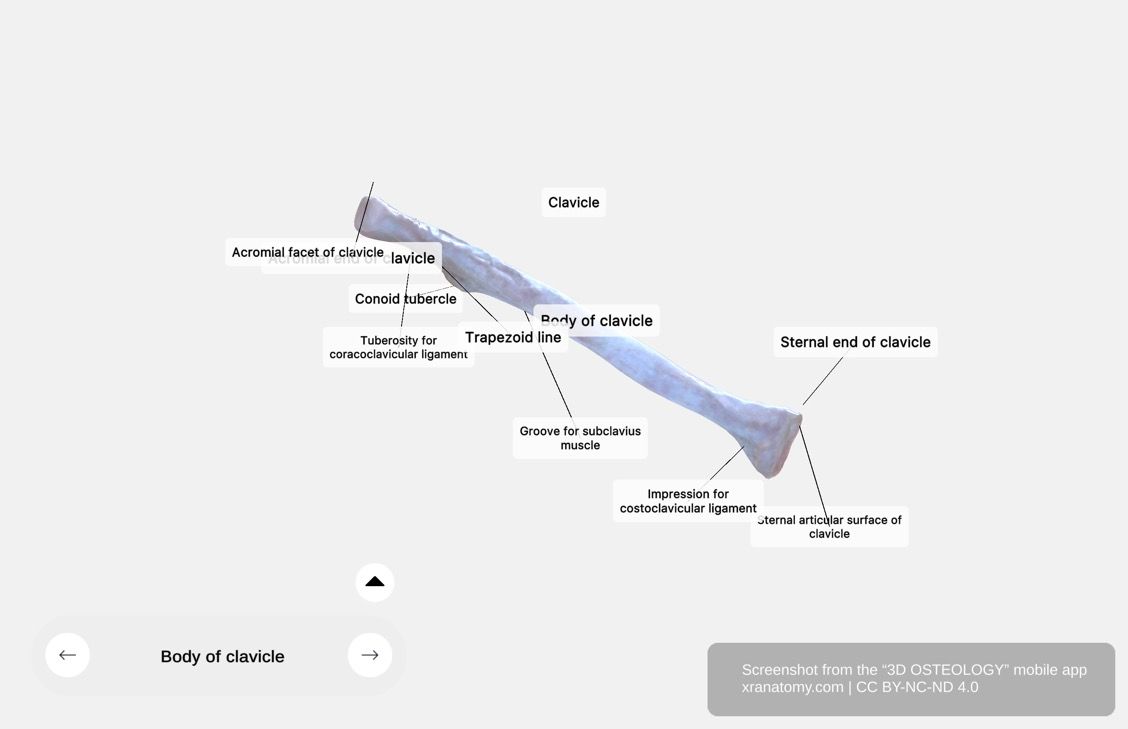
Body of the Clavicle, Preview from the app. Download 3D OSTEOLOGY for full 3D control—multiple views, x-ray mode, and unlimited zoom.
The body of your clavicle has two notable features: its characteristics (shape and curvature) and the groove for subclavius muscle on its underside.
Characteristics
The body displays a double curvature. The medial two-thirds has a cylindrical or prismoid shape, while the outer third is flattened.
Groove for Subclavius Muscle
On the underside of your clavicle, you will find a groove that provides attachment for your subclavius muscle.
ACROMIAL END
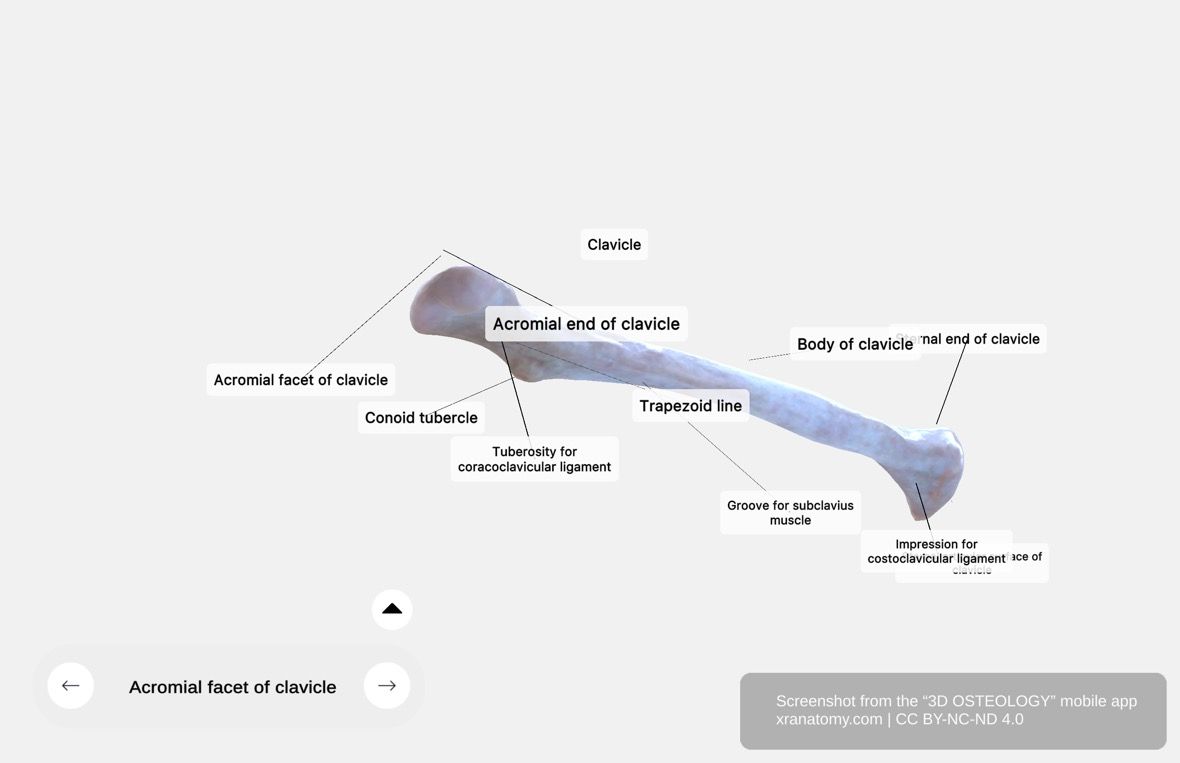
Acromial End of the Clavicle, Preview from the app. Download 3D OSTEOLOGY for full 3D control—multiple views, x-ray mode, and unlimited zoom.
The acromial end presents several important structures: its general features and function, the acromial facet, the conoid tubercle, and the trapezoid line.
Features
The acromial end presents a small, flattened surface that slopes slightly downward.
Function
The acromial end articulates with the acromion of your scapula.
Acromial Facet
The acromial facet is a flat surface for articulation with the acromion.
Conoid Tubercle
The conoid tubercle sits near the junction of the medial two-thirds and lateral third of your clavicle. It lies above the coracoid process of the scapula. It serves as the attachment point for the conoid ligament, which stabilizes your shoulder.
Trapezoid Line
The trapezoid line is an oblique ridge running forward and lateralward from the conoid tubercle. It provides attachment for the trapezoid ligament, which stabilizes your shoulder by connecting your clavicle to your scapula.
CHECK YOUR UNDERSTANDING
1. What two structures does the clavicle articulate with at its medial and lateral ends?
Reveal Answer
The medial end articulates with the manubrium of your breastbone (forming the sternoclavicular joint), and the lateral end articulates with the acromion of your scapula.
2. What is the function of the conoid tubercle and the trapezoid line?
Reveal Answer
The conoid tubercle provides attachment for the conoid ligament, and the trapezoid line provides attachment for the trapezoid ligament. Both stabilize your shoulder by connecting your clavicle to your scapula.
3. Describe the shape difference between the medial two-thirds and outer third of the clavicle body.
Reveal Answer
The medial two-thirds has a cylindrical or prismoid shape, while the outer third is flattened.
WHAT'S NEXT
Next, you will explore the Humerus, the longest and largest bone of your upper limb. You will study its proximal epiphysis (head, tubercles, neck), body (shaft), and distal epiphysis (capitulum, trochlea, epicondyles) that form parts of your shoulder and elbow joints.
Review this page again in 3 days to reinforce what you have learned.
BIBLIOGRAPHY
1. Henry G, Warren HL. Osteology. In: Anatomy of the Human Body. 20th ed. Philadelphia: Lea & Febiger; 1918. p. 129–97.
2. Standring S, editor. Gray's Anatomy: The Anatomical Basis of Clinical Practice. 41st ed. London: Elsevier; 2016.
3. Moore KL, Agur AMR, Dalley AF. Essential Clinical Anatomy. 5th ed. Philadelphia: Wolters Kluwer; 2015.