FRONTAL BONE ANATOMY
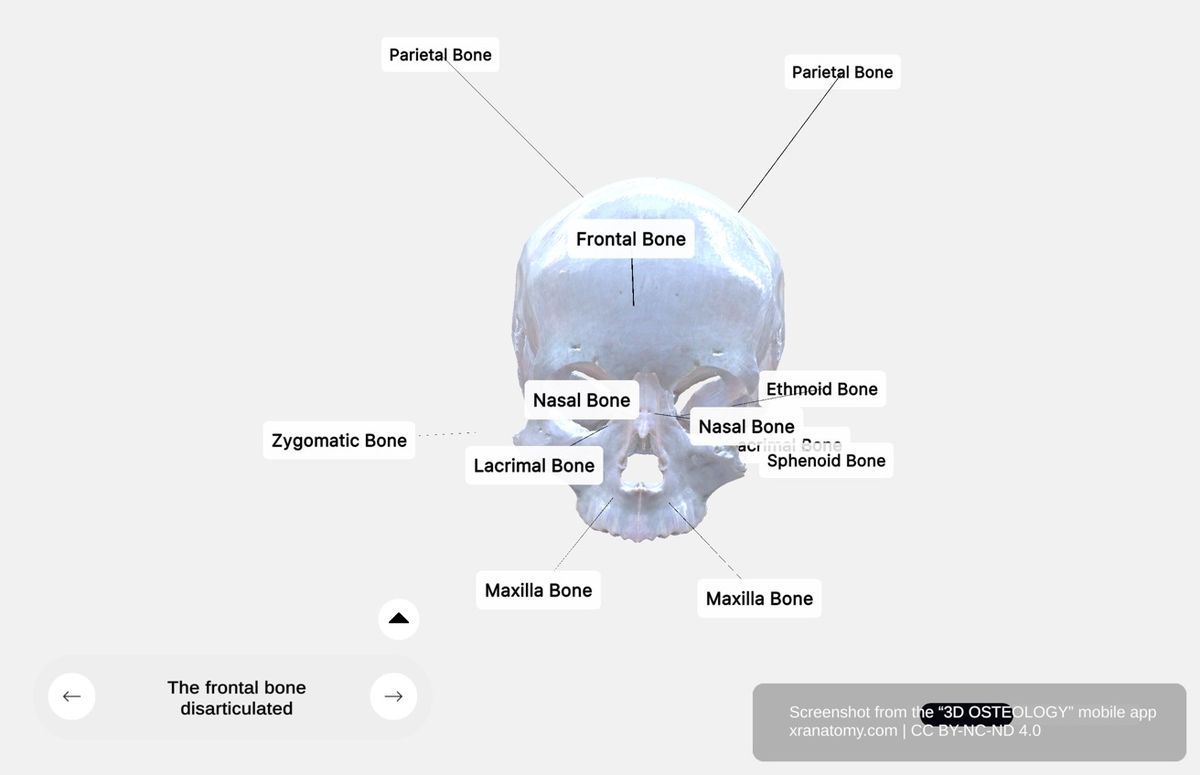
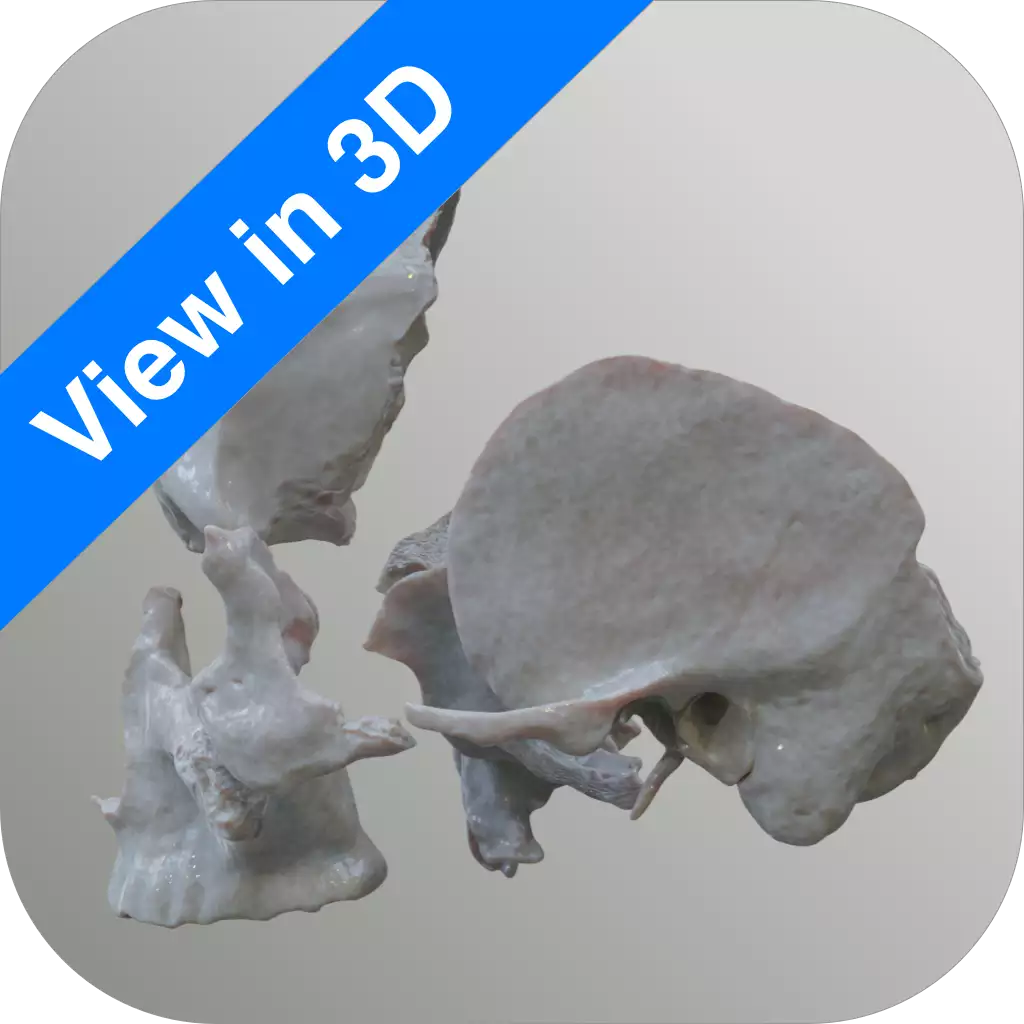
Frontal Bone - Articulations, Preview from the app. Download 3D OSTEOLOGY for full 3D control—multiple views, x-ray mode, and unlimited zoom.
WHY THIS MATTERS
The frontal bone forms your forehead and protects your frontal lobes. It also contributes to the roof of your eye sockets, the anterior cranial fossa floor, and houses paired frontal sinuses that lighten your skull and contribute to vocal resonance. Understanding its parts, from the squamous region to the orbital plates, helps you see how one bone serves multiple protective and structural roles.
In-Depth AR Atlas Available
Read the comprehensive anatomy description with AR illustrations and videos
Read AR Atlas →GENERAL CHARACTERISTICS
Overview
The frontal bone is a major cranial bone that forms your forehead. It contributes to your orbital roofs and to the anterior cranial floor.
Articulations
The frontal bone articulates with the sphenoid bone, ethmoid bone, paired parietal bones, paired nasal bones, paired maxillae, paired lacrimal bones, and paired zygomatic bones.
Functional Significance
The frontal bone protects your frontal lobes of the cerebrum. It forms the anterior cranial fossa floor via the orbital plates and provides structural support for your forehead and brow region. It houses paired frontal sinuses that lighten your skull and contribute to vocal resonance. It also contributes to the orbital roof, protecting your eyes from above.
SQUAMOUS PART
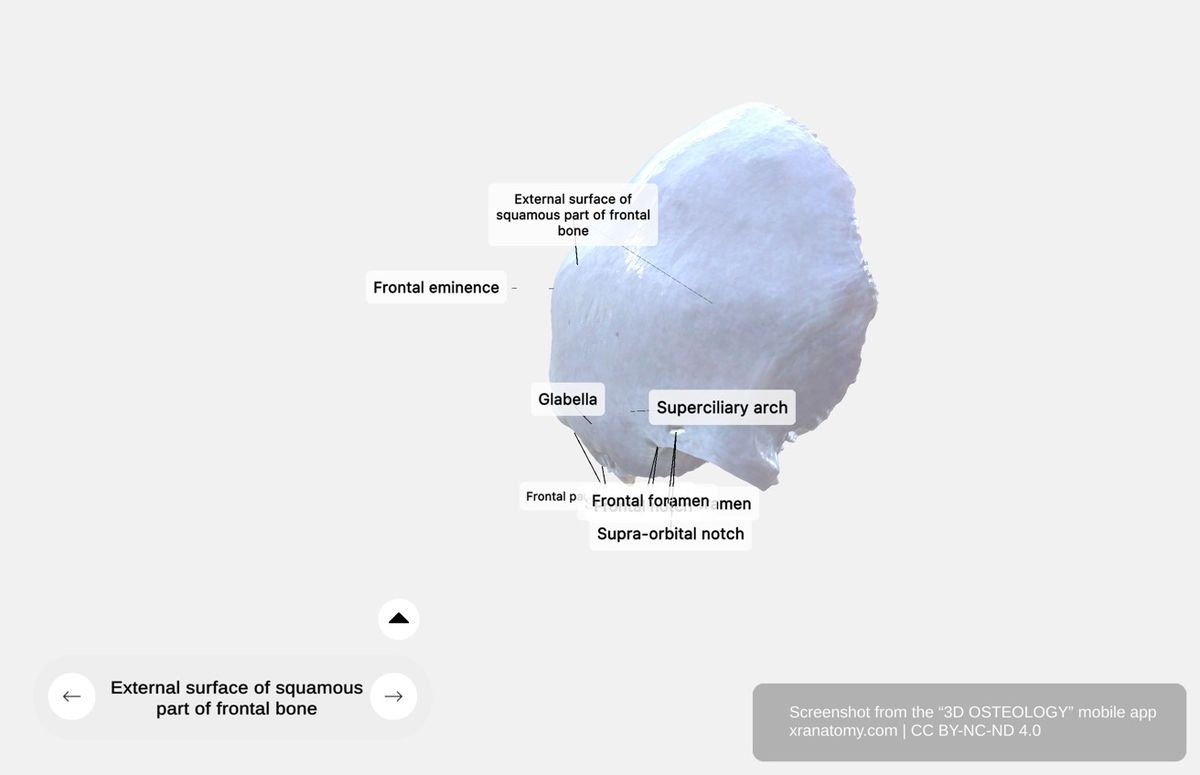
External Surface of the Squamous Part, Preview from the app. Download 3D OSTEOLOGY for full 3D control—multiple views, x-ray mode, and unlimited zoom.
The squamous part is a vertical flattened region that forms your forehead. Its external surface landmarks include the frontal eminences, the superciliary arches, and the glabella. The frontal portion of the orbital margin forms the inferior boundary, while the external surface features include the supraorbital notch or foramen and the frontal notch or foramen.
Squamous Part Description
The squamous part is a vertical flattened region forming your forehead. Its external aspect is smooth and convex, facing outward toward your scalp.
Frontal Eminences
The frontal eminences are paired rounded prominences located approximately 3 cm above the supraorbital margin. They sit on either side of the midline and contribute to your forehead contour.
Superciliary Arches
The superciliary arches are paired elevations located directly above the supraorbital margin. They accentuate your brow prominence.
Glabella
The glabella is a smooth midline elevation situated between the superciliary arches.
Frontal Portion of Orbital Margin
The frontal portion of the orbital margin forms the inferior boundary of the squamous part.
External Surface Features
The external surface is a smooth convex surface that forms your visible forehead area. The supraorbital notch or foramen is located on the medial aspect of the supraorbital margin and transmits neurovascular structures.
The frontal notch or foramen is positioned medial to the supraorbital notch. It provides passage for vessels and nerves that supply your forehead region.
TEMPORAL SURFACE
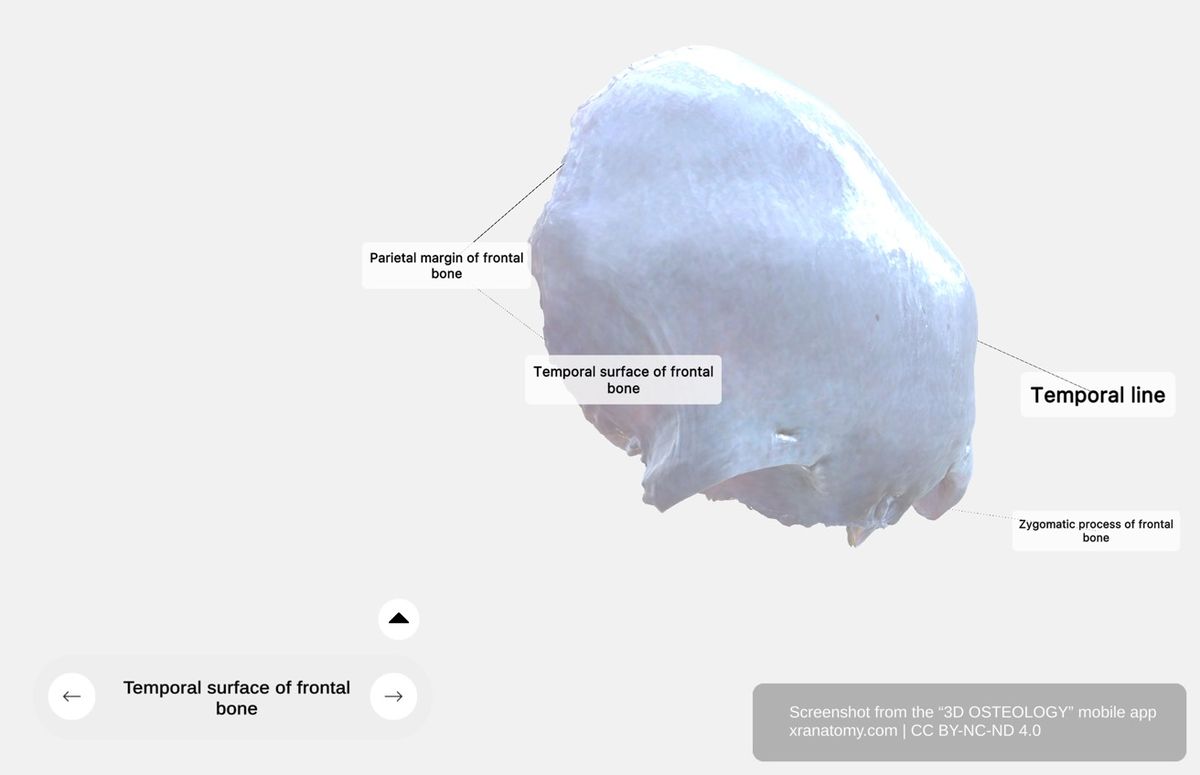
Temporal Surface of the Frontal Bone, Preview from the app. Download 3D OSTEOLOGY for full 3D control—multiple views, x-ray mode, and unlimited zoom.
The temporal surface is the lateral aspect of the frontal bone. It contributes to your temple region and features the parietal margin posteriorly, the zygomatic process laterally, and the temporal line extending from the zygomatic process.
Parietal Margin
The parietal margin is the posterior border of the temporal surface. It articulates with the parietal bones.
Zygomatic Process
The zygomatic process is a prominent lateral projection located at the lateral end of the supraorbital margin. It articulates with the zygomatic bone and forms part of the lateral orbital wall and orbital rim.
Temporal Line
The temporal line extends superiorly and posteriorly from the zygomatic process. It divides into superior and inferior temporal lines. These lines provide attachment for the temporalis muscle and temporal fascia.
INTERNAL SURFACE OF SQUAMOUS PART
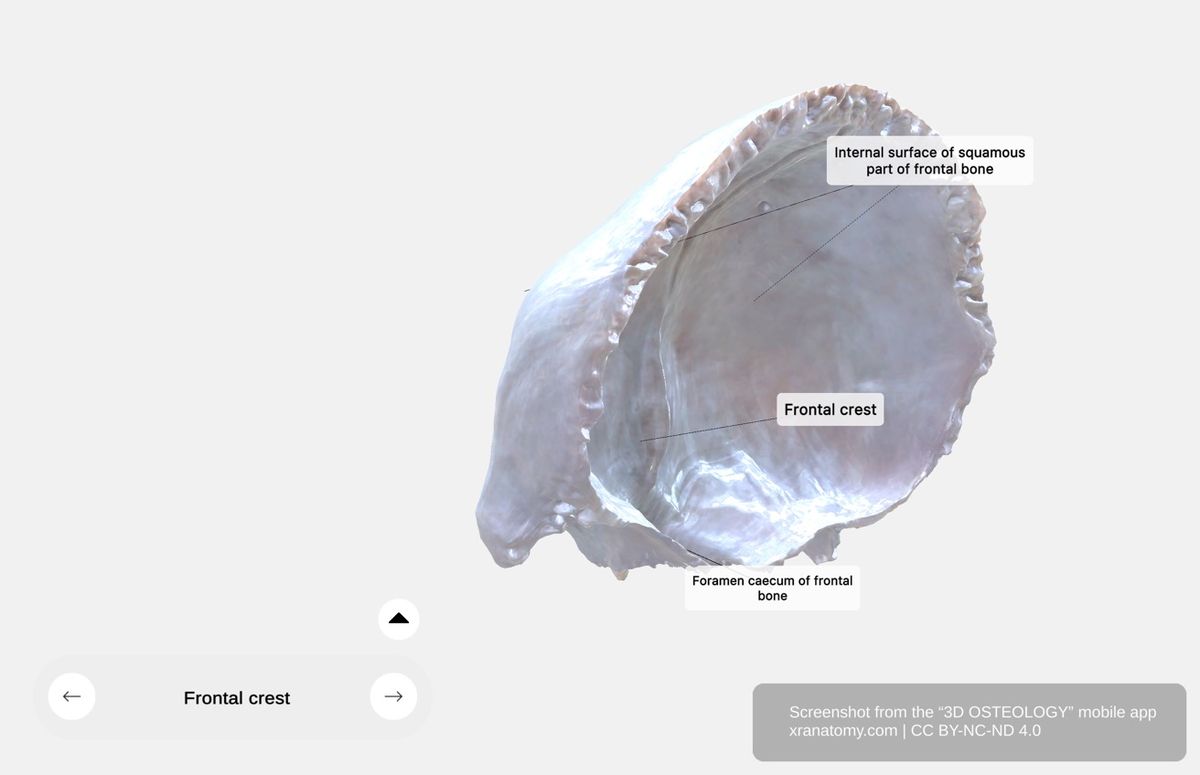
Internal Surface of the Squamous Part, Preview from the app. Download 3D OSTEOLOGY for full 3D control—multiple views, x-ray mode, and unlimited zoom.
The internal surface faces your cranial cavity. Its key landmarks include the frontal crest, a midline ridge, and the foramen cecum at its inferior end.
Frontal Crest
The frontal crest is a midline ridge formed by the convergence of the sagittal sulcus margins. It is located at the inferior midline of the internal surface.
Foramen Cecum
The foramen cecum is located at the inferior end of the frontal crest. It is formed by a small notch uniting with the ethmoid bone. It is usually a small blind-ended depression that occasionally accommodates a vein connecting to the superior sagittal sinus.
NASAL PART
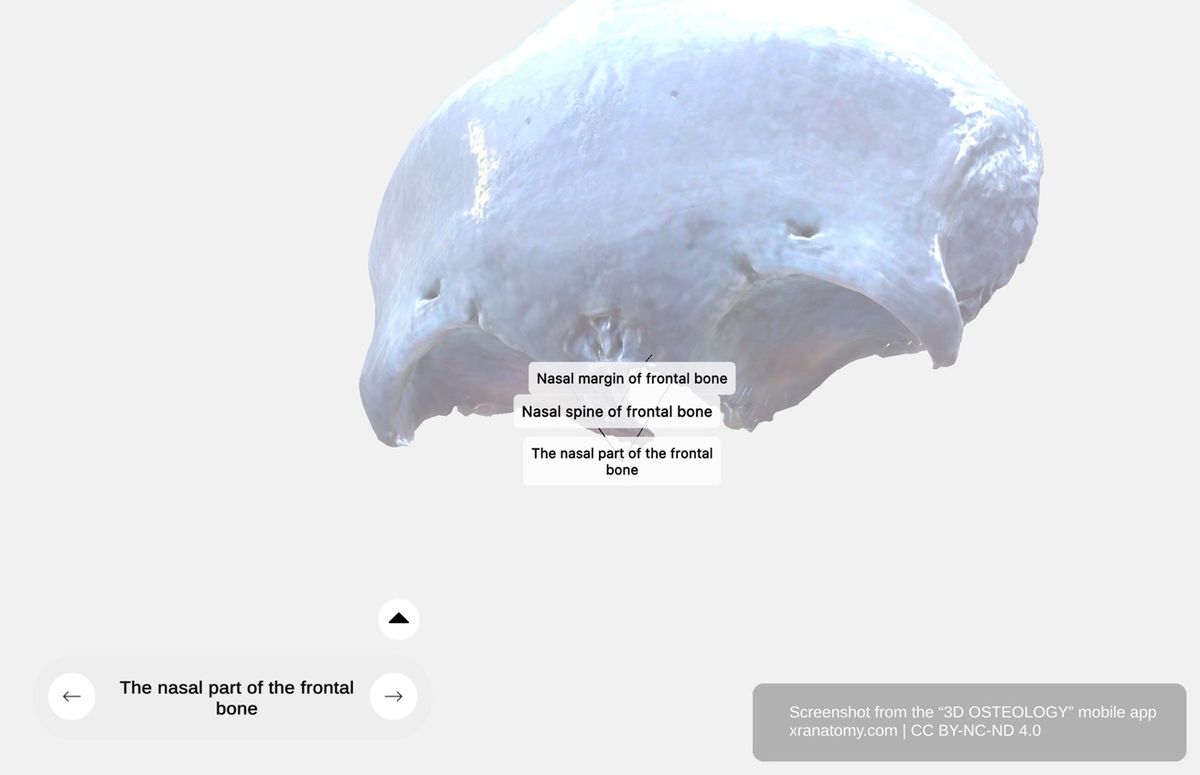
Nasal Part of the Frontal Bone, Preview from the app. Download 3D OSTEOLOGY for full 3D control—multiple views, x-ray mode, and unlimited zoom.
The nasal part is an inferior extension of the frontal bone, positioned between the supraorbital margins. Its key features include the nasal spine projecting inferiorly and the nasal margin forming the inferior border.
Nasal Spine
The nasal spine is a midline bony projection that extends inferiorly from the center of the nasal part. It articulates with the nasal bones and with the perpendicular plate of the ethmoid.
Nasal Margin
The nasal margin is the inferior border of the nasal part. It articulates with the superior borders of the nasal bones and contributes to your nasal bridge formation.
ORBITAL PART
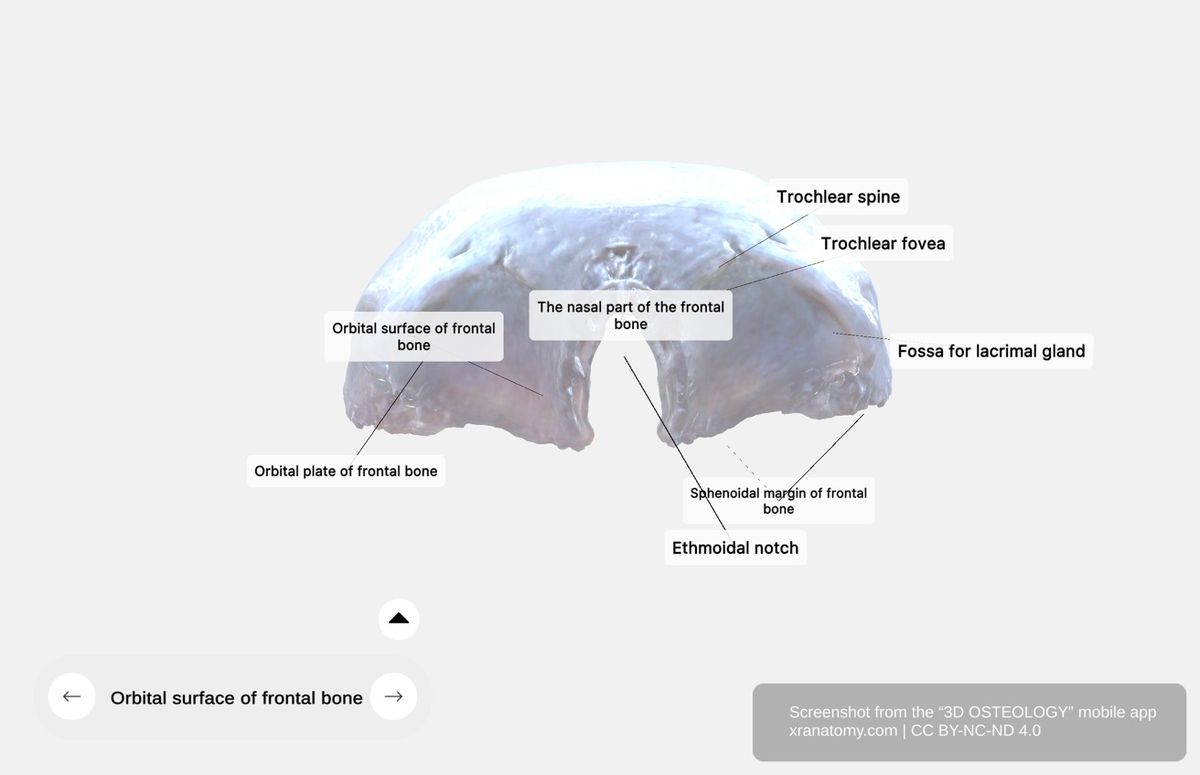
Orbital Part of the Frontal Bone, Preview from the app. Download 3D OSTEOLOGY for full 3D control—multiple views, x-ray mode, and unlimited zoom.
The orbital part is composed of two horizontal triangular plates called orbital plates. These form your orbital roofs and the anterior cranial fossa floor. Key features include the ethmoidal notch between the plates, the orbital surface facing into your orbit, and several landmarks on the orbital surface: the trochlear fovea, the fossa for the lacrimal gland, and the sphenoidal margin.
Ethmoidal Notch
The ethmoidal notch is the gap between the orbital plates. It accommodates the cribriform plate of the ethmoid bone.
Orbital Surface
The orbital surface is the inferior-facing aspect of each orbital plate. It is directed into your orbit.
Key Features of the Orbital Surface
The trochlear fovea is a small medial depression located near the nasal part. It serves as the attachment site for the trochlea of your superior oblique muscle.
The fossa for the lacrimal gland is a shallow depression located laterally. It houses your lacrimal gland.
The sphenoidal margin articulates with the greater wing of the sphenoid bone and completes the anterior cranial fossa.
FRONTAL SINUSES
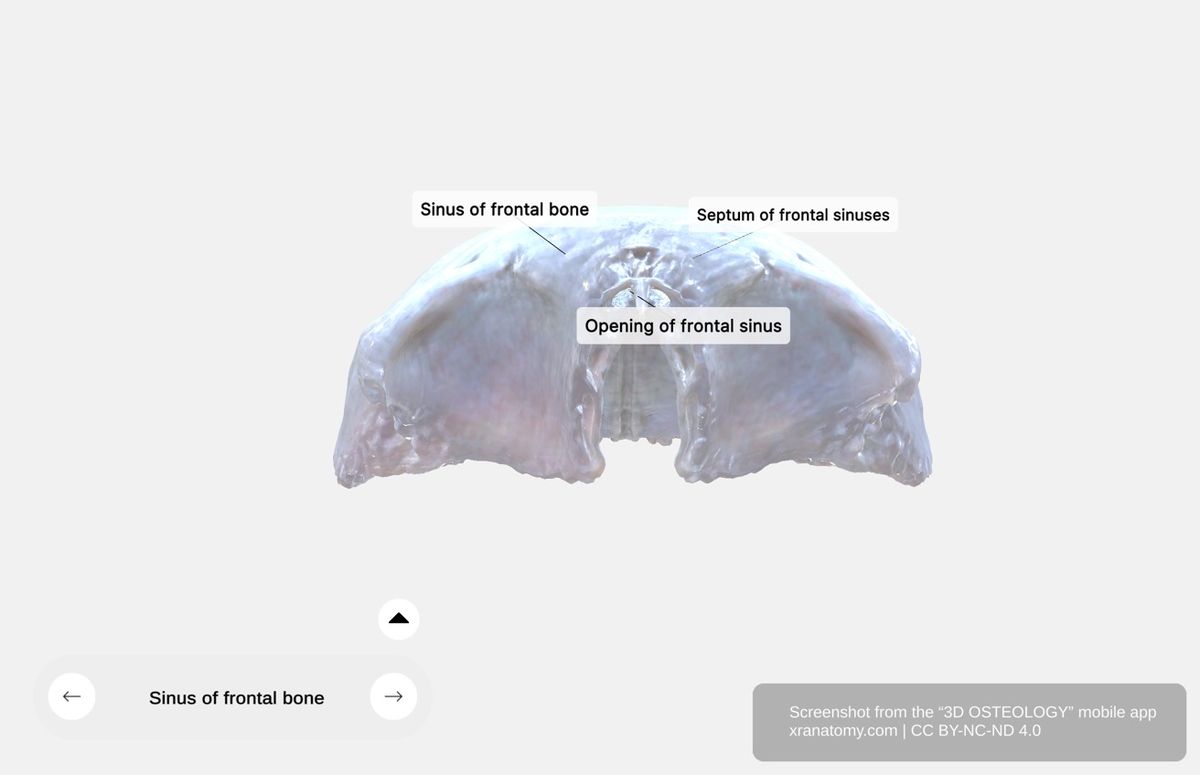
Frontal Sinuses, Preview from the app. Download 3D OSTEOLOGY for full 3D control—multiple views, x-ray mode, and unlimited zoom.
The frontal sinuses are paired irregular cavities located within the frontal bone. They sit superior to your orbits and posterior to the superciliary arches. Key features include the septum dividing the two cavities, the drainage openings into your nasal cavity, and several functions related to breathing, voice resonance, and skull weight.
Septum of the Frontal Sinuses
The septum of the frontal sinuses is a thin bony partition that separates the two cavities. Its position is variable and often results in asymmetrical sinuses.
Drainage Openings
The drainage openings open into your nasal cavity. They are located on either side of the nasal spine, positioned anterior to the ethmoidal notch.
Functions
The frontal sinuses contribute to humidification of the air you breathe in, enhancement of your voice resonance, and reduction of your skull weight.
CHECK YOUR UNDERSTANDING
1. What structure is located between the superciliary arches on the frontal bone?
Reveal Answer
The glabella, a smooth midline elevation.
2. Name three functions of the frontal sinuses.
Reveal Answer
Humidification of the air you breathe in, enhancement of your voice resonance, and reduction of your skull weight.
3. What does the foramen cecum connect?
Reveal Answer
The foramen cecum is usually a small blind-ended depression that occasionally accommodates a vein connecting to the superior sagittal sinus.
WHAT'S NEXT
Next, explore the Parietal Bone. You will study the paired flat bones that form the top and sides of your cranial vault, including their external and internal surfaces, borders, sutures, and angles.
Review this page again in 3 days to reinforce what you have learned.
BIBLIOGRAPHY
1. Henry G, Warren HL. Osteology. In: Anatomy of the Human Body. 20th ed. Philadelphia: Lea & Febiger; 1918. p. 129–97.
2. Standring S, editor. Gray's Anatomy: The Anatomical Basis of Clinical Practice. 41st ed. London: Elsevier; 2016.
3. Moore KL, Agur AMR, Dalley AF. Essential Clinical Anatomy. 5th ed. Philadelphia: Wolters Kluwer; 2015.