CUBOID BONE ANATOMY
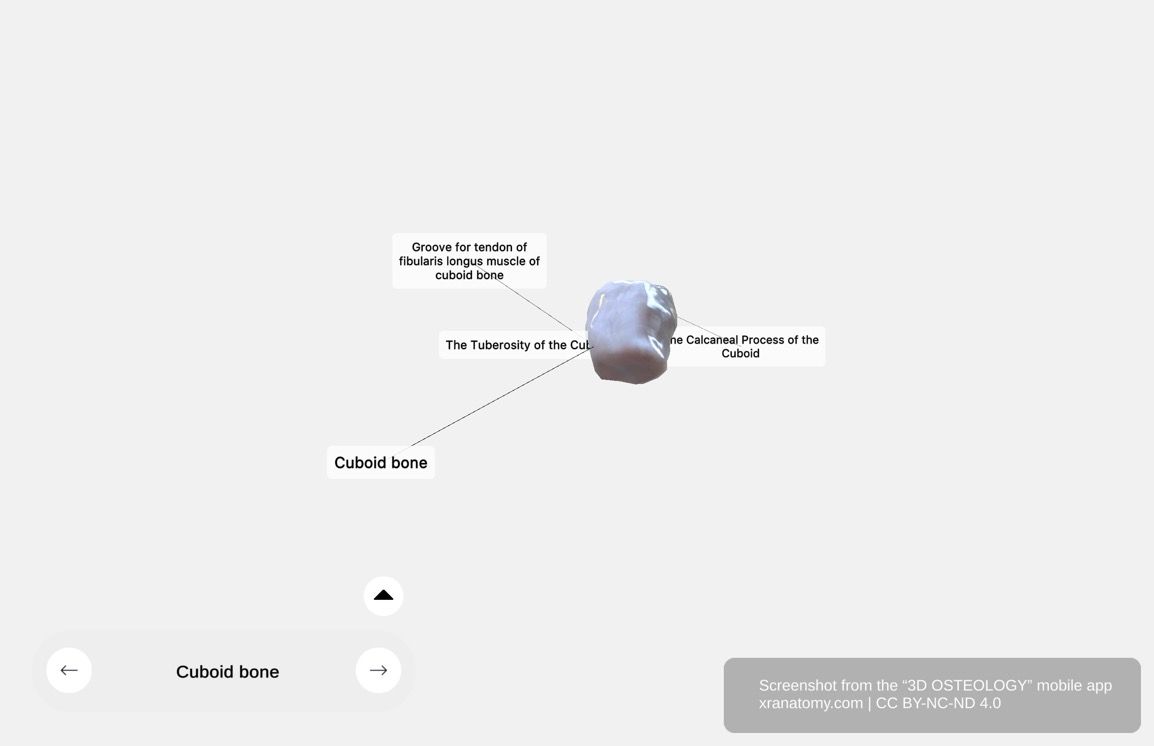
Cuboid Bone - General Structure, Preview from the app. Download 3D OSTEOLOGY for full 3D control—multiple views, x-ray mode, and unlimited zoom.
WHY THIS MATTERS
The cuboid bone is the keystone of the lateral longitudinal arch of your foot. It channels the fibularis longus tendon across your sole through its peroneal sulcus, directly supporting plantar flexion and eversion. Understanding the cuboid helps you see how the lateral column of your foot maintains its structural integrity.
GENERAL STRUCTURE
The cuboid bone sits on the lateral side of your foot, positioned between the calcaneus behind and the fourth and fifth metatarsal bones in front. It is one of the seven tarsal bones and plays an important role in maintaining the lateral longitudinal arch of your foot. Key features include its location and position within the lateral column and its articular surfaces connecting it to surrounding bones.
Location and Position
You will find the cuboid on the lateral side of your tarsus. It sits between the calcaneus posteriorly and the fourth and fifth metatarsal bones anteriorly. The cuboid forms a key part of the lateral longitudinal arch of your foot.
Articular Surfaces
The cuboid presents three main articular surfaces. The posterior surface is triangular and concavo-convex, and it articulates with the anterior surface of the calcaneus. The anterior surface is smaller and divided by a vertical ridge; it articulates with the fourth and fifth metatarsal bones. The medial surface presents a facet for articulation with the lateral cuneiform and may have a smaller facet for the navicular bone.
PERONEAL SULCUS
The peroneal sulcus (also known as the groove for fibularis longus) is a distinctive feature on the plantar surface of the cuboid bone that accommodates an important tendon of the lateral compartment of your leg. This section covers the sulcus's course and direction across the bone and its functional significance for tendon passage.
Course and Direction
The peroneal sulcus runs obliquely forward and medialward on the plantar surface. It extends from the lateral to the medial aspect of the bone, creating a pulley-like mechanism for the tendon.
Functional Significance
The sulcus provides a pathway for the tendon of the Fibularis longus muscle. This tendon crosses the sole of your foot to insert on the medial cuneiform bone and the base of the first metatarsal. The arrangement is important for plantar flexion and eversion of your foot.
TUBEROSITY OF THE CUBOID BONE
The tuberosity of the cuboid bone is a prominent projection on the plantar surface that serves as an important anatomical landmark and provides attachment for the long plantar ligament. It includes a specific location on the plantar surface and an oval facet that accommodates a sesamoid bone.
Location
The tuberosity sits on the lateral part of the plantar surface. It projects inferiorly from the main body of the cuboid and forms the lateral boundary of the peroneal sulcus.
Oval Facet
The tuberosity carries an oval facet on its plantar aspect. This facet accommodates the sesamoid bone found in the tendon of the Fibularis longus muscle. The sesamoid bone protects the tendon, improves its mechanical advantage, and reduces friction during your movement.
CALCANEAL PROCESS
The calcaneal process is a posteriorly directed projection from the cuboid bone that provides structural support and stability to the articulation with your calcaneus. This section covers the process's features, its functional role in the lateral column, and the clinical significance of the cuboid bone.
Features
The calcaneal process projects backward from the cuboid bone. It sits on the infero-lateral aspect and contributes to the stability of the calcaneocuboid joint.
Functional Role
This process supports the anterior end of your calcaneus and provides attachment for the short plantar ligament. It helps maintain the integrity of the lateral column of your foot.
Clinical Significance
Cuboid syndrome involves subluxation of the cuboid bone. It is common in dancers and athletes and causes lateral foot pain. Fractures of the cuboid may occur with midfoot injuries and are often associated with Lisfranc injuries.
CHECK YOUR UNDERSTANDING
1. Which four bones does the cuboid articulate with, and on which surfaces?
Reveal Answer
The calcaneus on the posterior surface, the fourth and fifth metatarsal bones on the anterior surface, and the lateral cuneiform on the medial surface. It may also occasionally articulate with the navicular.
2. What tendon runs through the peroneal sulcus, and where does it insert?
Reveal Answer
The tendon of the Fibularis longus muscle runs through the peroneal sulcus. It crosses the sole of your foot to insert on the medial cuneiform bone and the base of the first metatarsal.
3. What structure does the oval facet on the cuboid tuberosity accommodate, and what are its three functions?
Reveal Answer
The oval facet accommodates a sesamoid bone in the tendon of the Fibularis longus muscle. It provides protection for the tendon, improved mechanical advantage, and reduced friction during movement.
WHAT'S NEXT
Next, you will explore the Navicular Bone. This boat-shaped tarsal bone sits on the medial side of your foot, serving as a keystone of the medial longitudinal arch. You will study its articular surfaces for the talus and the three cuneiform bones, plus its tuberosity where the tibialis posterior tendon inserts.
Review this page again in 3 days to reinforce what you have learned.
BIBLIOGRAPHY
1. Henry G, Warren HL. Osteology. In: Anatomy of the Human Body. 20th ed. Philadelphia: Lea & Febiger; 1918. p. 129–97.
2. Standring S, editor. Gray's Anatomy: The Anatomical Basis of Clinical Practice. 41st ed. London: Elsevier; 2016.
3. Moore KL, Agur AMR, Dalley AF. Essential Clinical Anatomy. 5th ed. Philadelphia: Wolters Kluwer; 2015.