CARDIAC SEPTUM
In-Depth AR Atlas Available
Read the comprehensive anatomy description with AR illustrations and videos
Read AR Atlas →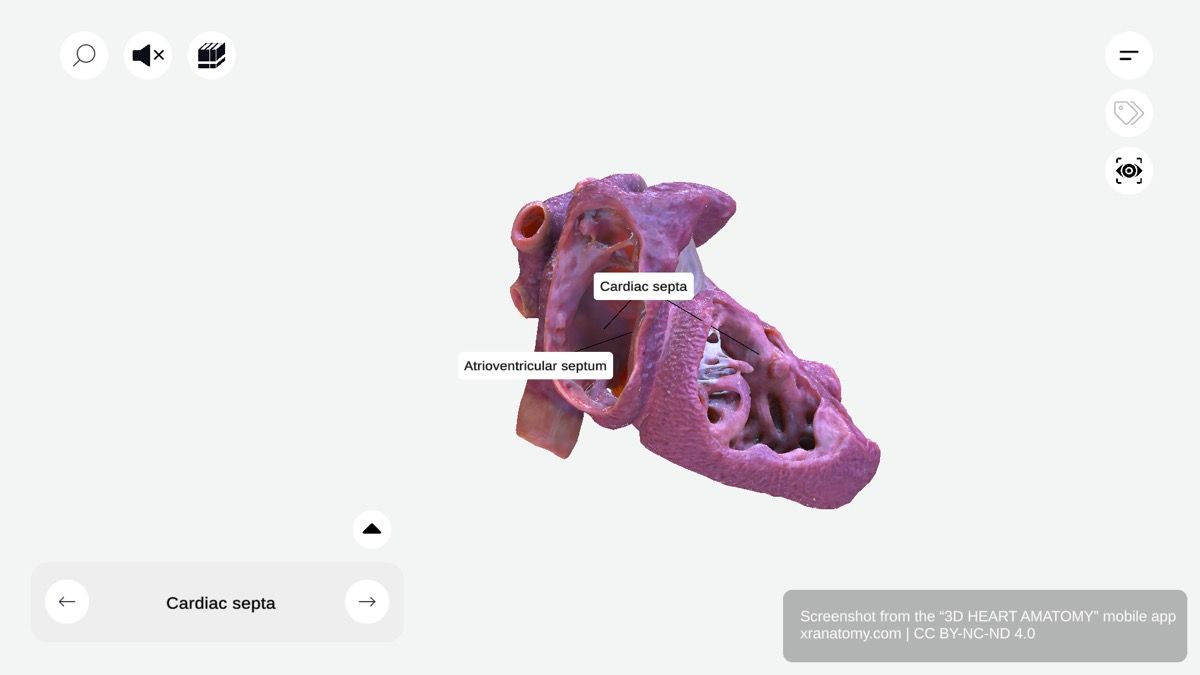
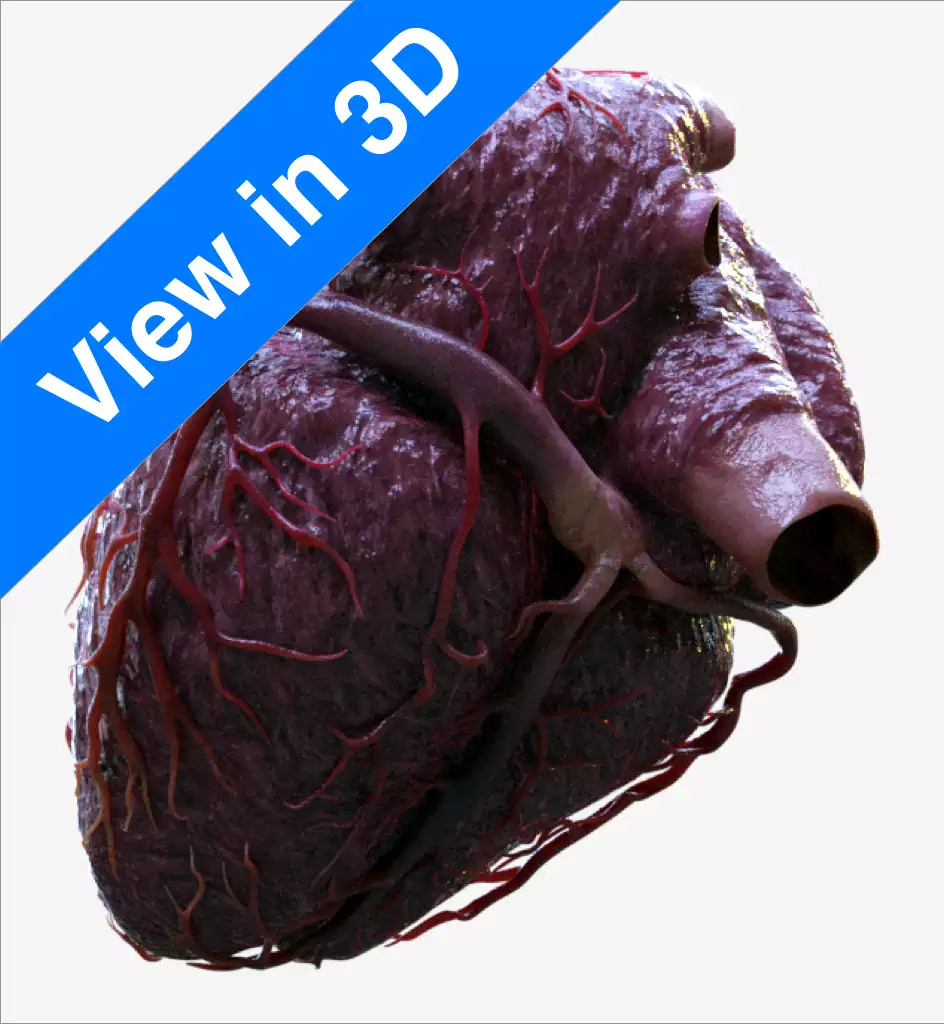
Cardiac Septum - Overview, Preview from the app.
WHY THIS MATTERS
The cardiac septum divides your heart into separate chambers, keeping oxygen-rich and oxygen-poor blood apart. Understanding the three septa and their components helps you see how your heart maintains unidirectional blood flow and efficient circulation.
CARDIAC SEPTUM
The cardiac septum consists of walls dividing your heart chambers, composed of both muscular and fibrous tissue. Your heart has three types of septa: the interatrial septum, the interventricular septum, and the atrioventricular septum. Together, these septa maintain unidirectional blood flow through your heart and prevent mixing of oxygenated and deoxygenated blood.
INTERATRIAL SEPTUM
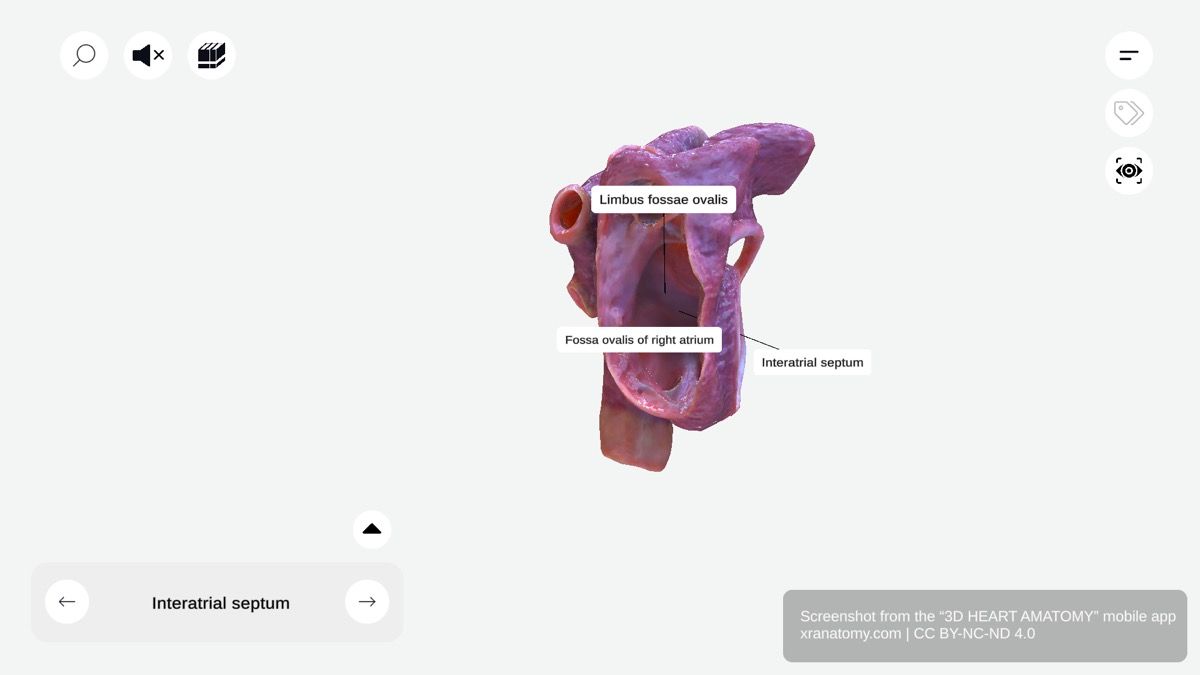
The interatrial septum is a thin, delicate wall between your right and left atria. It prevents mixing of atrial blood and maintains efficient circulation in your heart. Two key landmarks sit on this septum: the fossa ovalis, a depression visible from the right atrium, and the limbus fossae ovalis, a prominent ridge surrounding it.
Fossa Ovalis
The fossa ovalis is a depression within the septum, located in your right atrium. It is the remnant of the foramen ovale, which allowed fetal blood to bypass the lungs before birth. The foramen ovale normally closes after birth.
Limbus Fossae Ovalis
The limbus fossae ovalis is a prominent ridge surrounding the fossa ovalis. It borders the oval fossa and is more pronounced superiorly and along its edges.
ATRIOVENTRICULAR SEPTUM
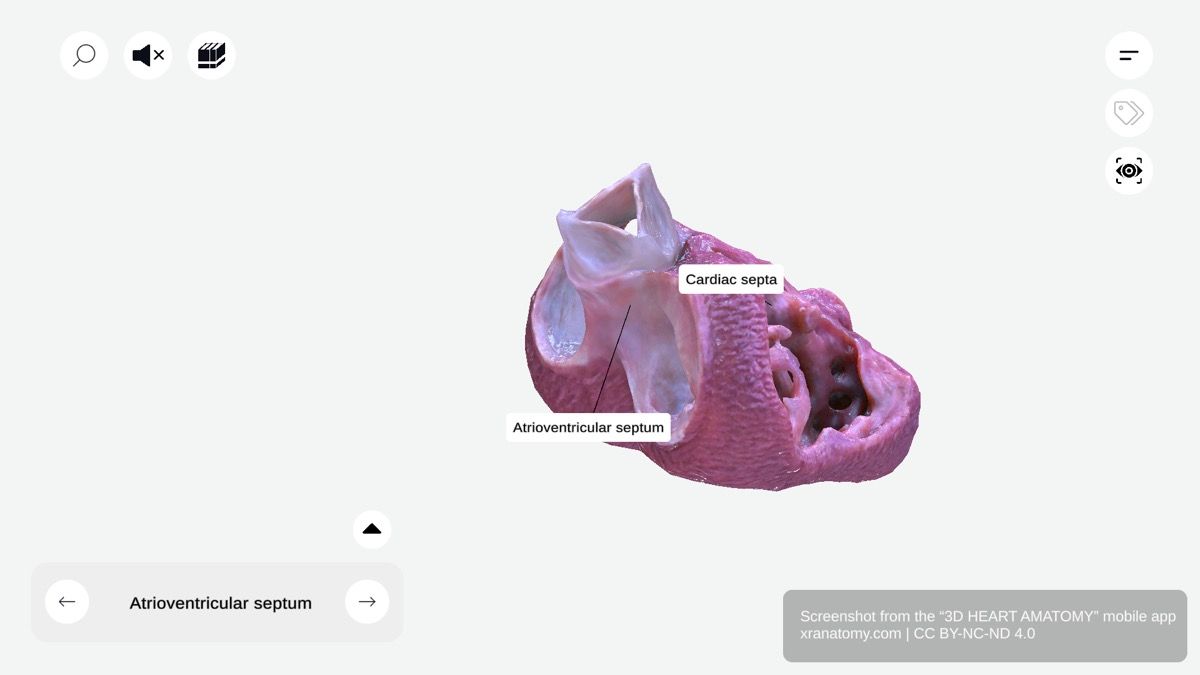
Atrioventricular Septum, Preview from the app.
The atrioventricular septum is the portion of septum between your atria and ventricles. It results from the offset attachment of the atrioventricular valves: the tricuspid valve and the mitral valve. This septum sits posterior to the tricuspid valve hinge.
The atrioventricular septum maintains structural separation between your upper and lower chambers. It also supports proper electrical conduction between your heart chambers.
INTERVENTRICULAR SEPTUM
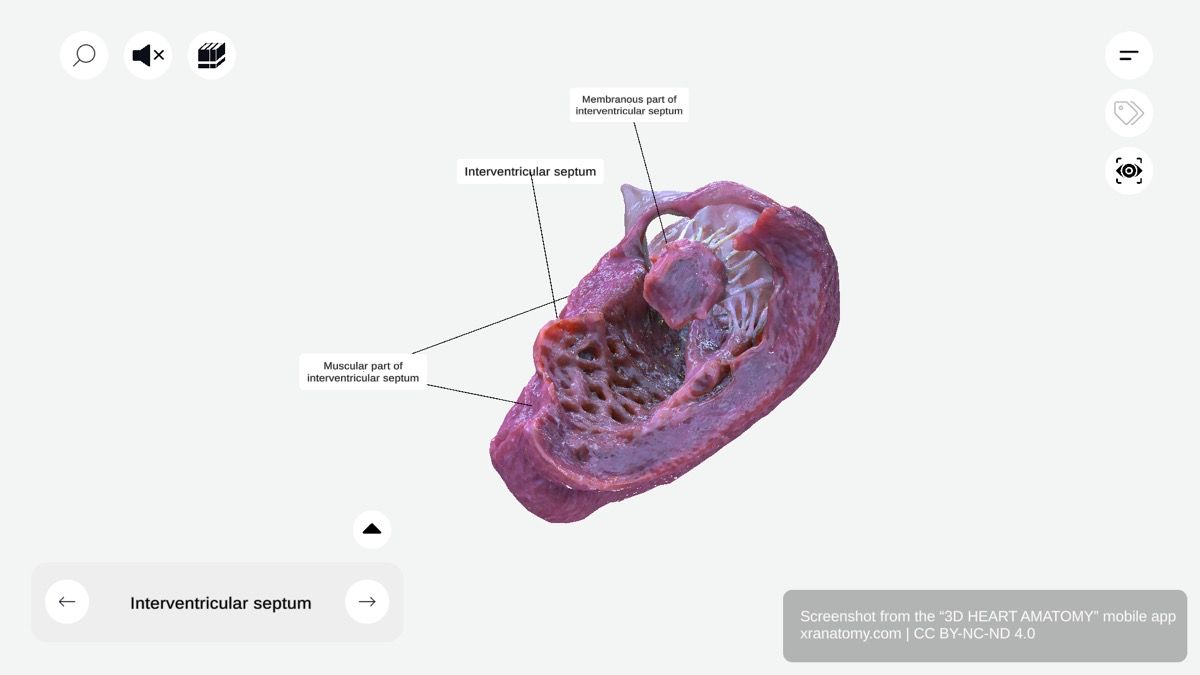
Interventricular Septum, Preview from the app.
The interventricular septum is a robust muscular wall dividing your left and right ventricles. It separates oxygen-rich blood in your left ventricle from oxygen-poor blood in your right ventricle, ensuring efficient unidirectional blood flow through your heart. The septum is composed of two parts: the muscular part and the membranous part.
Muscular Part
The muscular part comprises the majority of the septum. It is a thick structure that provides strength to withstand high ventricular pressures.
Membranous Part
The membranous part is a thinner section located near your atrioventricular valves. It is composed primarily of fibrous tissue. This area is a common site for ventricular septal defects. Congenital defects here can cause abnormal interventricular blood flow and may require surgical correction.
CHECK YOUR UNDERSTANDING
1. What are the three types of cardiac septa?
Reveal Answer
The interatrial septum, the interventricular septum, and the atrioventricular septum.
2. What is the fossa ovalis, and where is it located?
Reveal Answer
The fossa ovalis is a depression within the interatrial septum, located in the right atrium. It is the remnant of the foramen ovale, which allowed fetal blood to bypass the lungs before birth.
3. What are the two parts of the interventricular septum?
Reveal Answer
The muscular part (comprises the majority and withstands high ventricular pressures) and the membranous part (a thinner section near the atrioventricular valves, composed primarily of fibrous tissue and a common site for ventricular septal defects).
WHAT'S NEXT
Next, explore the Fibrous Skeleton of the Heart. You will study the connective tissue framework that supports your heart valves, including the fibrous rings, fibrous trigones, and the central fibrous body.
Review this page again in 3 days to reinforce what you have learned.
BIBLIOGRAPHY
1. Gray H, Lewis W. Angiology. In: Anatomy of the Human Body. 1918. p. 526–542.
2. Gosling JA, Harris PF, Humpherson JR, Whitmore I, Willan PLT. Human anatomy: color atlas and textbook. 6th ed. 2017. 45–58 p.
3. Anderson RH, Spicer DE, Hlavacek AM, Cook AC, Backer CL. (2013). Anatomy of the cardiac chambers. In Wilcox’s Surgical Anatomy of the Heart (4th ed., pp. 13–50). Cambridge University Press.
4. Fritsch H, Kuehnel W. Color Atlas of Human Anatomy. Vol. Volume 2, Color Atlas and Textbook of Human Anatomy. 2005. 10–42 p.
5. Moore K, Dalley A, Agur A. Clinically Oriented Anatomy. Vol. 7ed, Clinically Oriented Anatomy. 2014. 132–151 p.
6. Ho SYen. Anatomy for Cardiac Electrophysiologists: A Practical Handbook. Cardiotext Pub; 2012. 5–27 p.
7. Standring S, editor. Gray's Anatomy: The Anatomical Basis of Clinical Practice. 41st ed. London: Elsevier; 2016.
8. Moore KL, Agur AMR, Dalley AF. Essential Clinical Anatomy. 5th ed. Philadelphia: Wolters Kluwer; 2015.