MYOCARDIUM AND CONDUCTING SYSTEM
In-Depth AR Atlas Available
Read the comprehensive anatomy description with AR illustrations and videos
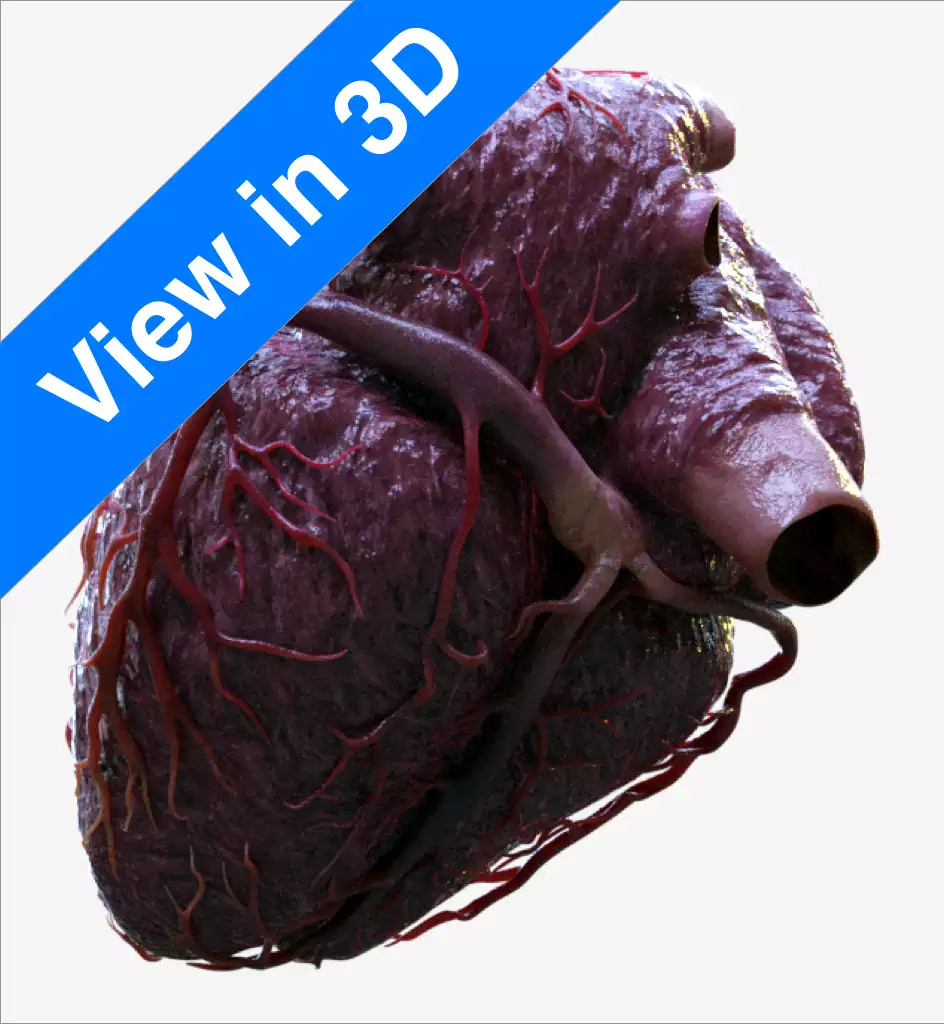
Read AR Atlas →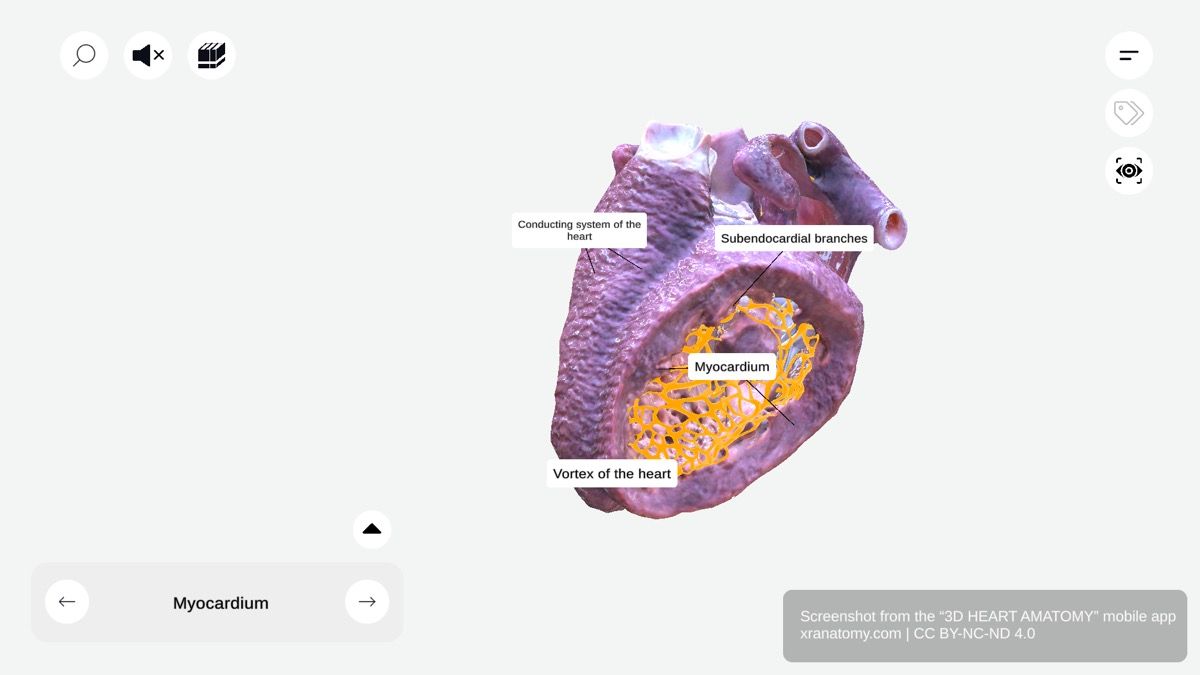
Myocardium - Cardiac Muscle Layer, Preview from the app.
WHY THIS MATTERS
Your myocardium is the thick muscular layer that powers every heartbeat. Embedded within it, a specialised conducting system generates and transmits electrical impulses so your heart chambers contract in the right sequence. Understanding how these structures work together shows you how your heart maintains its rhythm and pumps blood efficiently.
MYOCARDIUM
The myocardium is the thick muscular layer of your heart wall. It handles your heart's contractile function and is composed primarily of cardiac muscle cells. Two key features define this layer: the way its thickness varies between chambers, and the distinctive vortex of the heart at the cardiac apex.
Thickness Variation
Myocardial thickness varies depending on the workload of each chamber. The myocardium is thinner in your atria and significantly thicker in your ventricles. Your left ventricle is the thickest due to systemic pressure demands. Your right ventricle is thinner because it pumps to your pulmonary circulation.
Vortex of the Heart
The vortex of the heart is located at your cardiac apex, where both ventricles meet. Here, muscle fibres twist and spiral. This arrangement promotes efficient contraction of your ventricles.
CONDUCTING SYSTEM OF THE HEART
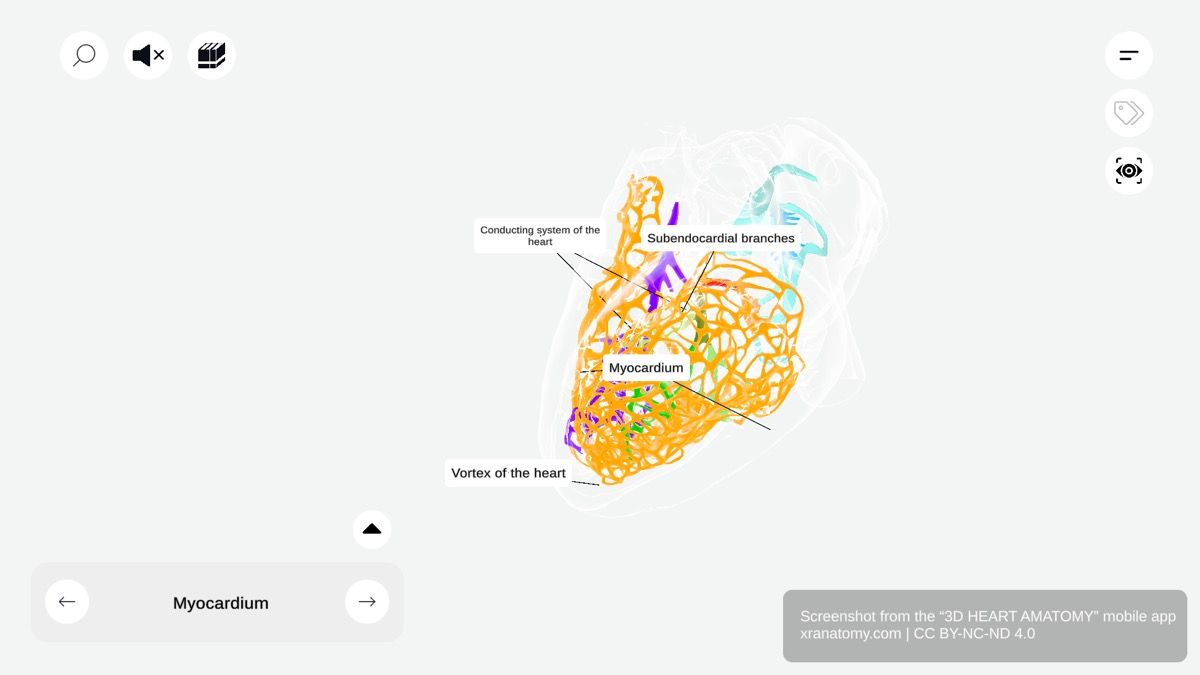
Conducting System Overview, Preview from the app.
The cardiac conducting system is a specialised network embedded within your myocardium. It generates and transmits electrical impulses, ensures coordinated cardiac muscle contraction, and regulates your heartbeat to maintain rhythm. Its components include the sinoatrial node, atrioventricular node, atrioventricular bundle, bundle branches, and Purkinje fibres.
SINOATRIAL NODE
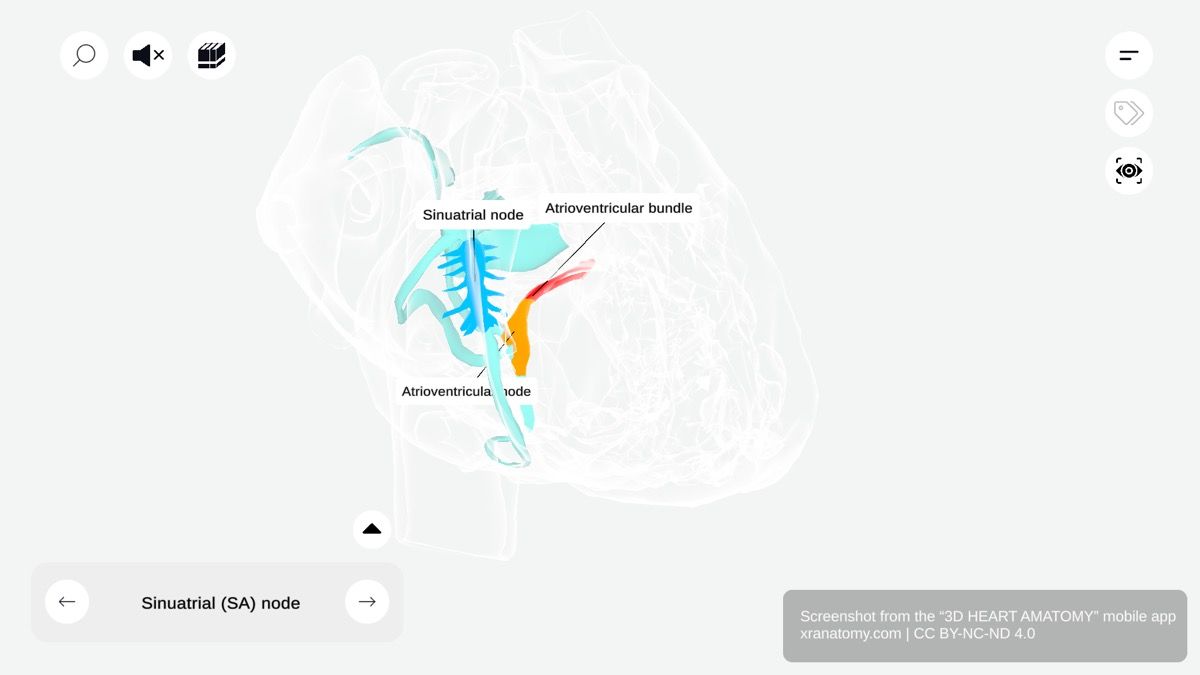
Sinoatrial Node (SA Node), Preview from the app.
The sinoatrial node is the natural pacemaker of your heart. It is a tadpole-shaped structure that generates electrical impulses. These impulses spread throughout your atria first, initiating each heartbeat. You can explore its precise position in the sub-section below.
Location
The sinoatrial node sits within your right atrium, at the sulcus terminalis (crista terminalis internally). It is located precisely at the junction of the superior vena cava and right atrium, anterior to the SVC opening.
ATRIOVENTRICULAR NODE
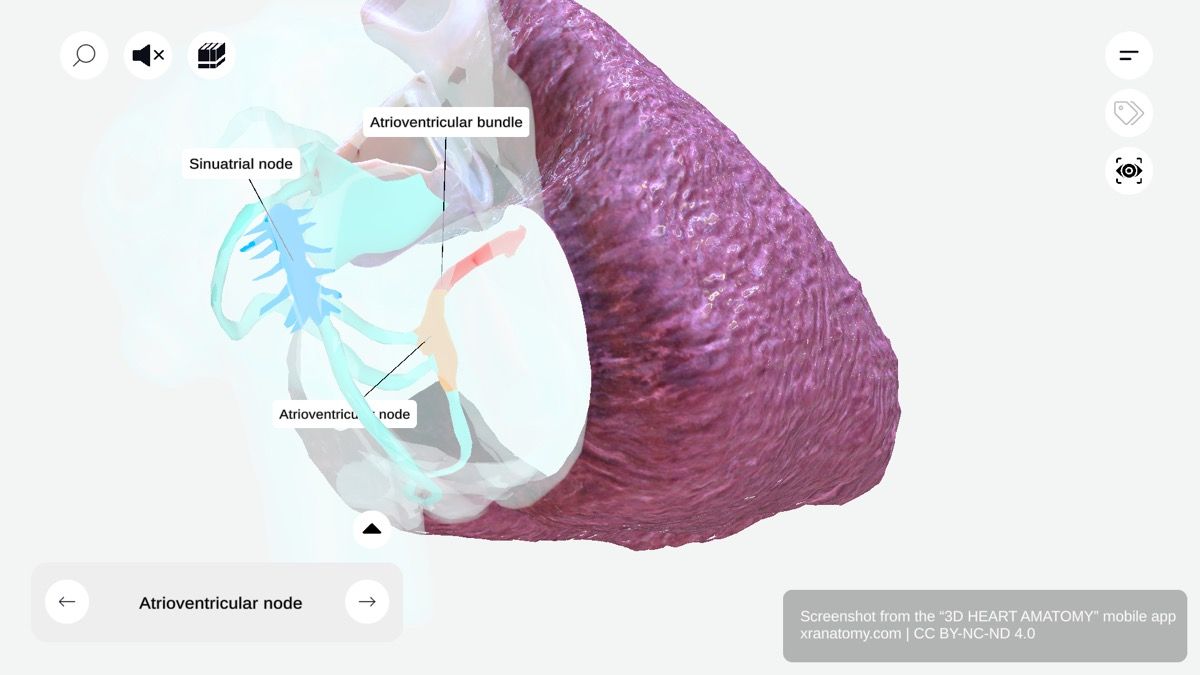
Atrioventricular Node (AV Node), Preview from the app.
The atrioventricular node is a specialised cluster of cells that functions as a critical gateway between your atria and ventricles. It briefly delays impulse transmission, allowing your atria to fully contract and empty blood into your ventricles before ventricular contraction begins. You can explore its precise position in the sub-section below.
Location
The atrioventricular node is located in your right atrium near the septum, within the Triangle of Koch.
ATRIOVENTRICULAR BUNDLE
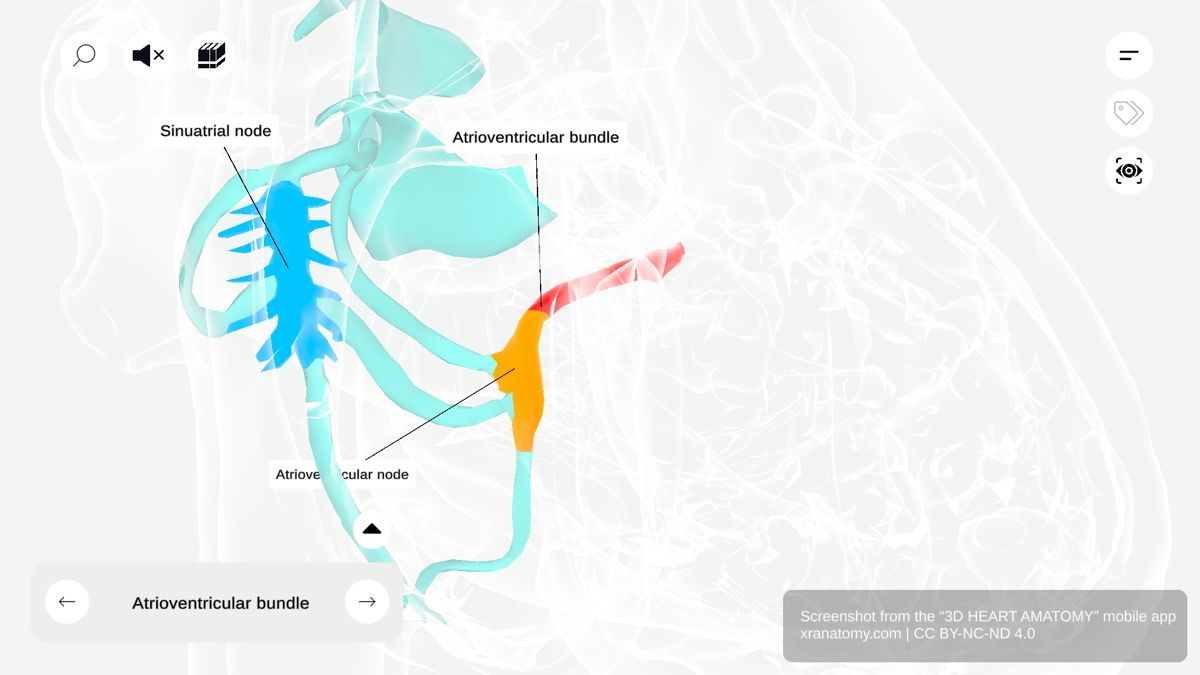
Atrioventricular Bundle (Bundle of His), Preview from the app.
The atrioventricular bundle, also known as the Bundle of His, is composed of specialised conducting fibres. It penetrates the fibrous skeleton of your heart and serves as the only electrical connection between your atria and ventricles. This ensures synchronised chamber contraction.
Divisions
The atrioventricular bundle divides into two main pathways: the right bundle branch and the left bundle branch.
BUNDLE BRANCHES
The bundle branches carry electrical impulses from the atrioventricular bundle toward your ventricles. They divide into two pathways: the right bundle branch serving your right ventricle, and the left bundle branch serving your left ventricle. The left bundle branch further splits into three fascicles.
Right Bundle Branch
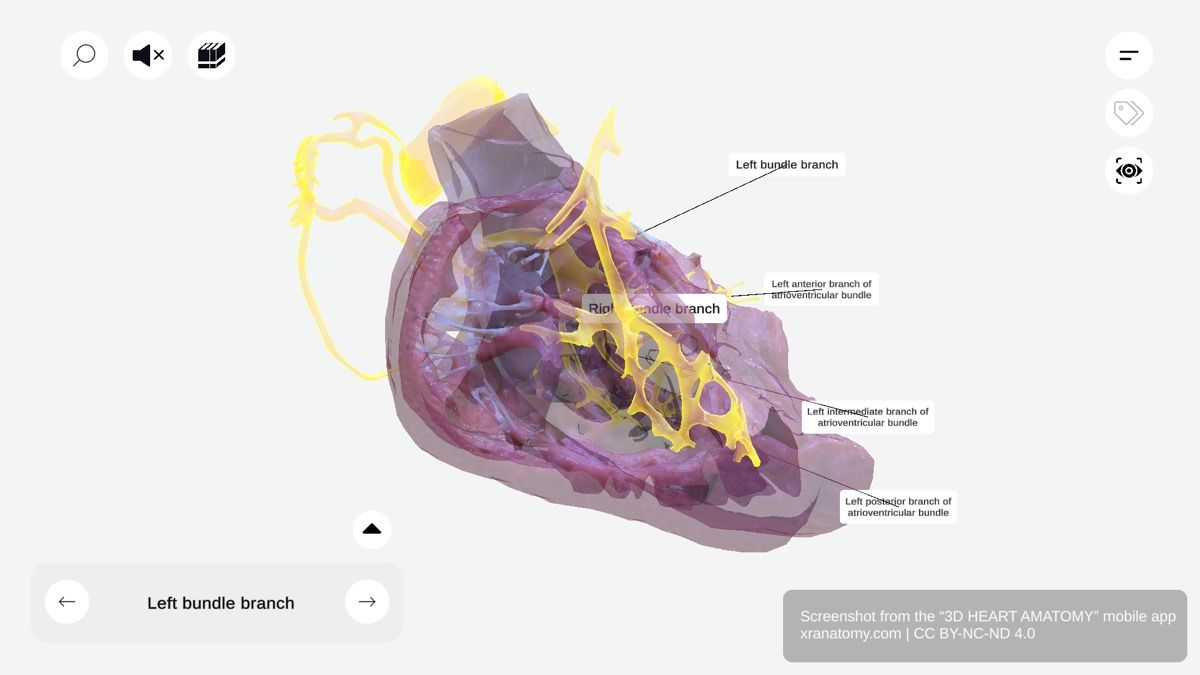
The right bundle branch carries impulses along the right side of your interventricular septum. It travels beneath the endocardium and is directed toward your right ventricle. It reaches the moderator band, a muscular band crossing the ventricular cavity. From there, it branches extensively in the right ventricular myocardium.
Left Bundle Branch
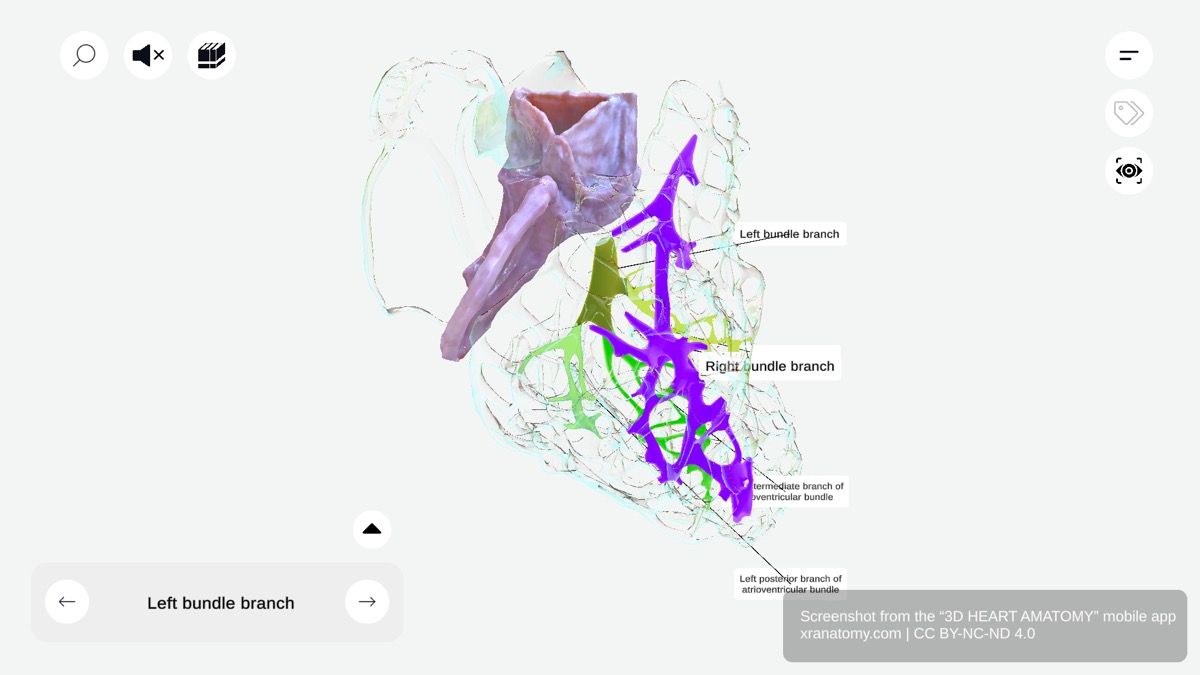
The left bundle branch travels beneath the endocardium on the left side of the septum and extends toward your left ventricle. It divides into three main fascicles: the left anterior fascicle, the left intermediate fascicle, and the left posterior fascicle.
Left Anterior Fascicle
The left anterior fascicle courses along the superior aspect of your left ventricle. It is directed toward the anterolateral papillary muscle and spreads in multiple directions over the muscle. This facilitates uniform anterior wall contraction.
Left Intermediate Fascicle
The left intermediate fascicle runs superficially through the subendocardium. It travels along the septum toward the left ventricular apex, ensuring the septum and apex receive synchronised stimulation. This contributes to your heart's effective pumping action.
Left Posterior Fascicle
The left posterior fascicle travels along the inferior aspect of your left ventricle. It is directed toward the posteromedial papillary muscle and disperses across the muscle. This synchronises posterior wall contraction.
PURKINJE FIBRES
Purkinje fibres, also called subendocardial branches, are the terminal portion of the bundle branches. These specialised conducting fibres form an extensive network lining your inner ventricular walls. They penetrate into the myocardium and interface directly with cardiac muscle cells. This enables rapid and synchronised impulse transmission, resulting in coordinated and forceful ventricular contraction.
FUNCTIONAL SIGNIFICANCE
The conducting system ensures simultaneous ventricular contraction, which enables efficient blood ejection into the pulmonary artery from your right ventricle and into the aorta from your left ventricle. Precise conduction maintains your cardiac rhythm and synchrony. Disruptions to this system can cause arrhythmias, conduction blocks, reduced cardiac output, and compromised cardiovascular health.
CHECK YOUR UNDERSTANDING
1. Name the five components of the cardiac conducting system in the order that electrical impulses travel through them.
Reveal Answer
Sinoatrial node, atrioventricular node, atrioventricular bundle (Bundle of His), bundle branches, and Purkinje fibres.
2. Why does the atrioventricular node briefly delay impulse transmission?
Reveal Answer
The delay allows the atria to fully contract and empty blood into the ventricles before ventricular contraction begins.
3. What are the three fascicles of the left bundle branch?
Reveal Answer
The left anterior fascicle, left intermediate fascicle, and left posterior fascicle.
WHAT'S NEXT
Now that you understand how the myocardium and conducting system work together, the next page explores the Cardiac Septum. You will study the interatrial septum, interventricular septum, and atrioventricular septum, including the fossa ovalis and its role in fetal circulation.
Review this page again in 3 days to reinforce what you have learned.
BIBLIOGRAPHY
1. Gray H, Lewis W. Angiology. In: Anatomy of the Human Body. 1918. p. 526–542.
2. Gosling JA, Harris PF, Humpherson JR, Whitmore I, Willan PLT. Human anatomy: color atlas and textbook. 6th ed. 2017. 45–58 p.
3. Anderson RH, Spicer DE, Hlavacek AM, Cook AC, Backer CL. (2013). Anatomy of the cardiac chambers. In Wilcox’s Surgical Anatomy of the Heart (4th ed., pp. 13–50). Cambridge University Press.
4. Fritsch H, Kuehnel W. Color Atlas of Human Anatomy. Vol. Volume 2, Color Atlas and Textbook of Human Anatomy. 2005. 10–42 p.
5. Moore K, Dalley A, Agur A. Clinically Oriented Anatomy. Vol. 7ed, Clinically Oriented Anatomy. 2014. 132–151 p.
6. Ho SYen. Anatomy for Cardiac Electrophysiologists: A Practical Handbook. Cardiotext Pub; 2012. 5–27 p.
7. Standring S, editor. Gray's Anatomy: The Anatomical Basis of Clinical Practice. 41st ed. London: Elsevier; 2016.
8. Moore KL, Agur AMR, Dalley AF. Essential Clinical Anatomy. 5th ed. Philadelphia: Wolters Kluwer; 2015.