BONES OF THE FOOT ANATOMY
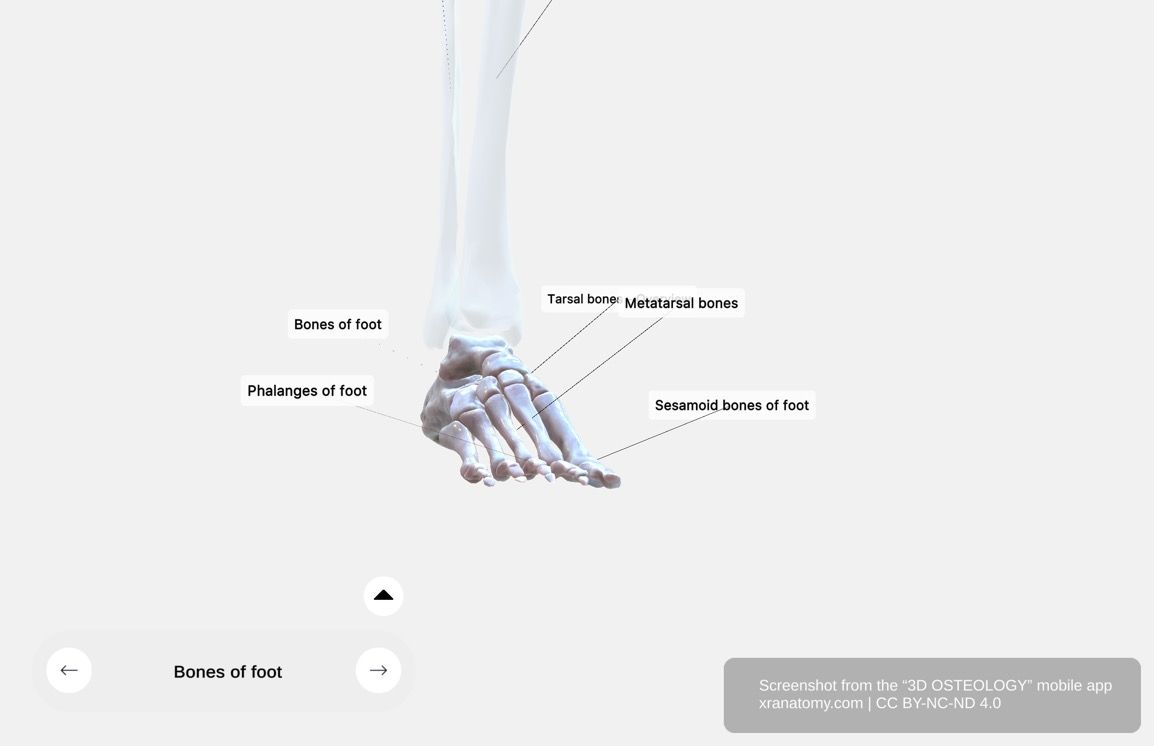
Bones of the Foot - Overview, Preview from the app. Download 3D OSTEOLOGY for full 3D control—multiple views, x-ray mode, and unlimited zoom.
WHY THIS MATTERS
Your foot contains 26 bones organized into three groups that work together for weight-bearing, balance, and movement. Understanding how the tarsal bones, metatarsals, and phalanges connect helps you see how your foot provides both stability and flexibility with every step.
GENERAL CHARACTERISTICS
The bones of your foot are organized into three main groups that work together to provide structure and functionality. The tarsal bones form the posterior section of your foot. The metatarsal bones create the framework of your midfoot. The phalanges of the foot form your toes.
TARSAL BONES
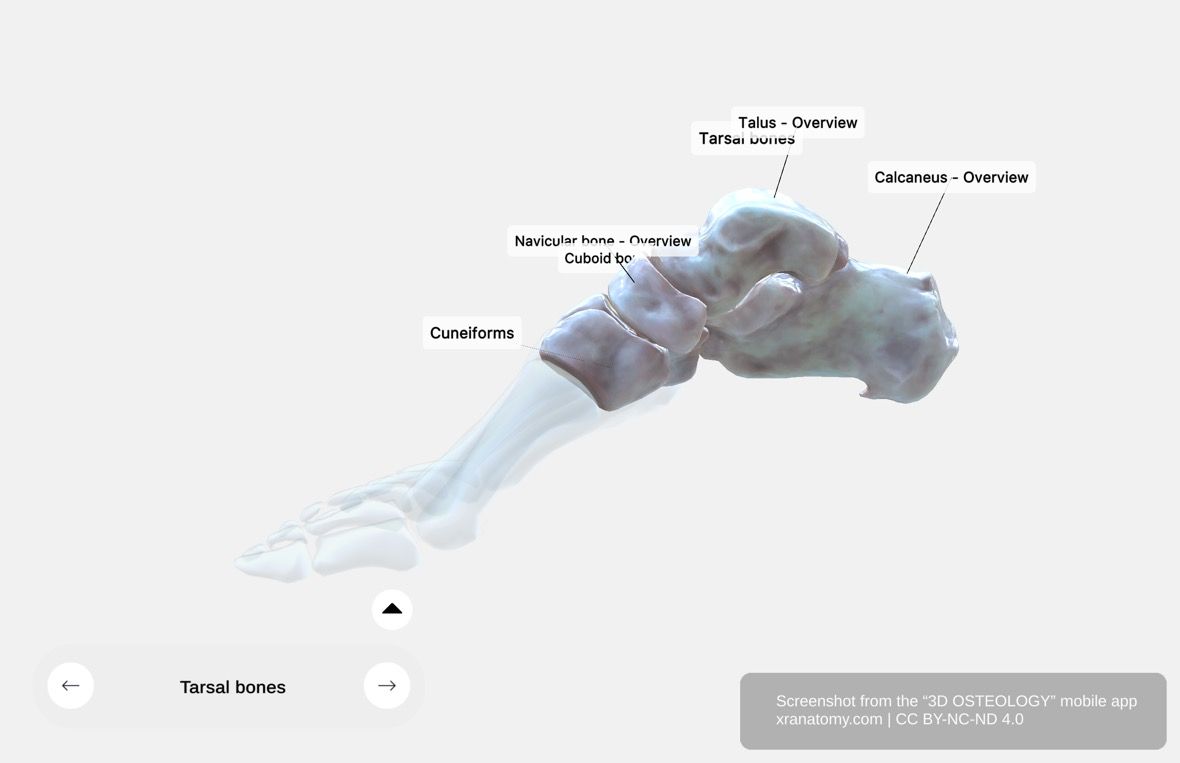
Tarsal Bones, Preview from the app. Download 3D OSTEOLOGY for full 3D control—multiple views, x-ray mode, and unlimited zoom.
Your foot contains seven tarsal bones that form the posterior section of your foot. They shape your foot's structure, enable its functional dynamics, and provide stability and support during your movement. The seven tarsals include the talus, calcaneus, navicular bone, three cuneiform bones, and the cuboid bone.
Talus
The talus supports your tibia and rests on the calcaneus. It articulates with the medial and lateral malleolus on either side and with the navicular bone in front.
Calcaneus
The calcaneus is the largest tarsal bone, located at the lower and posterior part of your foot. It transmits your body's weight to the ground and forms a strong lever for your calf muscles.
Navicular Bone
The navicular bone sits on the medial side of your tarsus. It is positioned between the talus behind and the cuneiform bones in front.
Cuneiform Bones
The cuneiform bones are three wedge-shaped bones. They articulate with the navicular bone behind and with the first, second, and third metatarsal bones in front.
Cuboid Bone
The cuboid bone sits on the lateral side of your foot. It is positioned between the calcaneus behind and the fourth and fifth metatarsal bones in front.
METATARSALS
Your foot contains five metatarsal bones that create the framework of your forefoot. They are numbered I to V from medial to lateral.
PHALANGES OF FOOT
Your foot has fourteen phalanges. Each of your toes contains three phalanges (proximal, middle, distal), except for your great toe, which has two (proximal and distal).
CHECK YOUR UNDERSTANDING
1. What are the three main groups of bones in your foot?
Reveal Answer
Tarsal bones (posterior section), metatarsal bones (framework of the forefoot), and phalanges (toes).
2. Which tarsal bone is the largest, and what role does it play?
Reveal Answer
The calcaneus is the largest tarsal bone. It transmits your body's weight to the ground and forms a strong lever for your calf muscles.
3. How many phalanges does the great toe have compared to the other toes?
Reveal Answer
The great toe has two phalanges (proximal and distal), while each of the other toes has three (proximal, middle, and distal).
WHAT'S NEXT
Next, take a closer look at the Talus. You will explore this second-largest tarsal bone in detail, including its head, neck, body, and trochlea, and how it connects your foot to your leg at the ankle joint.
Review this page again in 3 days to reinforce what you have learned.
BIBLIOGRAPHY
1. Henry G, Warren HL. Osteology. In: Anatomy of the Human Body. 20th ed. Philadelphia: Lea & Febiger; 1918. p. 129–97.
2. Standring S, editor. Gray's Anatomy: The Anatomical Basis of Clinical Practice. 41st ed. London: Elsevier; 2016.
3. Moore KL, Agur AMR, Dalley AF. Essential Clinical Anatomy. 5th ed. Philadelphia: Wolters Kluwer; 2015.