RIBS ANATOMY
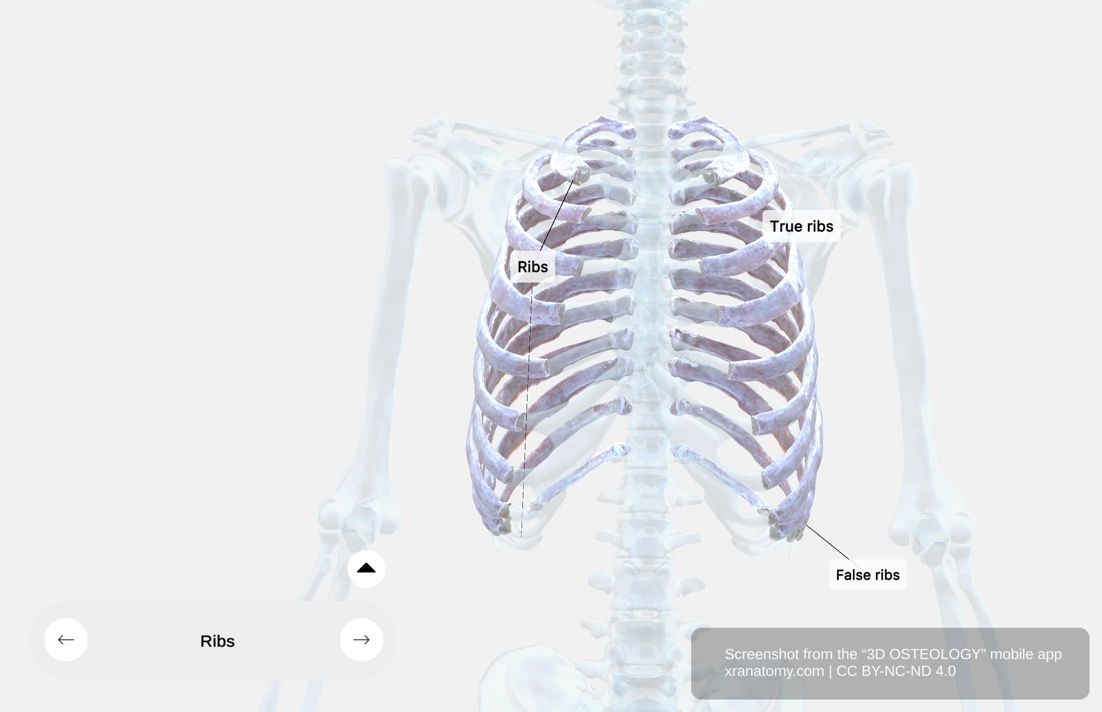
Ribs - General Structure, Preview from the app. Download 3D OSTEOLOGY for full 3D control—multiple views, x-ray mode, and unlimited zoom.
WHY THIS MATTERS
Your twelve pairs of ribs form the thoracic cage that protects your thoracic organs. Understanding how they attach posteriorly to your vertebral column and terminate anteriorly as cartilage, and how they are classified into true, false, and floating ribs, gives you a clear picture of how your rib cage is built.
TABLE OF CONTENTS
GENERAL FEATURES
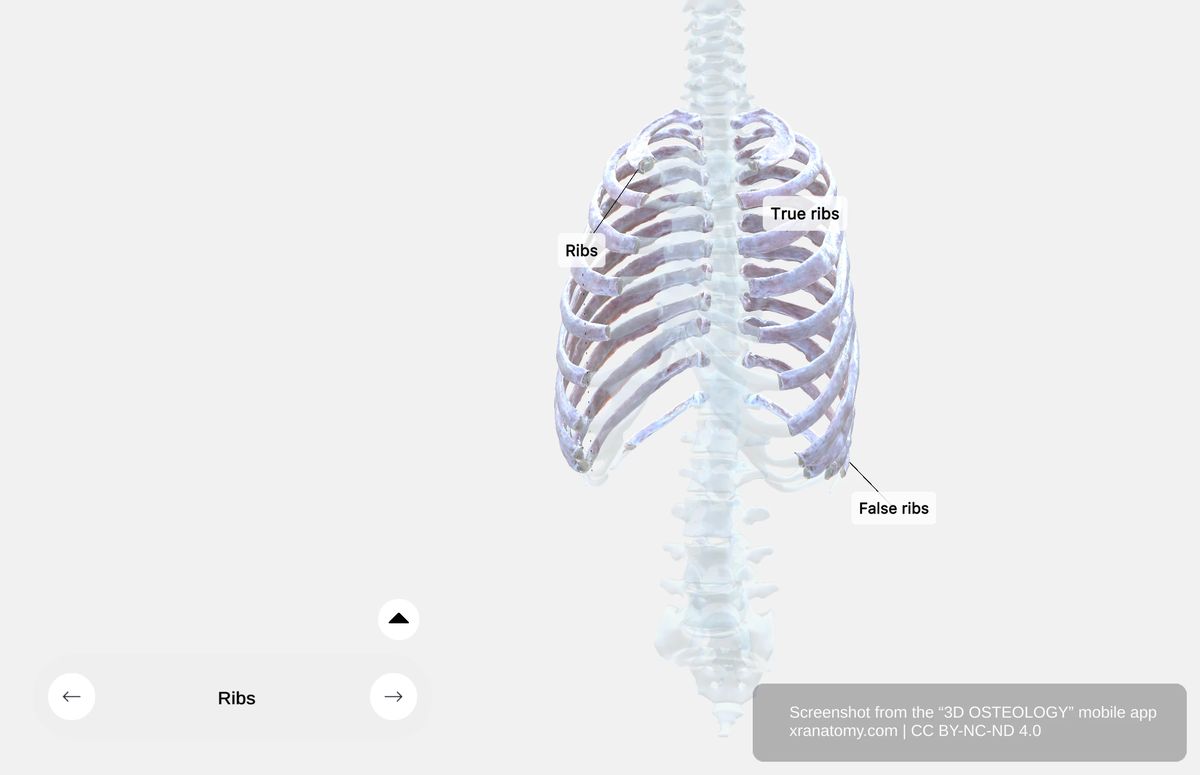
Your ribs consist of twelve paired bones that comprise your thoracic cage. They provide protection for your thoracic organs. Each rib articulates posteriorly with your vertebral column and terminates anteriorly as cartilage.
CLASSIFICATION
Ribs are classified based on their structural features and sternal attachment. Structural classification distinguishes typical ribs from atypical ribs. Sternal classification divides the ribs into true ribs, vertebrochondral ribs, and floating ribs based on how they connect to your sternum.
Based on Structural Features
Typical ribs share common structural characteristics. Atypical ribs display unique features not found in all ribs. The atypical ribs include ribs 1, 2, 10, 11, and 12.
Based on Sternal Attachment
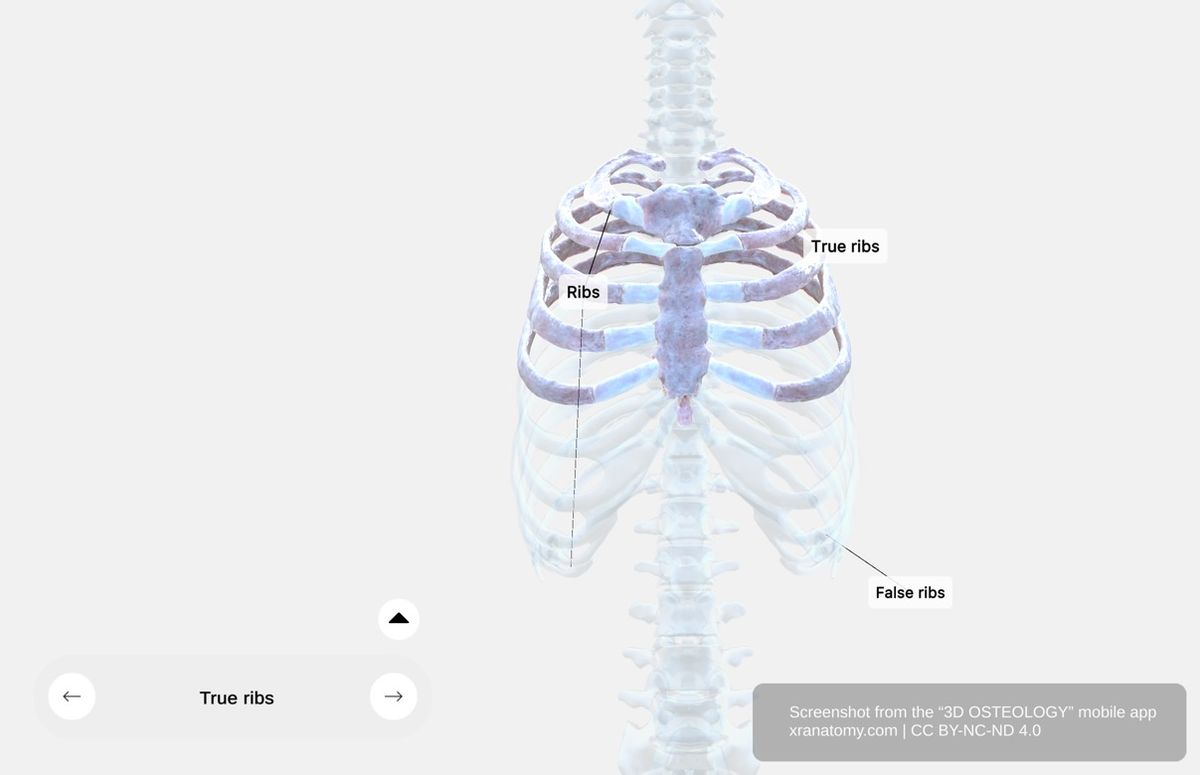
True Ribs (Ribs 1-7), Preview from the app. Download 3D OSTEOLOGY for full 3D control—multiple views, x-ray mode, and unlimited zoom.
True ribs comprise ribs 1 through 7. They connect directly to your sternum via individual costal cartilages.
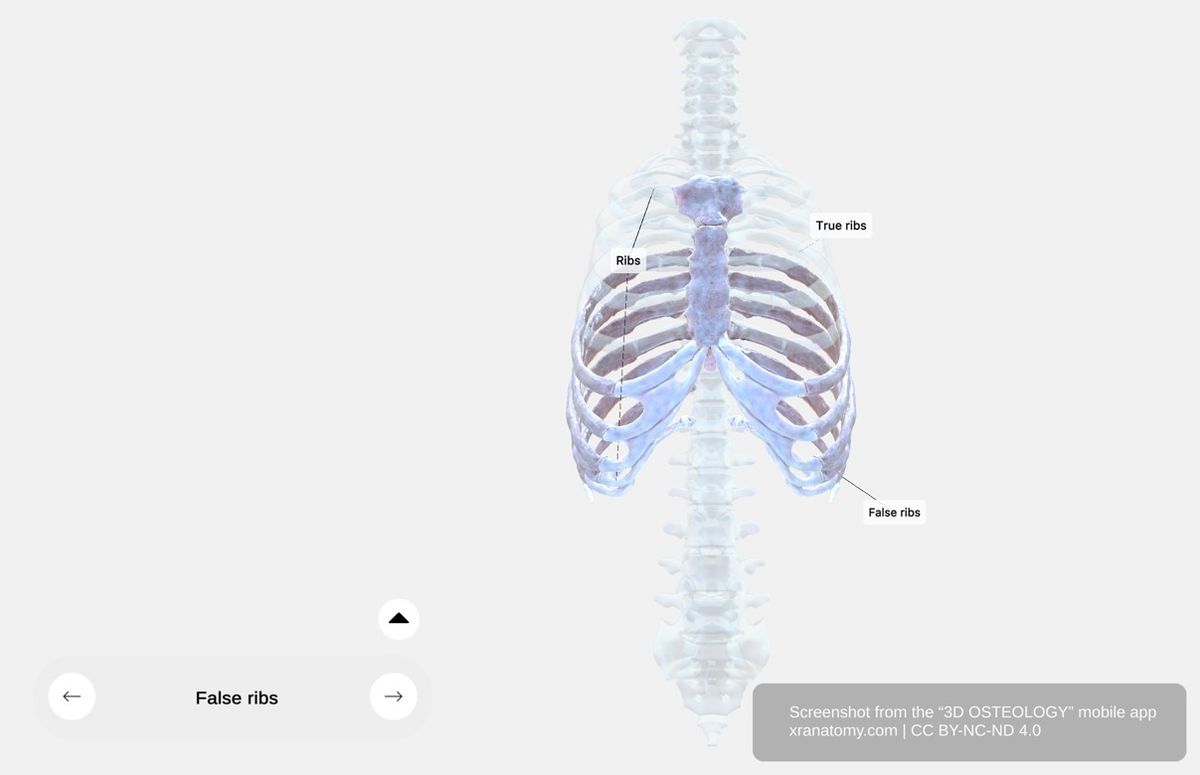
False Ribs (Ribs 8-12), Preview from the app. Download 3D OSTEOLOGY for full 3D control—multiple views, x-ray mode, and unlimited zoom.
False ribs comprise ribs 8 through 12 and lack direct sternal attachment. They are subdivided into two groups.
Vertebrochondral ribs (ribs 8, 9, and 10) attach indirectly to your sternum. Their costal cartilages join the cartilage of the rib above.
Floating ribs, also called vertebral ribs (ribs 11 and 12), have no anterior attachment to your sternum. They terminate freely in your posterior abdominal musculature.
| Category | Ribs | Sternal Attachment |
|---|---|---|
| True Ribs | 1 through 7 | Direct, via individual costal cartilages |
| Vertebrochondral Ribs | 8, 9, and 10 | Indirect, cartilages join rib above |
| Floating Ribs | 11 and 12 | None, terminate in posterior abdominal musculature |
CHECK YOUR UNDERSTANDING
1. How many paired bones make up your ribs, and what do they form?
Reveal Answer
Twelve paired bones that comprise your thoracic cage.
2. Which ribs are classified as true ribs, and how do they attach to the sternum?
Reveal Answer
Ribs 1 through 7. They connect directly to your sternum via individual costal cartilages.
3. What distinguishes floating ribs from vertebrochondral ribs?
Reveal Answer
Floating ribs (11 and 12) have no anterior attachment to the sternum and terminate freely in the posterior abdominal musculature. Vertebrochondral ribs (8, 9, and 10) attach indirectly to the sternum, with their costal cartilages joining the cartilage of the rib above.
WHAT'S NEXT
Now that you understand rib classification, the next page explores the Single Rib Structure. You will study the detailed anatomy of an individual rib, including the head, neck, body, tubercle, angle, and costal groove, plus special features of the first rib, second rib, and floating ribs.
Review this page again in 3 days to reinforce what you have learned.
BIBLIOGRAPHY
1. Henry G, Warren HL. Osteology. In: Anatomy of the Human Body. 20th ed. Philadelphia: Lea & Febiger; 1918. p. 129–97.
2. Standring S, editor. Gray's Anatomy: The Anatomical Basis of Clinical Practice. 41st ed. London: Elsevier; 2016.
3. Moore KL, Agur AMR, Dalley AF. Essential Clinical Anatomy. 5th ed. Philadelphia: Wolters Kluwer; 2015.