CUNEIFORM BONES ANATOMY
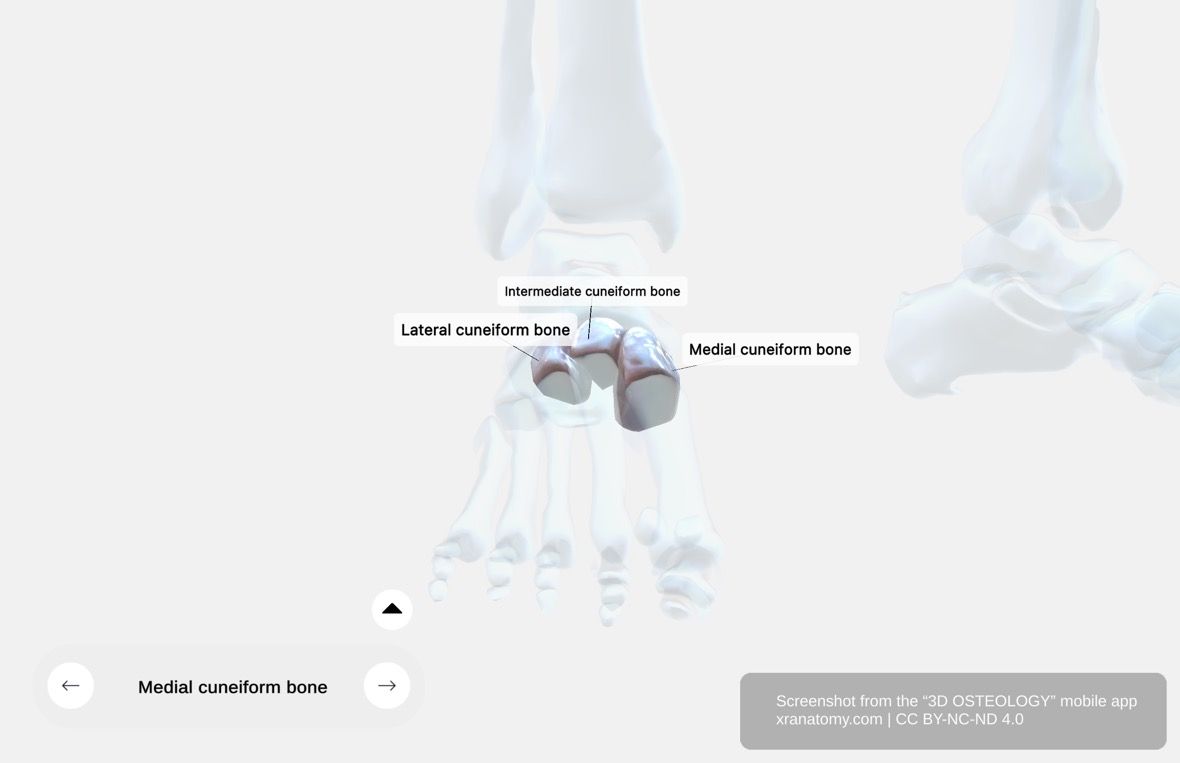
Cuneiform Bones - General Structure, Preview from the app. Download 3D OSTEOLOGY for full 3D control—multiple views, x-ray mode, and unlimited zoom.
WHY THIS MATTERS
The three cuneiform bones form the transverse arch of your foot and connect the navicular bone to your first three metatarsals. Understanding how the medial, intermediate, and lateral cuneiforms interlock helps you see how your foot distributes weight and maintains stability during movement.
GENERAL STRUCTURE
The cuneiform bones are three wedge-shaped bones located in the medial part of your tarsus. They contribute to the structure and stability of your foot's arch. The cuneiforms are named according to their relative positions: medial, intermediate, and lateral. Below you will explore their location in the tarsal row and their function in your foot.
Location
The cuneiforms sit in the medial part of your tarsus. They are positioned between the navicular bone posteriorly and the first three metatarsals anteriorly. All three bones are arranged side by side in the distal row of tarsal bones.
Function
The cuneiforms contribute to the transverse arch of your foot. They provide structural support for your weight distribution and allow for limited movement between tarsal bones.
MEDIAL CUNEIFORM
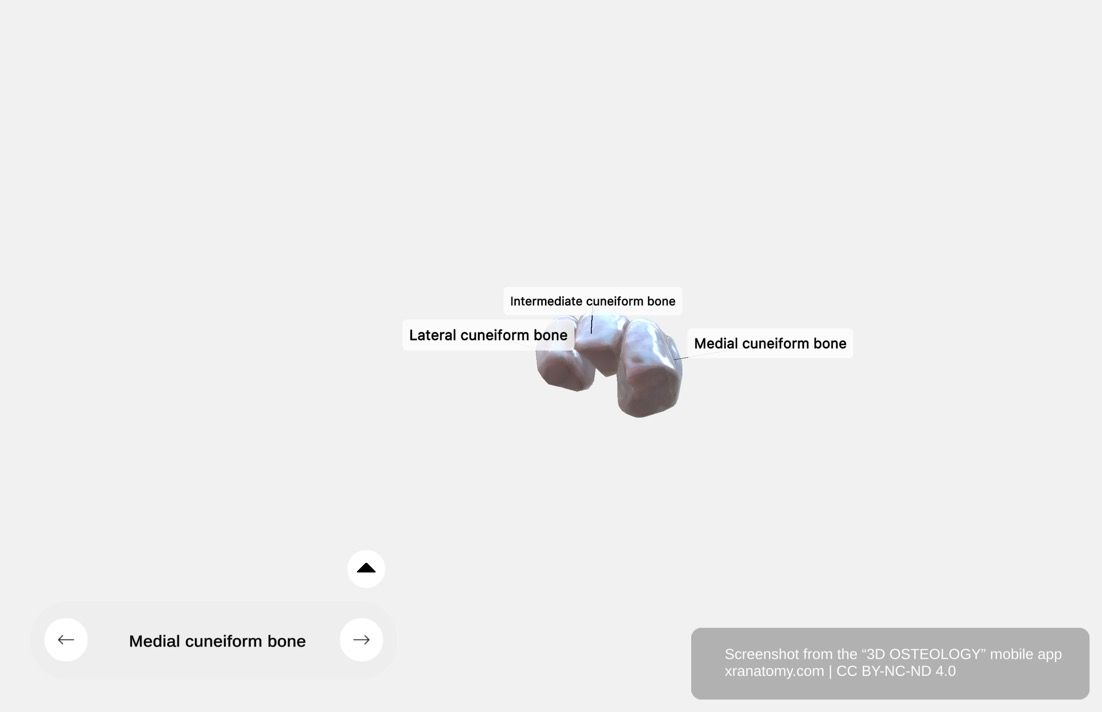
Cuneiform Bones - Isolated View, Preview from the app. Download 3D OSTEOLOGY for full 3D control—multiple views, x-ray mode, and unlimited zoom.
The medial cuneiform is the largest of the cuneiform bones. It sits at the medial side of your foot and plays a crucial role in forming your medial longitudinal arch. Below you will find details on its size and shape, articulations, and muscle attachments.
Size and Shape
The medial cuneiform is the largest of the three cuneiform bones. It is wedge-shaped with the base directed plantarly (inferiorly) and the apex pointing dorsally. You will find it on the medial side of your foot.
Articulations
The medial cuneiform articulates with the navicular bone posteriorly (behind) and the base of the first metatarsal bone anteriorly (in front). On its lateral side, it articulates with the intermediate cuneiform. It may also articulate with the base of the second metatarsal.
Muscle Attachments
Three muscles attach to the medial cuneiform. The tibialis anterior inserts on its medial and plantar surfaces. The tibialis posterior has a partial insertion here. The fibularis longus (formerly peroneus longus) inserts on the lateral aspect.
INTERMEDIATE CUNEIFORM
The intermediate cuneiform is the smallest of the cuneiform bones. It sits between the medial and lateral cuneiforms. Below you will explore its size and shape, articulations, and unique recessed position.
Size and Shape
The intermediate cuneiform is the smallest of the three cuneiform bones. It is wedge-shaped with the base directed dorsally (superiorly) and the apex pointing plantarly. It is shorter than the medial and lateral cuneiforms.
Articulations
The intermediate cuneiform articulates with the navicular bone posteriorly (behind) and the second metatarsal bone anteriorly (in front). On one side it articulates with the medial cuneiform, and on the other side with the lateral cuneiform.
Position
The intermediate cuneiform is recessed relative to its neighbors, creating a mortise for the second metatarsal. This arrangement provides stability to your tarsometatarsal joint.
LATERAL CUNEIFORM
The lateral cuneiform is intermediate in size between the medial and intermediate cuneiform bones. It sits between the intermediate cuneiform and the cuboid bone. Below you will find details on its size and shape, articulations, and muscle attachments.
Size and Shape
The lateral cuneiform is intermediate in size between the medial and intermediate cuneiforms. It is wedge-shaped with the base directed dorsally (superiorly) and the apex pointing plantarly. You will find it on the lateral aspect of the cuneiform group.
Articulations
The lateral cuneiform articulates with the navicular bone posteriorly (behind) and the third metatarsal bone anteriorly (in front). Medially it articulates with the intermediate cuneiform, and laterally with the cuboid bone.
Muscle Attachments
The tibialis posterior has a partial insertion on the lateral cuneiform. The flexor hallucis brevis may have a partial origin here.
CHECK YOUR UNDERSTANDING
1. Which cuneiform bone is the largest, and which is the smallest?
Reveal Answer
The medial cuneiform is the largest and the intermediate cuneiform is the smallest.
2. What structure does the recessed position of the intermediate cuneiform create for the second metatarsal?
Reveal Answer
It creates a mortise for the second metatarsal, providing stability to the tarsometatarsal joint.
3. Name three muscles that attach to the medial cuneiform.
Reveal Answer
Tibialis anterior, tibialis posterior (partial insertion), and fibularis longus (formerly peroneus longus).
WHAT'S NEXT
Next, you will study the Metatarsal Bones. These are the five long bones of your forefoot, numbered 1 through 5 from medial to lateral, each consisting of a base, body, and head.
Review this page again in 3 days to reinforce what you have learned.
BIBLIOGRAPHY
1. Henry G, Warren HL. Osteology. In: Anatomy of the Human Body. 20th ed. Philadelphia: Lea & Febiger; 1918. p. 129–97.
2. Standring S, editor. Gray's Anatomy: The Anatomical Basis of Clinical Practice. 41st ed. London: Elsevier; 2016.
3. Moore KL, Agur AMR, Dalley AF. Essential Clinical Anatomy. 5th ed. Philadelphia: Wolters Kluwer; 2015.