BONES OF THE LOWER LIMB
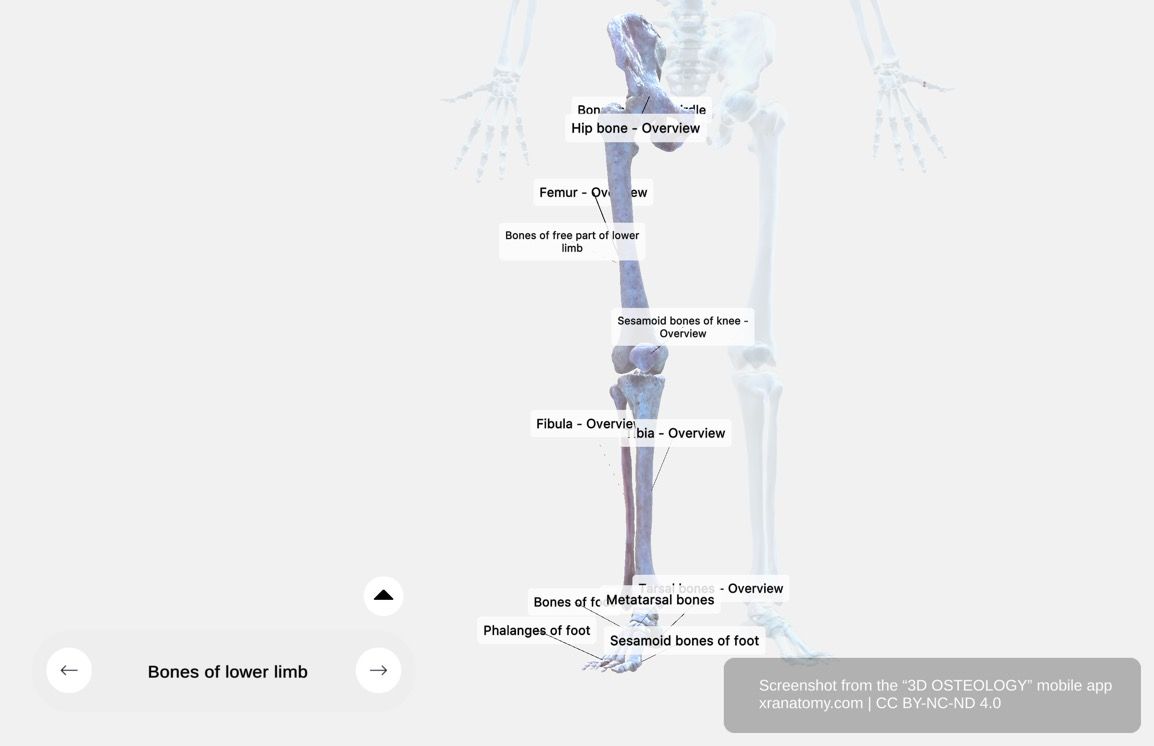
Bones of the Lower Limb - Overview, Preview from the app. Download 3D OSTEOLOGY for full 3D control—multiple views, x-ray mode, and unlimited zoom.
WHY THIS MATTERS
Your lower limb bones are vital for supporting your body and facilitating movement. From the pelvic girdle that anchors your limbs to the femur, tibia, fibula, and foot bones that carry your weight with every step, these two main components work together to enable walking, running, and standing.
OVERVIEW
The bones of your lower limb are vital for supporting your body and facilitating movement. They are composed of two main components: the pelvic girdle, which includes the hip bones, sacrum, and coccyx, and the bones of the free part of the lower limb, consisting of the femur, tibia, fibula, patella, and the bones of the foot.
PELVIC GIRDLE
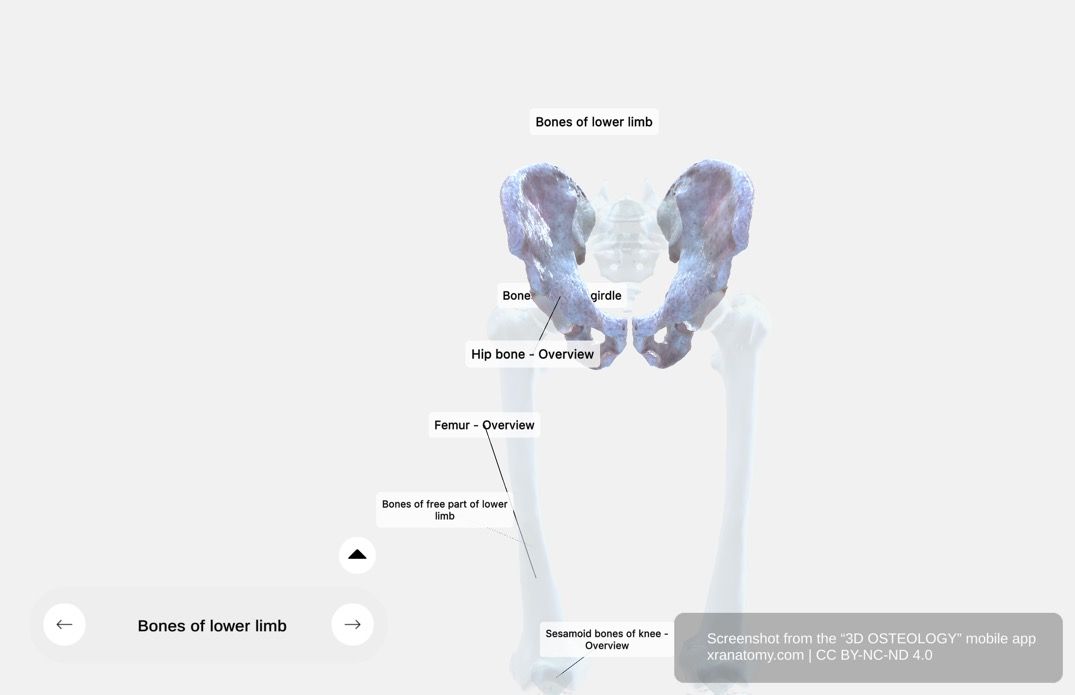
Pelvic Girdle, Preview from the app. Download 3D OSTEOLOGY for full 3D control—multiple views, x-ray mode, and unlimited zoom.
The pelvic girdle is made up of the hip bones on each side, the sacrum, and the coccyx. Its primary function is to support attachment of your lower limbs. Each hip bone is a large, flat, irregular bone formed by three parts (ilium, ischium, pubis) that pairs with the opposite hip bone to form the complete girdle.
Composition
The pelvic girdle consists of the hip bones on each side, the sacrum, and the coccyx.
Function
The pelvic girdle supports attachment of your lower limbs.
Hip Bone
The hip bone is a large, flat bone with an irregular shape. It is formed by three parts: the ilium, ischium, and pubis. Each hip bone pairs with the opposite hip bone to form the complete girdle.
BONES OF THE FREE PART OF THE LOWER LIMB
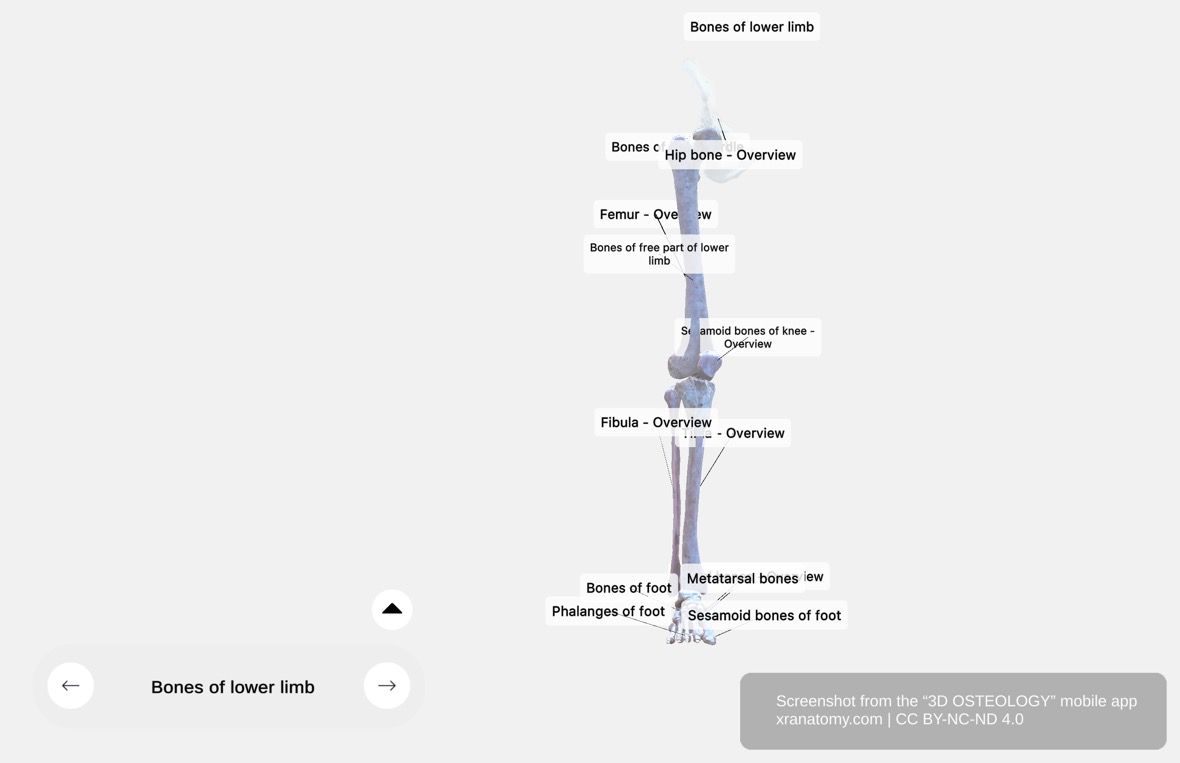
Bones of the Free Lower Limb, Preview from the app. Download 3D OSTEOLOGY for full 3D control—multiple views, x-ray mode, and unlimited zoom.
The free lower limb contains the femur, the longest and most robust bone in your body that serves as the principal support for your body weight. It also includes the patella, the largest sesamoid bone that enhances your knee joint mechanics; the tibia on the inner side of your leg; and the fibula on the outer side, which provides additional stability to your ankle joint.
Femur
The femur is the longest and most robust bone in the human skeleton. It serves as the principal support for your body weight and contributes to your leg mobility and lower limb activities.
Patella
The patella is the largest and most prominent sesamoid bone. It enhances your knee joint mechanics.
Tibia
The tibia sits on the inner side of your leg. It contributes to your knee joint above and your ankle joint below.
Fibula
The fibula sits on the outer side of the tibia. It provides additional stability to your ankle joint during movement.
FOOT BONES
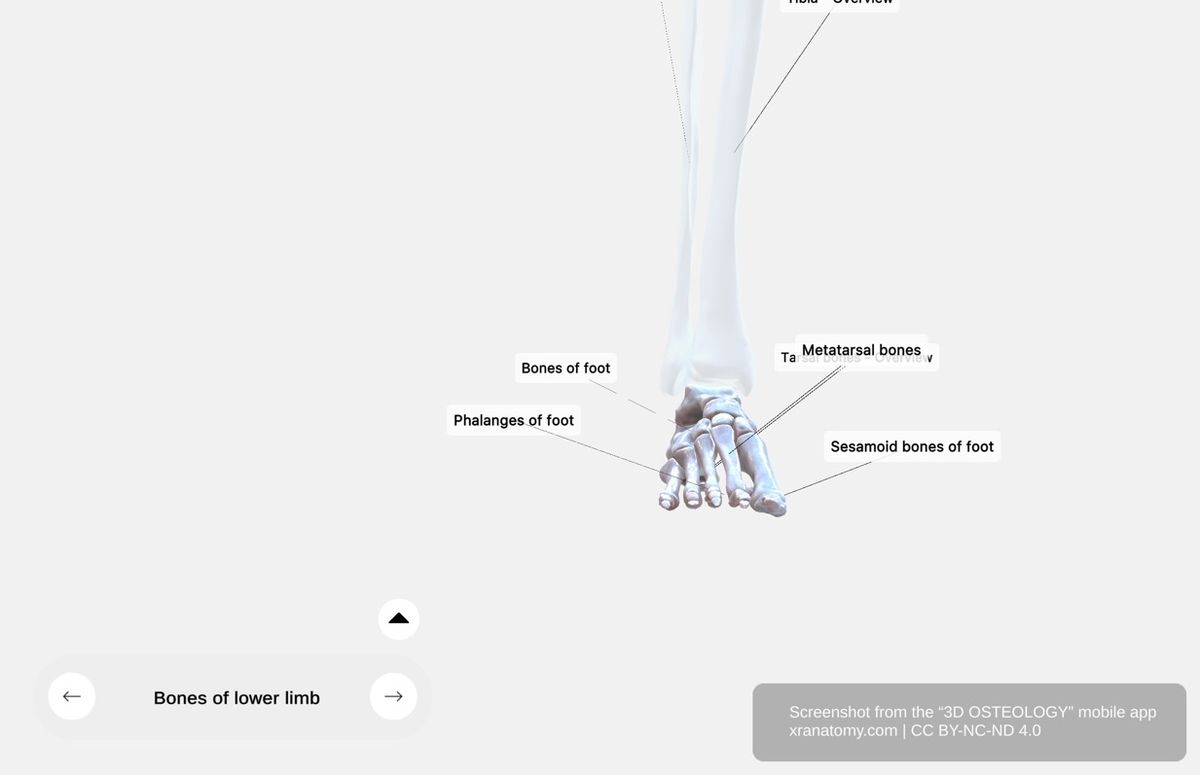
Foot Bones, Preview from the app. Download 3D OSTEOLOGY for full 3D control—multiple views, x-ray mode, and unlimited zoom.
Your foot bones support your body weight and enable movement. They are organized into three groups: the tarsal bones, which form the hindfoot and midfoot; the metatarsal bones, five bones forming the framework of your forefoot; and the phalanges, fourteen bones that enable flexibility. Small sesamoid bones embedded in tendons also enhance mechanical efficiency.
Foot Bones Overview
Your foot bones support your body weight and enable movement. The tarsal bones form the hindfoot (calcaneus, talus) and midfoot (navicular, cuboid, cuneiforms) of your foot. The metatarsal bones are five bones forming the framework of your forefoot; they bear your body weight and allow movements involved in walking and balancing. The phalanges are fourteen bones, arranged similarly to your fingers, that enable flexibility and movement for your foot functions.
Tarsal Bones
The tarsal bones shape the posterior section of your foot and enable functional dynamics.
Metatarsal Bones
The metatarsal bones are five bones forming the central segment of your foot. They bear your body weight and allow movements involved in walking and balancing.
Phalanges
The phalanges of your foot consist of fourteen bones, arranged similarly to your fingers. They enable flexibility and movement for your foot functions.
Sesamoid Bones
The sesamoid bones of your foot are embedded within tendons, particularly under the metatarsophalangeal joint of your big toe. They enhance mechanical efficiency of your foot during walking or running.
CHECK YOUR UNDERSTANDING
1. What two main components make up the bones of the lower limb?
Reveal Answer
The pelvic girdle (hip bones, sacrum, coccyx) and the bones of the free part of the lower limb (femur, tibia, fibula, patella, and the bones of the foot).
2. Which bone is the longest and most robust in the human skeleton?
Reveal Answer
The femur. It serves as the principal support for your body weight and contributes to your leg mobility.
3. Name the three groups of foot bones.
Reveal Answer
Tarsal bones (forming the hindfoot and midfoot), metatarsal bones (five bones forming the forefoot framework), and phalanges (fourteen bones enabling flexibility and movement).
WHAT'S NEXT
Now that you have an overview of the lower limb bones, the next page focuses on the Hip Bone. You will explore the os coxae in detail, including its three fused components (ilium, ischium, pubis) and the acetabulum that articulates with the femoral head.
Review this page again in 3 days to reinforce what you have learned.
BIBLIOGRAPHY
1. Henry G, Warren HL. Osteology. In: Anatomy of the Human Body. 20th ed. Philadelphia: Lea & Febiger; 1918. p. 129–97.